
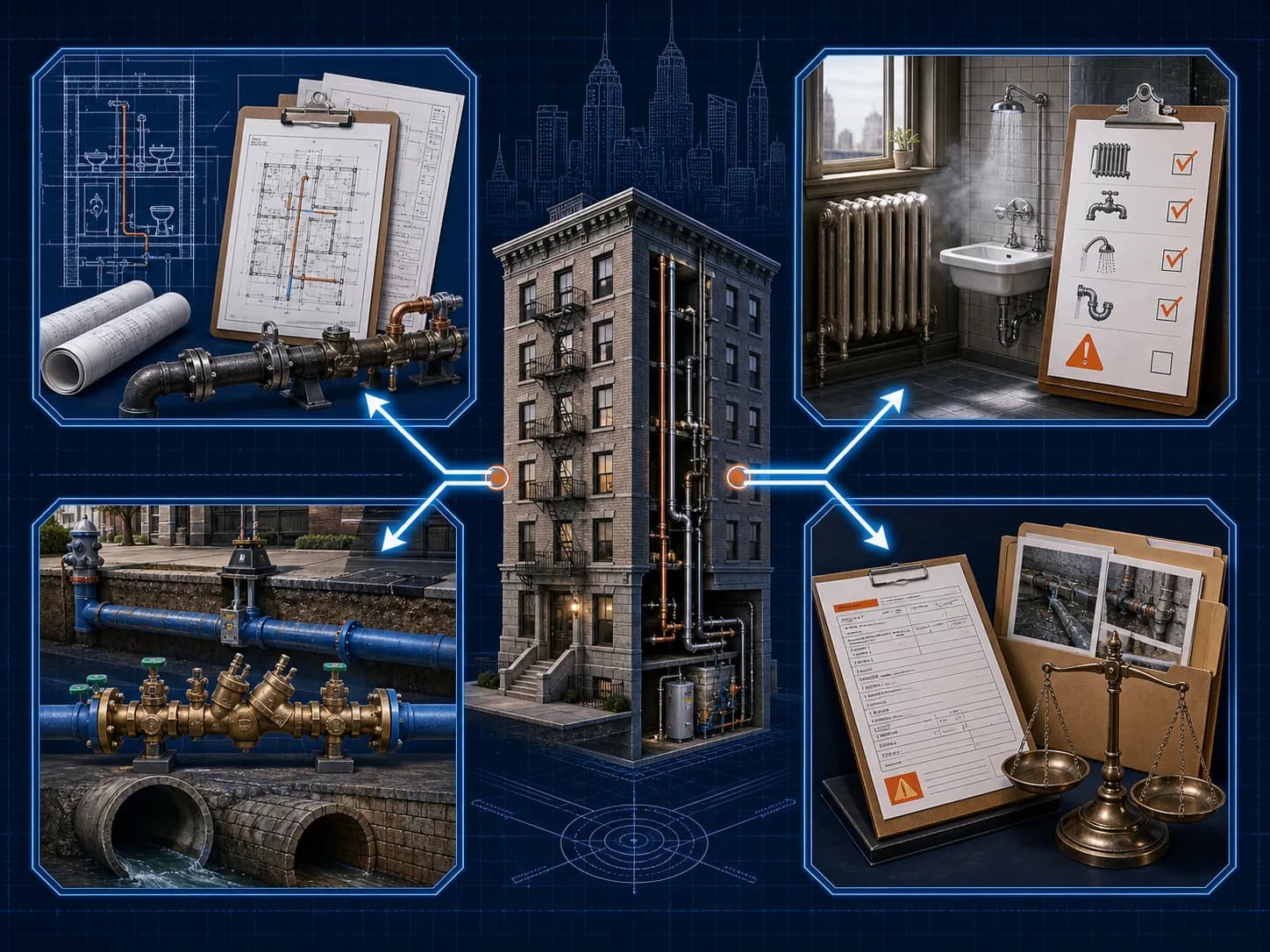
Key takeaways
- HPD, DOB, DEP, and OATH maintain different records and enforcement processes.
- Start with the issuing agency, then check for related permits, complaints, summonses, and filings.
- Do not assume payment, repair, or dismissal in one system updates every other record.
Four agencies, four sets of rules, four different correction processes. Here's how DOB, HPD, DEP, and OATH divide plumbing enforcement - and why fixing one violation doesn't always fix the problem.
A leaking pipe in a Brooklyn apartment building can generate violations from two different city agencies on the same day. A failed backflow preventer can trigger a third. And if any of those violations go unanswered, a fourth agency steps in to collect penalties.
This is the reality of plumbing enforcement in New York City. The Department of Buildings, the Department of Housing Preservation and Development, the Department of Environmental Protection, and the Office of Administrative Trials and Hearings all have jurisdiction over different aspects of plumbing - and they don't coordinate with each other.
Property owners who fix the DOB violation but miss the HPD violation, or who correct the plumbing condition but forget about the DEP filing, end up paying twice. This guide breaks down which agency handles what, how their violation processes differ, and what you actually need to do to clear every open item on your property.
The Four Agencies at a Glance
Before diving into specifics, here's the high-level breakdown of who does what:
| Agency | Primary plumbing-related role | Starting record | Where owners verify status |
|---|---|---|---|
| DOB | Construction, permits, building systems, gas piping, and code compliance | Violation, application, permit, inspection, or notice of deficiency | BIS and DOB NOW |
| HPD | Housing maintenance and tenant-service conditions | Complaint, inspection, or housing-maintenance violation | HPD Online |
| DEP | Water supply, sewer connections, cross-connection control, and backflow records | Device notice, test record, correspondence, or summons | DEP records and the named response channel |
| OATH | Hearings and decisions for summonses issued by enforcement agencies | OATH summons | OATH Summons Finder and hearing records |
The critical thing to understand: these agencies operate independently. Fixing a DOB violation does not automatically resolve an HPD violation for the same condition. Paying a DEP fine does not close a DOB case.
DOB: The Building Code Agency
The Department of Buildings regulates construction and building systems. For plumbing, DOB's jurisdiction covers whether the work was done correctly, legally, and with proper permits.
What DOB Cares About
DOB issues plumbing violations when the physical work or installation doesn't meet the NYC Plumbing Code or the NYC Fuel Gas Code. Their focus is on the system itself - how it was built, whether it was permitted, and whether it meets technical standards.
- Work performed without a DOB plumbing permit.
- Gas piping installations that don't meet code.
- Failure to file Local Law 152 gas piping inspection certifications.
- Cross-connections between potable and non-potable water systems.
- Plumbing alterations that weren't signed off by the Department.
DOB Violation Classes
DOB records and OATH summonses can carry hazard classifications and infraction-specific instructions. Read the actual notice and use DOB’s current violation guidance before applying a generic class description.
How to Resolve a DOB Plumbing Violation
When the cited condition requires licensed plumbing work, an LMP reviews the field condition, handles the required plumbing filing and correction, and prepares the trade documentation. Administrative records that do not require plumbing work may follow a different path.
HPD: The Housing Conditions Agency
HPD regulates the conditions tenants live in. Where DOB asks whether the work was built to code, HPD asks whether the apartment is habitable.
What HPD Cares About
HPD doesn't care whether your plumbing permit was filed correctly. They care whether tenants have running water, hot water, heat, and functional drains. HPD violations are about the outcome for occupants, not the technical compliance of the installation.
- No hot water or inadequate hot water temperature.
- No heat during heating season, October 1 through May 31.
- Leaking pipes causing water damage to apartments.
- Clogged or non-functional drains.
- Toilet or fixture failures.
- Water damage to ceilings, walls, or floors from plumbing leaks.
HPD Violation Classes
HPD classifies housing-maintenance violations by hazard level. Correction periods and penalties vary by condition and can change, so use the class, order, and dates shown in HPD Online rather than relying on a generic deadline table.
How HPD Violations Start
An HPD case can begin with a tenant complaint or an agency inspection. Use HPD Online to confirm the complaint, inspection, violation class, correction date, and current certification status for the building.
How to Resolve an HPD Violation
After correcting the condition, follow the certification instructions attached to that HPD record and verify the resulting status in HPD Online. A submitted certification does not by itself prove that every related DOB or permit record is closed.
Here's where it gets tricky: fixing the HPD violation might not fix the DOB violation. Restoring hot water may solve the habitability problem, but DOB can still have an open case if the water heater was installed without a permit.
DEP: The Water and Sewer Agency
The Department of Environmental Protection manages NYC's water supply and sewer system. Their plumbing jurisdiction is narrower than DOB's or HPD's, but it covers areas those agencies don't touch.
What DEP Cares About
DEP's focus is on protecting the public water supply and ensuring proper sewer connections. Their plumbing-related enforcement centers on backflow prevention device compliance, cross-connection control, and sewer connection compliance.
Backflow Prevention: The Most Common DEP Violation
Installed backflow prevention devices can carry recurring DEP testing and documentation requirements. Use DEP’s cross-connection control guidance and the device record to confirm the required tester, signatures, form, and response path.
How DEP Violations Differ
DEP violations follow a different track entirely. There's no Certification of Correction filed through DOB NOW. Instead, you have the device tested by a certified backflow tester, file the results with DEP, and either pay the fine or contest it at an OATH hearing.
**The overlap risk:**A backflow device that fails testing might generate a DEP violation for the failed test and a DOB violation if the device's installation doesn't meet code.
OATH: The Penalty Enforcement Agency
OATH, formerly known as ECB, doesn't issue original violations. Instead, it adjudicates civil penalties for violations referred by DOB, HPD, DEP, FDNY, and other agencies.
When OATH Gets Involved
- A violation goes uncorrected past its deadline.
- A DOB violation includes an ECB summons.
- A DEP violation triggers a hearing.
- An HPD violation with accumulating daily penalties is referred for enforcement.
The OATH Hearing Process
When you receive an OATH summons, respond by the date and method stated on the summons. OATH’s hearing guidance describes the available response formats and how to submit evidence.
At a hearing, the hearing officer reviews the violation, examines evidence such as corrective work documentation, photographs, permits, and test certificates, and renders a decision. Penalties can often be reduced when an owner can demonstrate quick correction.
What Happens If You Ignore OATH
A failure to respond can result in a default decision and higher amounts due. Check the specific summons and current OATH record before making claims about judgments, interest, or transaction impact.
The Overlap Problem: One Condition, Multiple Violations
A single plumbing failure can generate violations from multiple agencies, and fixing one does not fix the others.
Example: A Leaking Riser in a Multifamily Building
HPD may issue a Class B or C violation because tenants report water damage or loss of adequate water pressure.
DOB may issue a Class 2 violation because the riser repair requires a plumbing permit, or a previous riser replacement was never permitted.
DEP may issue a separate summons if the riser includes a backflow preventer that hasn't been tested.
OATH may become involved if any of those items go unresolved and get referred for civil penalties.
How to Handle Multi-Agency Violations
- Identify every open violation. Search your property on DOB's BIS system, HPD Online, and DEP records.
- Hire one Licensed Master Plumber to handle the physical work. One LMP can fix the pipe, pull permits, and generate documentation for all agencies.
- File corrections with each agency separately. DOB, HPD, and DEP each have their own portal, forms, and timelines.
- Respond to any OATH summonses. Attend the hearings or respond online with documentation showing correction.
Quick Reference: Where to Look Up and Resolve Each Violation Type
| Agency | Lookup tool | Typical next record |
|---|---|---|
| DOB | BIS and DOB NOW | Permit, inspection, Certificate of Correction, or compliance filing |
| HPD | HPD Online | Housing-maintenance correction certification and status |
| DEP | DEP correspondence and applicable device or account records | Test report, application, correction record, or agency response |
| OATH | Summons Finder | Hearing response, decision, payment, or default record |
Why This Matters for Property Sales and Financing
Open agency records can affect buyer, lender, title, attorney, or board review, but the effect depends on the record and transaction. Pull the records early, ask transaction counsel what must be resolved, and use accepted agency closeout documents rather than verbal assurances.
Related next steps
- Start with Austin’s DOB violation removal process when physical plumbing correction is required.
- Use the buyer-side record lookup guide to reconcile public systems.
- Read the OATH/ECB hearing guide for a summons-specific response.
Common Questions
Is an HPD plumbing violation the same as a DOB plumbing violation?
No. HPD generally tracks housing-maintenance conditions, while DOB tracks building, permit, equipment, and construction-code issues. A property can have related records in both systems.
Does paying an OATH summons close the related DOB violation?
Not necessarily. Payment addresses the summons or penalty track; DOB may still require correction evidence, permits, inspection, or a Certificate of Correction.
Which record should an owner review first?
Start with the notice or record that triggered the issue, then compare DOB, HPD, OATH, DEP, permit, and internal service records for related open items.