
Key takeaways
- Keep the failed test result and move directly into documented repair and retesting.
- A failed report does not satisfy the annual testing requirement.
- Confirm that the passing retest was submitted through the correct DEP process.
What should you do immediately after a failed backflow test?
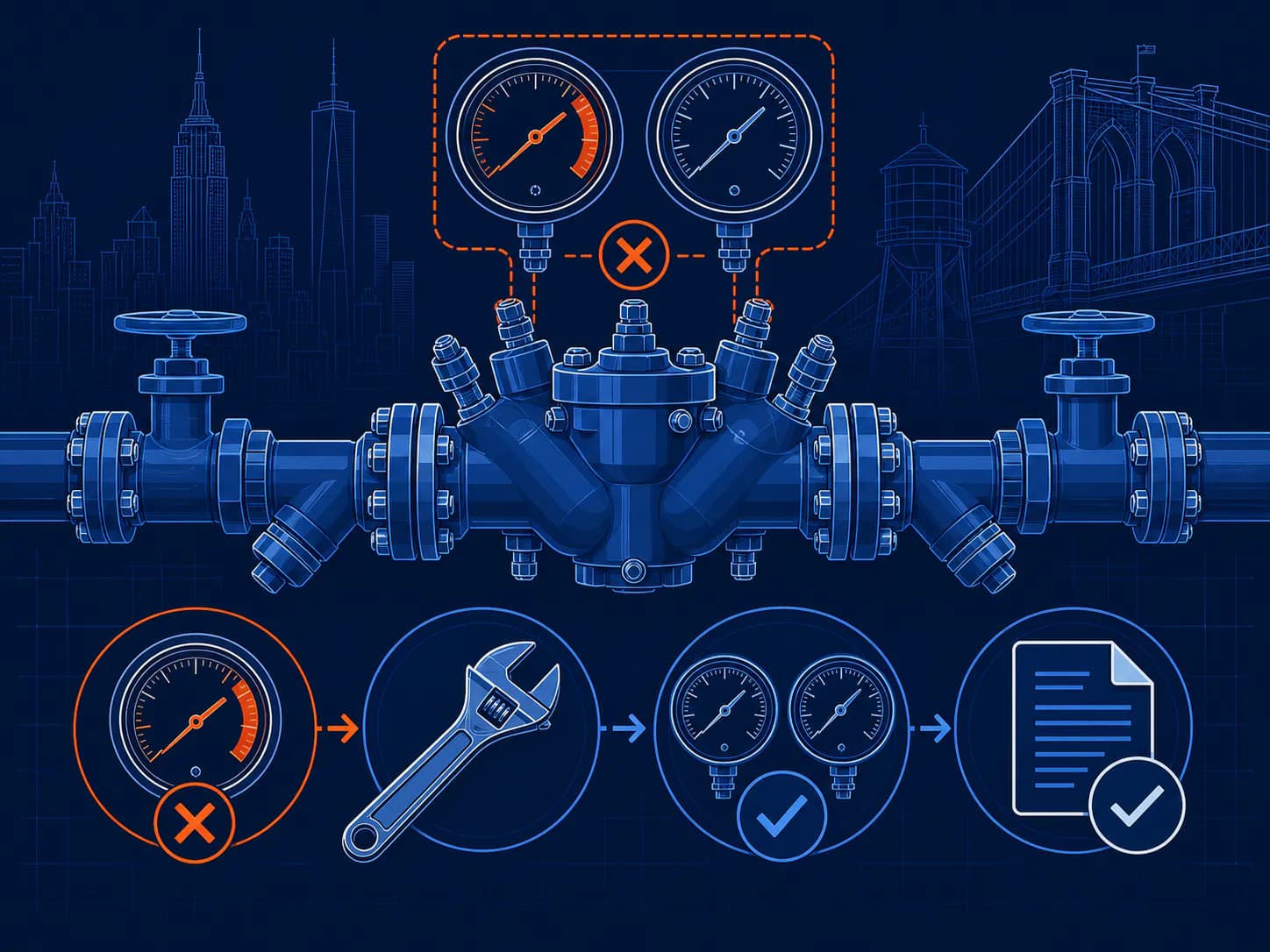
A failed backflow test is not a completed annual filing. It means the assembly did not demonstrate acceptable operation during the certified test. The owner should keep the test results, leave the device in service only as directed by the licensed professionals handling the condition, arrange repair or replacement, retest the assembly, and submit the passing record to the correct agency.
NYC DEP's Cross-Connection Control Program Handbook sets two specific clocks for failed containment assemblies: defects found during testing must be repaired within 30 days, and retest results must be submitted within 30 days after the repair is completed. DEP also says a report that does not show a properly working device will not be accepted.
If you are still preparing for the first visit, use Austin's annual backflow testing owner checklist. If the device has already failed, switch from scheduling mode to a documented correction path.
What does a failed result actually tell the owner?
The certified tester records how the assembly performed before repair. On NYC DEP's GEN215B form, the test section captures results for the first check valve, second check valve, and differential pressure relief valve where applicable. The same form also has fields for repairs, the repairer, the repair date, and the final test.
That sequence matters. A failed result identifies a performance problem, but it does not by itself tell an owner whether a limited repair, a larger rebuild, or replacement is the right decision. The Licensed Master Plumber and certified tester need to connect the readings to the actual assembly, its condition, and its approved record.
Possible field findings include fouled or worn check components, a relief valve that does not operate correctly, damaged seals, corrosion, freeze damage, shutoff-valve problems, drainage or clearance problems, or a device that does not match the paperwork. The diagnosis should name the failed component and the proposed correction. "Failed; replace device" is not enough information for an owner approving a scope.
Ask for a copy of the test result showing:
- Facility address, block and lot.
- Device make, model, size, serial number, and exact location.
- Whether the service is domestic, fire, combined, or another listed system.
- The pre-repair test readings and failed component.
- Any upstream connection or installation deficiency noted by the tester.
- The recommended repair or replacement scope.
Step 1: Which agency owns the backflow record?
Before anyone files a form, confirm whether the failed assembly is a DEP containment device or a DOB internal device. The two records are related to backflow prevention, but they are not interchangeable.
| Device record | Typical role | Agency and form |
|---|---|---|
| Containment assembly | Protects the City water supply at the service connection | NYC DEP, Form GEN215B |
| Internal or secondary assembly | Protects equipment or an internal potable-water connection | NYC DOB, Form OP129 |
NYC DOB specifically describes OP129 as the report for internal or secondary backflow devices used for equipment such as cooling towers, boilers, and medical equipment. DEP's handbook likewise directs internal-device reports to DOB while using GEN215B for containment assemblies.
Do not decide from the device nickname alone. Owners may call several assemblies "the RPZ," and a building can have more than one. Match the serial number, location, service type, prior report, and agency record. If a DEP notice is already open, compare the notice to the failed device before assuming the annual form will clear it.
Austin's backflow prevention violation guide explains the broader record issue when testing or filing has already become an enforcement matter.
Step 2: Decide whether to repair or replace
The repair-versus-replacement decision should follow the diagnosis, not a generic price rule. Owners should compare the failed components, overall body and valve condition, repair-parts availability, access, service interruption, and whether the installed make, model, size, and location match the approved record.
A repair may be reasonable when the body and installation remain serviceable and the failed internals can be corrected. Replacement may be the better path when the assembly is badly deteriorated, damaged, repeatedly failing, or not practical to restore. A record mismatch or installation deficiency can add plan or agency work even when the new device itself passes.
Ask the Licensed Master Plumber to define:
- The exact failed components and test readings.
- The repair scope and parts to be used.
- Whether the existing installation and drainage remain acceptable.
- Whether replacement would change the approved make, model, size, or location.
- Which permits, approvals, or record updates apply to the proposed scope.
- Who will perform the retest and complete the filing.
This keeps a field repair from creating a second problem in the agency record. For buildings with several open plumbing items, Austin's NYC compliance services can help separate the device correction from unrelated DOB, DEP, gas, boiler, or violation work.
Step 3: How quickly must the failed device be repaired?
For a failed DEP containment assembly, 15 RCNY §20-04 says defects found during testing must be repaired within 30 days. The rule also requires a retest after repair. That deadline is tied to correcting the failed device; it is not permission to wait 30 days before starting coordination.
Owners should preserve a simple document trail:
- Original failed test report.
- Approved repair or replacement scope.
- Parts and materials used.
- Name and license information for the repairer.
- Date the repair was completed.
- Photos of the assembly tag and completed work.
- Any permit, plan, or agency correspondence tied to the correction.
The GEN215B form includes fields for the repair description, repairer, Licensed Master Plumber information, repair date, and final test. Keeping those details together reduces the risk of a passing field result being delayed by missing paperwork.
Do not bypass, remove, or make the containment assembly inoperative while deciding what to do. NYC DEP rules require prior approval before a containment backflow prevention assembly is decommissioned, swapped, or removed outside the approved correction path.
Step 4: Retest the corrected assembly
The correction is not complete when the last repair part is installed. The assembly must be retested to verify satisfactory performance. NYC DEP requires testing by a New York State certified backflow prevention assembly tester employed by a Licensed Master Plumber.
The final test should be tied to the same device record as the failure. Confirm the address, block and lot, device identification, location, service type, repair date, and final readings before the form is signed. If the assembly was replaced or the installation changed, confirm whether the existing DEP approval still supports the record.
A clean retest package should answer three questions without guesswork:
- What failed on the original test?
- What was repaired or replaced?
- What final readings show the assembly passed after correction?
Austin's backflow testing and repair service is set up around that full sequence: certified testing, Licensed Master Plumber review, repair or replacement where needed, retesting, and filing support.
Step 5: Submit the passing report to the correct agency
For DEP containment assemblies, use the current GEN215B process and follow DEP's submission instructions. DEP's backflow page also provides an online submission option for initial and annual test forms, with the signed and sealed form attached as required.
For an annual DEP test, the certified tester completes the testing information and a Licensed Master Plumber signs and seals the report. Initial installation has additional Professional Engineer or Registered Architect requirements. Do not add or omit signers based on an old building file; use the current instructions for the type of test being submitted.
NYC DEP's rule says retest results must be submitted within 30 days after completion of the repair. Save the final signed report and the submission confirmation. An invoice stating "RPZ repaired" does not prove that DEP received an acceptable annual report.
For an internal or secondary assembly, follow DOB's OP129 path instead. If a building has both containment and secondary devices, it may need separate records rather than one combined filing.
What should go in the owner's closeout file?
A complete closeout file lets the next property manager, buyer, lender, or contractor reconstruct what happened without repeating the investigation. Keep it with the building's annual compliance records.
| Closeout item | What to verify |
|---|---|
| Failed test | Device identity, date, readings, and failed component |
| Correction scope | Repair or replacement details and responsible licensee |
| Final retest | Passing readings tied to the corrected assembly |
| Signed report | Required tester, LMP, and any applicable PE or RA information |
| Submission proof | Agency, submission date, confirmation, and any response |
| Next due date | Calendar based on the accepted device record |
Portfolio managers should add the next test to the property manager plumbing compliance calendar only after the corrected record has been submitted. A recurring reminder is useful, but it should point back to the final report and the correct device serial number.
Common mistakes after a failed backflow test
Treating repair as closeout. A repaired assembly still needs a passing retest and the required report submission.
Filing with the wrong agency. DEP containment devices and DOB secondary devices use different records. Confirm the assembly's role before selecting GEN215B or OP129.
Losing the failed result. The original readings explain why work was needed and connect the repair to the final test.
Approving replacement without checking the record. A changed make, model, size, location, or installation can raise approval questions beyond the mechanical replacement.
Waiting for a notice before acting. The failed test already starts the correction path. Owners should work from the test date, repair date, and applicable filing rule rather than waiting for another letter.
When should an owner call Austin?
Call Austin when a containment or secondary backflow assembly fails, the device record is unclear, the prior filing is missing, or a DEP notice is already active. Bring the failed test, prior annual report, device photos, DEP or DOB correspondence, and any deadline shown on the notice.
Austin can identify the device and agency lane, review the failed readings, scope repair or replacement, coordinate certified retesting, and organize the required filing record. The goal is not simply to make the valve pass on site. It is to leave the owner with a passing assembly and a traceable compliance file.
Common Questions
How long do I have to repair a failed NYC backflow prevention device?
For a containment device governed by NYC DEP rules, defects found during testing must be repaired within 30 days. The repair must be followed by a retest, and the retest results must be submitted to DEP within 30 days after the repair is completed.
Can a failed backflow test report complete the annual DEP filing?
No. NYC DEP rules say an initial or annual test report that does not show a properly working device will not be accepted. The owner needs a documented repair or replacement, a passing retest, the required signatures and seal, and submission of the corrected test record.
Does a failed backflow preventer always need to be replaced?
No. The repair decision depends on the failed components, the assembly condition, parts availability, installation, and whether the device still matches the approved record. A Licensed Master Plumber should compare repair and replacement only after the certified test results and field condition are reviewed.
Is GEN215B always the correct backflow test form in NYC?
No. GEN215B is the DEP form for containment backflow prevention assemblies. DOB says internal or secondary devices serving equipment such as boilers, cooling towers, or medical equipment are recorded with DOB on Form OP129. Confirm the agency and device record before filing.