
Key takeaways
- Maintain one calendar for annual, cycle-based, and record-triggered plumbing obligations.
- Assign an owner, lead time, evidence requirement, and follow-up check to every compliance task.
- Reconcile the calendar with current agency and building records instead of relying on prior-year dates.
Why property managers need a plumbing compliance calendar
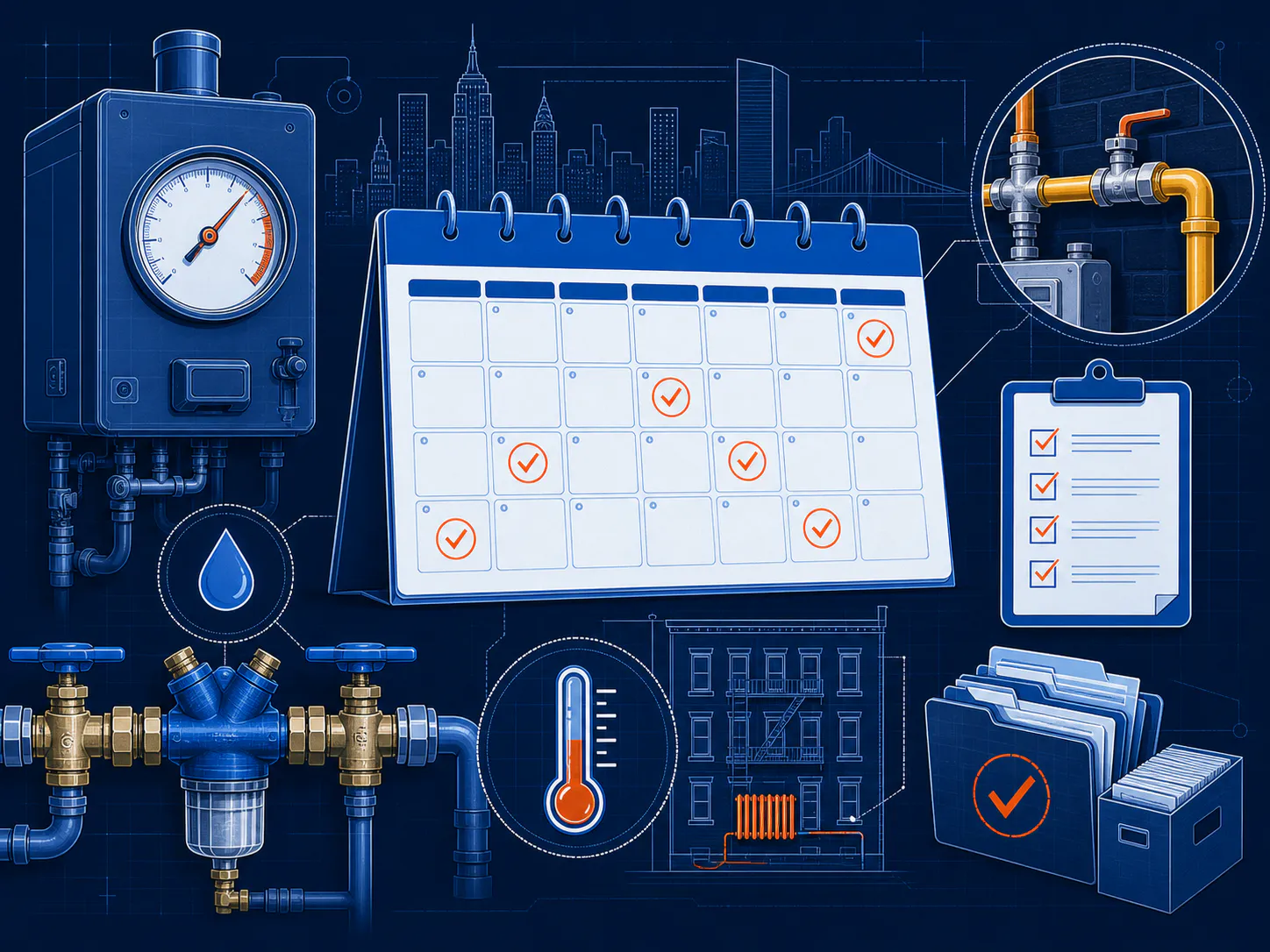
In 2026, NYC plumbing compliance is not one deadline. It is a recurring operating system that touches DOB gas inspections, boiler filings, DEP backflow testing, HPD heat complaints, and open violation records. The goal is simple: know what is due before an agency notice, tenant complaint, sale, refinance, or utility issue forces the schedule.
For property managers, the safest calendar is built around three checks: scheduled annual work, cycle-based filings, and record monitoring. Austin Plumbing treats this work as a compliance lane, not just a repair call. The same building may need a Local Law 152 gas inspection, an annual boiler filing, a backflow prevention test, and a violation review in the same operating year. Portfolio owners can connect those deadlines to recurring field coverage through Austin's building maintenance contracts.
This guide gives you a practical year-round rhythm. It is not legal advice, and it is not a substitute for checking your actual building record. Use it as the manager's working checklist, then confirm deadlines against DOB, DEP, HPD, utility, and property-specific records.
January: reset the building record before the year gets away
Start the year by checking public agency records, not just your internal maintenance tracker. DOB NOW: Safety lets owners and industry users submit compliance filings, view and search violations and notices of deficiency, make payments or waiver requests, and view filing status. HPD Online can show complaints, violations, property registration, charges, litigation, block and lot information, and vacate orders.
That means January should be a record-reconciliation month. Pull DOB, HPD, DEP, and OATH items for each managed building. Compare those records with your prior-year vendor invoices, inspection reports, permit filings, and closeout documents. The question is not just "was the work done?" It is "does the agency record show the work as accepted, filed, dismissed, or still open?"
For Austin's compliance clients, this is where many surprises show up. A boiler may have been inspected but not filed correctly. A violation may have been corrected in the field but not certified. A backflow device may have passed last year's test but still need this year's 12-month test window. A gas piping inspection may be due because the community district cycle is approaching.
Use January to assign owners for each open item. Give each one a next step: monitor, schedule, file, correct, certify, or escalate.
February and March: map gas, boiler, and backflow obligations
By late winter, build a property-by-property compliance matrix. Put gas, boiler, and backflow in separate columns because each one follows a different rule path.
For gas piping, DOB's current Local Law 152 guidance says covered buildings must have gas piping systems inspected at least once every four years. A Licensed Master Plumber must provide the Gas Piping System Periodic Inspection Report to the owner within 30 days of inspection, and the owner must submit the LMP-backed certification to DOB within 60 days of inspection. If corrective conditions are identified, DOB describes 120-day or 180-day correction certification paths, depending on whether more time was indicated in the initial certification. Beginning July 27, 2026, certifications and related transactions move to DOB NOW: Safety; the legacy portal closes after July 24 and no submissions can be made July 25 or 26. Failure to file by the applicable due date may result in a $5,000 civil penalty.
For boilers, DOB's boiler compliance guidance says a boiler inspection report must be filed in DOB NOW: Safety within 14 days of the inspection. Late filings after the 14-day deadline can trigger a $50 per month civil penalty per boiler, up to $600. Reports after the late-filing period are treated as expired and can trigger a $1,000 failure-to-file civil penalty per boiler. If inspection defects are found, DOB says they must be corrected within 90 days of the initial inspection date, with the subsequent inspection report filed within 14 days of that inspection.
For backflow, DEP's current cross-connection guidance says annual device testing is required every 12 months after installation and initial testing. DEP also says failure to perform the annual test could result in fines or water service disconnection. The annual test form needs to be completed by a certified tester and signed by a Licensed Master Plumber.
The calendar takeaway: do not keep these items in one vague "annual compliance" bucket. They need separate dates, separate documents, and separate follow-up owners.
April through June: schedule field work before deadline pressure
Spring is the best time to turn calendar items into appointments. The point is to inspect early enough that corrections can still be handled calmly.
Start with gas and boiler work because failed inspections can create repair scope. If a Local Law 152 inspection finds conditions that require correction, the filing path can extend beyond the initial inspection. If a boiler inspection finds defects, DOB's correction and subsequent-report timelines matter. A manager who waits until the end of the cycle has less room to obtain access, approve work, file permits, schedule reinspections, or gather closeout paperwork.
Backflow testing should also be scheduled before the due month, especially for mixed-use buildings, restaurants, medical uses, commercial properties, and multifamily buildings with existing devices. If the device fails, the owner needs time for repair, retest, and documentation. The related Austin guide on NYC grease trap requirements is also useful for food service spaces, where DEP issues can overlap with plumbing buildout planning.
This is also a good quarter to check construction and tenant-improvement work. If a tenant is opening a restaurant, clinic, salon, laundry, or other water-heavy use, confirm whether plumbing, gas, backflow, grease interceptor, or DOB permit work is needed before the lease deadline turns into an emergency.
July through September: prepare for heat season and fall filings
Summer is boiler-room planning time. HPD heat season runs from October 1 through May 31, and HPD says owners must provide hot water 365 days per year at a constant minimum temperature of 120 degrees Fahrenheit. During heat season, HPD says heat is required during the day when the outside temperature is below 55 degrees, with inside temperature at least 68 degrees Fahrenheit between 6:00am and 10:00pm. Overnight, from 10:00pm to 6:00am, the inside temperature must be at least 62 degrees Fahrenheit regardless of outside temperature.
That means July, August, and September are the wrong months to ignore boiler rooms. Test heat controls, review prior HPD complaints, confirm annual boiler inspection scheduling, and address recurring hot water complaints before October. A building with a weak domestic hot water loop or unreliable steam distribution will not get easier to manage once tenants start calling 311.
Use this quarter to confirm which buildings need heating and boiler service, which need compliance filing support, and which should move onto a planned maintenance-contract schedule. The Austin guide to HPD vs. DOB plumbing violations can help managers separate tenant-service complaints from DOB permit and equipment issues.
October through December: monitor heat, close records, and plan next year
Once heat season starts, the calendar changes from planning to monitoring. Log tenant heat and hot water complaints, document service calls, and keep records of completed boiler, plumbing, or gas work. If an HPD complaint becomes a violation, the manager needs to know whether the field condition has been corrected and whether any DOB-side filing is also involved.
December is also the month to close loose ends. Confirm boiler inspection reports were accepted. Confirm backflow test forms were submitted. Confirm Local Law 152 filings, correction certifications, and extension statuses where relevant. Check DOB NOW: Safety and HPD Online again, then compare agency records against your internal closeout file.
If an OATH summons is involved, do not treat it as ordinary paperwork. OATH explains that certain unpaid monetary judgments resulting from a hearing or default can become docketed when filed with Civil Court, which means the City may attempt collection through court proceedings or by attaching liens to real property. If a summons, hearing, default, or docketed judgment appears, route it for review instead of leaving it in a general maintenance inbox.
For buildings with open gas, boiler, or plumbing violations, Austin's DOB plumbing violation removal process is built around record research, site review, corrective work, filings, inspections, and sign-off documentation.
Monthly compliance checklist for property managers
Use this monthly checklist for every active building in your portfolio.
| Month | What to check | Why it matters |
|---|---|---|
| January | DOB NOW, HPD Online, OATH, DEP records | Starts the year with agency records, not assumptions |
| February | Local Law 152 cycle status | Gas deadlines depend on building status and community district |
| March | Boiler inventory and prior filing status | Covered boilers need annual inspection and DOB filing |
| April | Backflow device test windows | DEP annual testing runs every 12 months after installation |
| May | Spring corrective work | Repairs are easier before summer vacations and fall heat pressure |
| June | Tenant buildout plumbing needs | Restaurants and commercial tenants may need DOB/DEP planning |
| July | Boiler-room service planning | Heat season starts October 1 |
| August | HPD complaint history | Recurring heat and hot water complaints should be fixed early |
| September | Heat-season readiness | Confirm heat controls, hot water, access, and vendor coverage |
| October | Heat and hot water monitoring | HPD heat rules are active from October 1 |
| November | Open violations and summonses | Catch record issues before year-end |
| December | Filing acceptance and next-year plan | Close documents and schedule the next cycle |
This table is not a legal deadline chart. It is an operating rhythm. The exact due dates still come from the building record, agency rule, inspection date, equipment status, and notices already issued.
What documents should stay in the building compliance file?
A property manager's compliance file should be boring, searchable, and complete. Store the source document, the proof of work, and the agency outcome together.
For gas piping, keep the inspection report, accepted DOB NOW certification, correction certification if any, extension records if any, permits, gas authorization documents, utility communications, and final accepted filings. For boiler work, keep annual inspection reports, DOB NOW filing confirmations, defect correction records, subsequent inspection reports, and any notices or waiver decisions. For backflow, keep DEP test forms, certified tester information, Licensed Master Plumber sign-off, repair records, retest results, and DEP correspondence.
Also keep records of DOB violations, HPD violations, OATH summonses, certificates of correction, permits, inspection sign-offs, photos, tenant access notices, and service reports. If a lender, buyer, board, tenant attorney, agency inspector, or utility asks what happened, the file should answer without a scavenger hunt.
When should a manager escalate to a Licensed Master Plumber?
Escalate when the item involves gas piping, boiler work, backflow device testing, DOB plumbing permits, sewer or water service work, a certificate of correction, or any notice that cannot be resolved with routine maintenance alone. A super can identify a symptom, but many NYC plumbing compliance items require licensed review, filing, inspection coordination, and sign-off.
Escalate sooner when the issue affects safety, utilities, tenant services, financing, a closing, a restaurant opening, a stop work order, or a hearing date. For example, a gas shutoff needs a different response than a slow drain. A missed boiler filing needs a different response than a noisy radiator. A failed backflow test needs repair, retest, and DEP documentation, not just a note in the service log.
If you are not sure which lane the issue belongs in, start with Austin's compliance services. The intake question is simple: is this a field-service issue, an agency-record issue, or both?
How to use this calendar without creating busywork
The best compliance calendar is light enough that your team will actually use it. Keep one tracker per building. Add columns for agency, requirement, due date, vendor or licensee, document needed, date filed, agency status, next action, and owner. Review it monthly with the same discipline you use for rent rolls, open work orders, and insurance renewals.
Avoid vague entries like "check DOB" or "boiler stuff." Use specific tasks: "confirm LL152 certification status in DOB NOW," "schedule low-pressure boiler inspection," "upload backflow annual test form," "check HPD heat complaints," or "confirm OATH summons response." Specific tasks can be assigned. Vague tasks get ignored.
The point is not to turn property management into paperwork theater. The point is to spot compliance risk while it is still manageable. For NYC buildings, that is often the difference between a scheduled inspection and an emergency call.
Common Questions
Do all NYC buildings follow the same plumbing compliance calendar?
No. Local Law 152 depends on community district and gas piping status, boiler filing depends on covered boiler equipment, backflow testing depends on the installed device, and HPD heat obligations apply to residential tenants during heat season.
How often should a property manager check DOB and HPD records?
A practical rhythm is monthly for active portfolios and immediately before sales, refinancing, tenant buildouts, or major repairs. DOB NOW: Safety and HPD Online both expose building records that can change after inspections, complaints, filings, or hearings.
When should a property manager call a Licensed Master Plumber instead of waiting?
Call before the deadline when a filing requires licensed sign-off, when a gas, boiler, backflow, sewer, or permit issue appears, or when a violation, utility notice, or OATH summons needs documentation tied to corrective work.