
Key takeaways
- Confirm the food-service use and plumbing design before finalizing buildout pricing.
- Separate plumbing installation work from ongoing pump-out and waste-hauling responsibilities.
- Keep design, permit, maintenance, and disposal records available for owner and agency review.
NYC requires commercial grease-generating establishments to install, operate, and maintain properly sized grease interceptors. For a restaurant or other food-service space that generates fats, oils, or grease, the practical questions are whether the interceptor fits the use, was installed through the correct licensed-plumbing path, is maintained often enough, and has a record the operator and owner can reconstruct.
Grease trap compliance matters for restaurants, bakeries, cafes, ghost kitchens, supermarkets, catering facilities, schools, commissaries, and other grease-generating establishments. When an interceptor is missing, undersized, bypassed, or poorly maintained, grease can enter the sewer system, cause backups, and expose the business to DEP enforcement. NYC Business currently lists a $100-to-$1,500 penalty range for failure to install or maintain a grease interceptor.
This guide explains NYC grease trap requirements in plain English for restaurant owners, landlords, property managers, architects, and contractors planning a food service build-out. For a lease review, new kitchen, or equipment change, Austin's commercial kitchen plumbing team connects interceptor planning to the rest of the licensed plumbing scope.
What Is a Grease Trap?
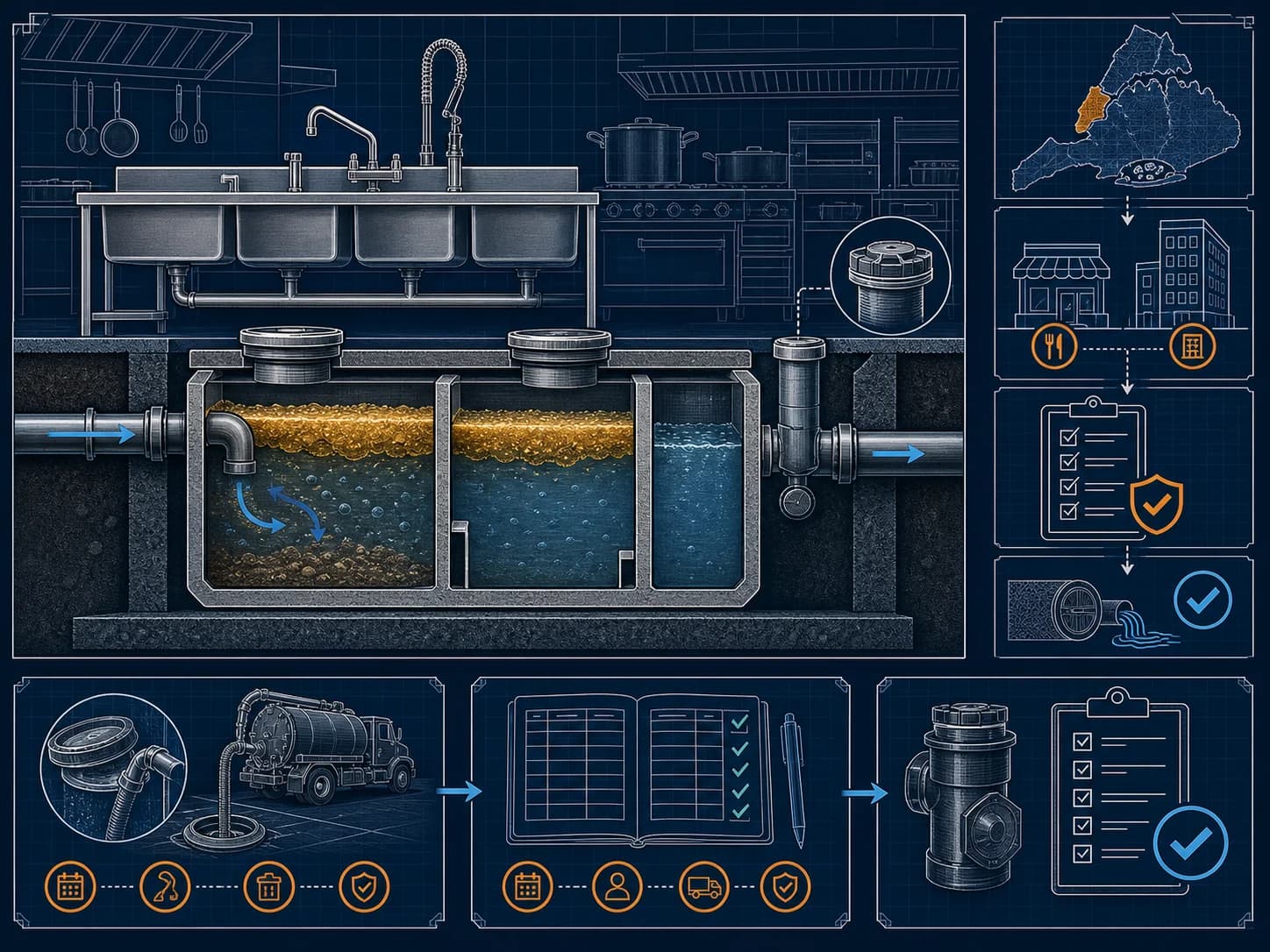
A grease trap, also called a grease interceptor, is a plumbing device installed on a kitchen waste line to separate fats, oils, grease, and solids before wastewater reaches the building sewer. In NYC food service spaces, it is a compliance device as much as a plumbing device.
Small indoor units are often called hydromechanical grease interceptors. Larger outdoor or below-grade units are often gravity grease interceptors. The right choice depends on the kitchen layout, fixture count, equipment load, flow rate, available space, and DEP/DOB requirements for the specific project.
A correctly installed grease interceptor protects the public sewer, the building's waste piping, the restaurant's operating schedule, and the owner's compliance record. A poorly selected unit can become a recurring backup problem from the first month of operation.
Who Needs a Grease Trap in NYC?
NYC requires properly sized grease interceptors for businesses that generate fats, oils, or grease. That group includes more than full-service restaurants.
- Restaurants, bars with food service, cafes, diners, and fast casual kitchens
- Bakeries, delis, bagel shops, pizza shops, and takeout operations
- Ghost kitchens, commissaries, catering kitchens, and commercial prep spaces
- Supermarkets, food halls, institutional kitchens, schools, and cafeterias
- Tenant spaces converted from retail or office use into food service use
The deciding factor is not the tenant's marketing category. It is whether the operation generates grease and how its wastewater reaches the sewer system. The installed unit must be sized and maintained for the actual use.
Landlord vs. Tenant: Who Is Responsible?
Responsibility between landlord and tenant depends on the lease and project documents, but the interceptor connects to the building plumbing system. Owners and managing agents should therefore verify the installation and maintenance record rather than assume every obligation belongs to the operator.
The tenant may be assigned daily use, cleaning, disposal records, and a maintenance schedule. The building owner can still be affected when the device is missing, incorrectly installed, connected through undocumented work, or too small for the approved food-service use.
The highest-risk moment is a change of use. A storefront that once held dry retail, a small office, or a light-prep cafe may not have plumbing designed for a high-volume restaurant. Before a lease is signed or a build-out begins, the grease interceptor question should be answered by a Licensed Master Plumber, not left for the first DEP inspection.
How Grease Interceptors Are Sized
A grease trap is not compliant just because one is installed. NYC grease interceptor sizing depends on the actual kitchen load. Fixture count, drain flow rate, sink compartment size, dishwasher discharge, food prep volume, and cooking equipment all matter.
| Sizing factor | Why it matters |
|---|---|
| Fixture count | Three-compartment sinks, prep sinks, floor drains, and dishwasher connections can add flow. |
| Fixture volume | Larger sinks can discharge more wastewater during peak use. |
| Cooking profile | Fryers, grills, woks, and heavy-prep operations can create higher FOG loads. |
| Operating volume | Meal volume and operating pattern affect accumulation. |
| Available location | Placement affects service access, venting, pitch, and practical unit selection. |
An undersized interceptor can reach its capacity too quickly, allow grease downstream, create odors or backups, and leave the operator without a defensible maintenance plan. Sizing should follow the proposed fixtures, equipment, and operating load rather than simply reuse whatever a prior tenant left behind.
Installation Requires a Licensed Master Plumber
Grease interceptor installation is plumbing work. DEP states that interceptors must be properly sized and installed by a licensed plumber; see its business grease-disposal guidance. The permit and review path depends on the project scope.
A compliant installation is more than setting the unit in place. The waste piping, indirect connections, venting, cleanouts, access clearances, flow control, trap seals, and maintenance access all need to work together. The installation also needs to match the submitted plans or filing documents for the space.
If a restaurant inherits an old grease trap from a prior tenant, do not assume it is legal or correctly sized. Older units may have been installed for a different use, abandoned in place, connected incorrectly, or modified during unpermitted renovations.
Pumping Records and the 25 Percent Rule
A grease interceptor only works if it is cleaned before accumulated grease and solids take over the unit. NYC Business guidance says maintenance should prevent fats, oils, grease, and solids from exceeding 25% of the total liquid depth or rated capacity; see the official restaurant compliance guide.
The maintenance interval should be based on measured accumulation and the unit’s rated capacity, not a generic weekly or monthly schedule.
- Use a fat renderer, grease recycling company, or other properly authorized trade-waste provider for collected grease and oil.
- Keep cleaning and disposal records available so the maintenance interval can be demonstrated.
- Do not use enzymes or additives as a substitute for proper pumping.
- Inspect baffles, covers, gaskets, and access points during service.
- Adjust the schedule when menu, hours, tenant, or kitchen volume changes.
Common DEP Grease Trap Violations
DEP says it inspects grease interceptors for correct sizing, installation, maintenance, and effective operation. Conditions that can trigger corrective work or enforcement include:
- No grease interceptor serving a grease-producing food service operation
- A grease trap that is too small for the actual kitchen fixture load
- Improper installation, bypassed fixtures, missing flow control, or poor access
- No reliable cleaning or disposal record to show the maintenance schedule
- Grease discharge causing building drain backups or downstream sewer issues
- Tenant build-out work that does not match the required plumbing-permit path
When a notice or violation is already active, the required response depends on the cited condition and agency instructions. Pumping alone may not address an undersized or improperly installed unit. A Licensed Master Plumber may need to verify sizing, correct piping, replace the interceptor, and document the correction path.
What to Check Before Signing a Restaurant Lease
Before a food service tenant signs a lease or starts construction, the grease interceptor should be reviewed like any other mission-critical utility. A fast plumbing review can prevent months of permitting delays, change orders, and landlord-tenant arguments.
- Confirm whether a grease interceptor exists. Identify the unit, location, size, access, and connected fixtures.
- Compare the unit to the proposed menu and equipment. A former coffee shop setup may not support a full-service kitchen.
- Review existing records. Ask for pump-out manifests, permits, closeout documents, and prior violation history.
- Check routing and access. The unit must be serviceable, and the connected waste piping must be configured correctly.
- Have an LMP advise before build-out pricing is final. Grease interceptor replacement can affect floors, walls, excavation, permits, and schedule.
Grease Trap Maintenance Is Not Drain Cleaning
Hydro jetting, snaking, and emergency drain cleaning can clear a backup, but they do not make a non-compliant grease interceptor compliant. If the trap is undersized, bypassed, or rarely pumped, the same backup can return after the next busy weekend.
Austin Plumbing handles the licensed-plumbing side of the issue: inspecting grease waste lines, reviewing interceptor sizing, coordinating with the operator's authorized grease-removal provider, correcting defective piping, and installing appropriately sized interceptors for NYC food-service properties.
For active service issues, see our sewer and drain service. For installation, sizing, or DEP compliance, start with our grease trap compliance service.
Restaurants should also confirm whether the building has a device covered by the NYC backflow testing checklist.
Common Questions
Who is responsible for a restaurant grease interceptor?
Lease terms may divide responsibilities, but the operator and property owner should document who handles design, permitted installation, access, maintenance, pump-outs, and record retention.
Is grease-interceptor installation the same as routine cleaning?
No. Plumbing design and installation are separate from recurring pump-out and disposal work performed by an appropriate waste hauler.
When should a plumber review a restaurant buildout?
Before the layout and pricing are final, because interceptor type, location, access, drainage, venting, permits, and existing building conditions can affect the scope.