Key takeaways
- A failed First Test means DOB found defects that must be corrected before the boiler can pass reinspection and receive job approval and sign-off.
- Build the correction scope from the actual inspection result, approved documents, permit, and field condition. Do not rely on a verbal summary alone.
- Track correction, reinspection, approval, permit closeout, and annual boiler compliance as separate records.
- Do not treat contractor startup, an annual inspection report, or a completed repair as a substitute for a passing First Test.
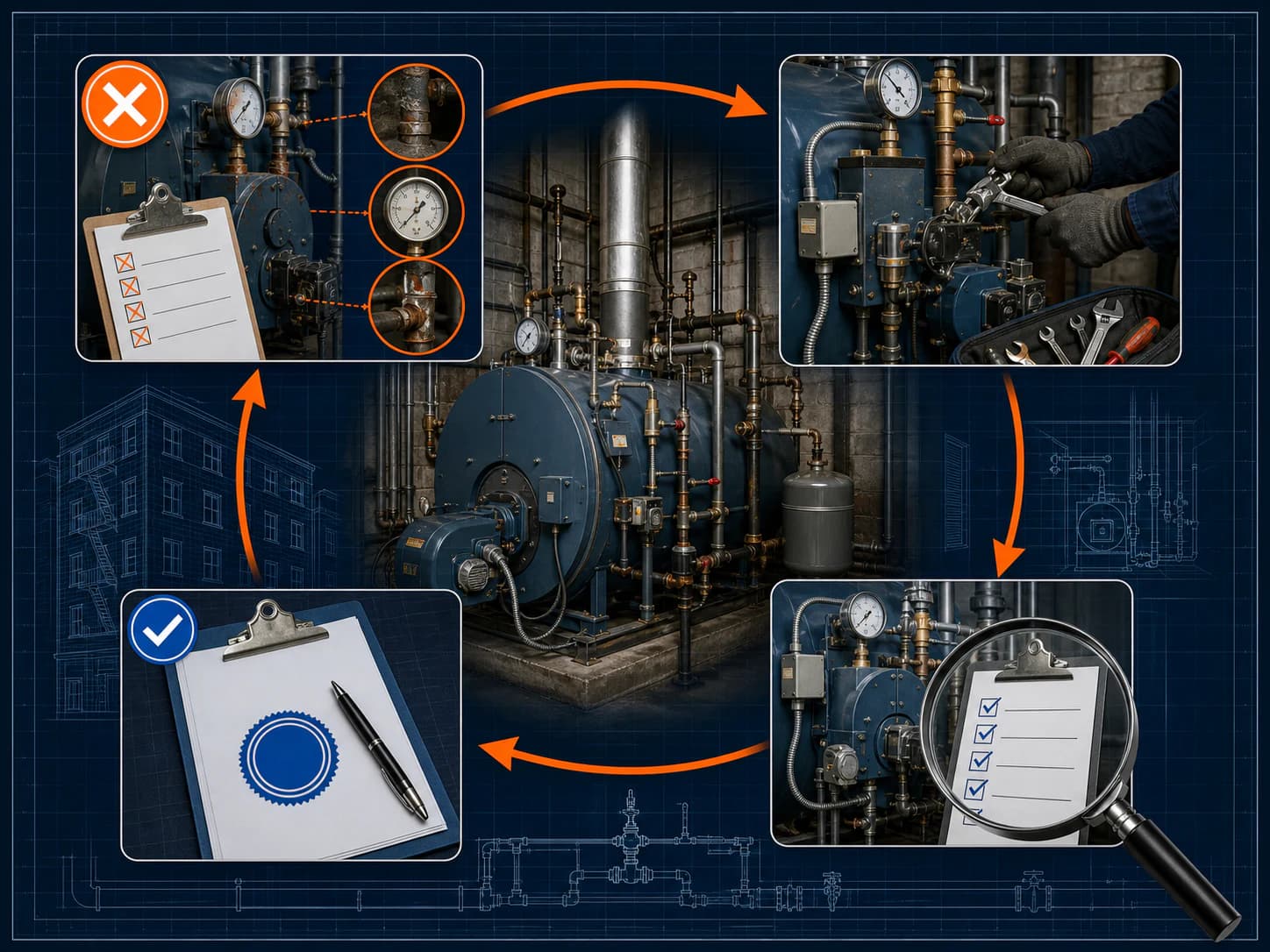
A failed NYC boiler First Test is a project-control problem, not just a service call. DOB requires qualifying new boiler installations, boilers with more than half their principal components or sections replaced, and boilers with replaced fuel burners to pass a Department First Test before use. When defects are found, DOB requires correction and reinspection before it can approve and sign off the job (NYC DOB, First Test Requirements, retrieved 2026-08-31).
The owner should first secure the inspection result and identify the exact failed conditions. Then the project team should compare those conditions with the approved scope, correct the work under the proper licensed and professional responsibility, request the next inspection through the correct DOB record, and confirm the resulting approval and closeout status.
If the project is still being planned, use Austin's NYC boiler replacement permit, First Test, and turnover sequence to establish the project gates before demolition and installation. This guide begins after an inspection has already failed.
What does a failed boiler First Test mean?
A failed First Test means the inspected boiler installation did not satisfy DOB's requirements at that inspection. It does not, by itself, establish that every part of the boiler is unsafe or that the whole project must be redesigned. The controlling evidence is the actual inspection result, its objections, and the approved project documents.
DOB distinguishes the First Test from recurring annual boiler compliance. A First Test is the Department inspection used to approve and register qualifying new or replaced boiler work before use. If defects are found, the boiler must be corrected and reinspected before DOB can approve and sign off the job. DOB also warns that a boiler put into use without passing the required First Test is considered unregistered and may receive an ECB violation (NYC DOB, First Test Requirements, retrieved 2026-08-31).
Before authorizing work, confirm four facts:
| Record | What the owner needs to confirm |
|---|---|
| Inspection result | Failed inspection type, date, objections, and any referenced condition |
| Job and permit | Job number, permit status, contractor of record, applicant, and approved scope |
| Field condition | What is installed now and whether it matches the approved documents |
| Closeout path | Corrections, supporting inspections, reinspection, commissioning if applicable, and final sign-off |
Step 1: Collect the failed inspection record
Start with the inspection record, not a summary such as "the boiler failed." Download or preserve the inspection result and list each objection in the same language used by DOB. Match it to the job, permit, boiler device, and contractor information so the team is solving the right record.
Ask for the approved drawings and specifications, permit, equipment schedule, prior inspection results, special-inspection requirements, commissioning requirements, and contractor notes. If the installation changed from the approved documents, the Registered Design Professional should determine whether revised documents or a post-approval amendment are required before reinspection.
Keep the failed First Test separate from any annual filing, utility red tag, HPD complaint, or boiler violation. Those records can overlap, but each has its own owner, status, and closeout evidence. Austin's annual boiler filing guide explains the recurring DOB NOW: Safety record that follows a different cycle.
Step 2: Assign each correction to the responsible professional
DOB's owner checklist tells owners to retain a Registered Design Professional for the project documents and a Licensed Master Plumber or Licensed Oil Burner Installer for boiler work. It also tells owners to coordinate required special inspections and commissioning when the project requires them (NYC DOB, Project Checklists for Owner: Boiler, retrieved 2026-08-31).
Do not assume one contractor owns every objection. Depending on the approved scope, correction may involve the licensed boiler contractor, applicant of record, electrician, controls contractor, chimney or venting professional, Special Inspection Agency, commissioning agent, or another responsible trade. The approved documents and inspection objection should determine that handoff.
The Licensed Master Plumber or Licensed Oil Burner Installer should inspect the field condition before pricing the correction. If an objection points to gas piping, combustion air, venting, safety controls, pressure relief, equipment arrangement, or work outside the approved scope, the team should identify the professional and inspection requirements before work begins. Avoid solving a document problem only in the field, or a field problem only on paper.
Step 3: Correct the cited conditions and build the evidence file
The goal is not simply to make the boiler run. The goal is to correct the cited conditions so the installation matches the approved, code-compliant project and is ready for the required reinspection.
Use a correction log with one row per objection. Record the responsible party, approved correction, completion evidence, related drawing or document, required supporting inspection, and person who verified readiness. Photos can help document hidden or completed work, but they do not replace required inspections, test reports, certifications, or revised filings.
Before requesting reinspection, confirm that:
- Each First Test objection has a documented disposition.
- Required corrective work is complete and accessible for inspection.
- Approved documents still match the installed condition, or required revisions have been filed.
- Required special or progress inspections are complete or ready at the correct stage.
- Safety controls, venting, fuel connections, relief provisions, and other scope-specific items are ready for the actual inspection.
- The permit and responsible project participants remain active and correctly associated with the job.
DOB's registrant guidance lists multiple boiler-work inspection surfaces and makes clear that the applicable special inspections depend on the project scope (NYC DOB, Boiler Work and Inspections for Registrants, retrieved 2026-08-31). Treat that guidance as a coordination checklist, not as a substitute for the approved project requirements.
Step 4: Request reinspection through the correct DOB record
DOB directs boiler inspection requests through DOB NOW: Inspections. Licensees and design professionals must register to take action and request inspections, while owners should use the email address associated with their filing when registering (NYC DOB, DOB NOW: Inspections, retrieved 2026-08-31).
Before the responsible professional requests the appointment, verify the job number, permit type, inspection type, contact information, site access, boiler readiness, and any documents the system or inspector requires. A new appointment requested against the wrong record or before all corrections are ready can add another failed result without advancing closeout.
Coordinate access to the boiler room and every condition the inspector must see. The owner or manager should also confirm who will attend, who can answer scope questions, and who will receive the result. Do not promise a universal inspection date or approval timeline. Appointment availability and the work needed to clear objections vary by project.
Step 5: Verify approval, sign-off, and the next compliance record
After a passing First Test, DOB says it gives boiler or fuel-burner job approval and sign-off. The owner should preserve the passing result and then verify the related job, permit, device, special-inspection, commissioning, and final sign-off records rather than assuming one screen means every closeout item is complete.
DOB's boiler project checklist says owners should ensure Department inspections and sign-offs are complete and, when required, commissioning is filed before sign-off (NYC DOB, Project Checklists for Owner: Boiler, retrieved 2026-08-31). For a larger plant project, use Austin's heating-plant capital-planning guide to keep testing, commissioning, training, warranties, and turnover records in the same closeout file.
Also confirm the annual boiler compliance record. DOB says a boiler that passes its First Test does not need an annual inspection report in that same inspection year. However, a failed First Test that crosses calendar years, an existing annual violation, or another device record may create a separate issue. DOB's current First Test page notes a work-in-progress waiver path for a specific annual violation scenario, but eligibility is fact-specific and the owner must apply through DOB NOW: Safety (NYC DOB, First Test Requirements, retrieved 2026-08-31).
Common mistakes that delay boiler sign-off
Treating the failure as a generic repair list. The correction scope should trace back to the inspection objections, approved documents, and actual installation.
Requesting reinspection before every objection is ready. A completed mechanical repair may still leave revised documents, special inspections, controls, access, or commissioning unresolved.
Using annual filing paperwork as a substitute. The First Test and recurring annual boiler program are separate DOB paths. A filed annual report does not approve an installation that failed First Test.
Assuming a running boiler is a signed-off boiler. Startup, heat production, a contractor invoice, and DOB approval are different records.
Losing the record handoff. Owners should retain the failed result, correction log, revised documents, supporting inspections, passing result, approval, sign-off, and future annual compliance schedule together.
What should an owner bring to a correction review?
Bring the DOB job and permit numbers, failed inspection result, approved drawings, equipment and burner information, contractor and applicant contacts, photos of the current installation, special-inspection records, commissioning records when applicable, prior boiler filings, and any related violation or utility notice.
Austin Plumbing & Heating can review the boiler and project record, inspect the licensed plumbing and heating scope, organize the correction questions, and coordinate the applicable reinspection and filing steps with the project's responsible professionals. Start with Austin's boiler inspection and compliance service, and use the violation review intake when the failed First Test has already produced a separate DOB or ECB record.
Common Questions
Can an NYC boiler be used after it fails First Test?
DOB says boilers that require a First Test must pass before use. A boiler used without passing is considered unregistered and may be issued an ECB violation. The project team should correct the cited defects and obtain the required reinspection and sign-off.
Does a failed First Test tell the owner exactly what repair contract to approve?
Not by itself. Start with the inspection result, objections, approved documents, permit scope, and field condition. The Licensed Master Plumber or Licensed Oil Burner Installer, Registered Design Professional, and other project professionals should identify the correction scope that applies.
Can an annual boiler inspection replace a failed First Test?
No. A First Test is the DOB inspection and registration path for qualifying new, substantially replaced, or burner-replacement work. An annual report does not substitute for correcting a failed First Test and obtaining DOB approval and sign-off.
How is another First Test requested after corrections?
DOB directs inspection requests through DOB NOW: Inspections. The responsible project professional should confirm the inspection type, permit record, required documents, and readiness before requesting the appointment.
Does passing the reinspection close every boiler project requirement?
Passing supports DOB boiler approval and sign-off, but the owner should still verify the job and permit status, required special inspections, commissioning when applicable, final sign-off, and the building's recurring annual boiler obligations.