
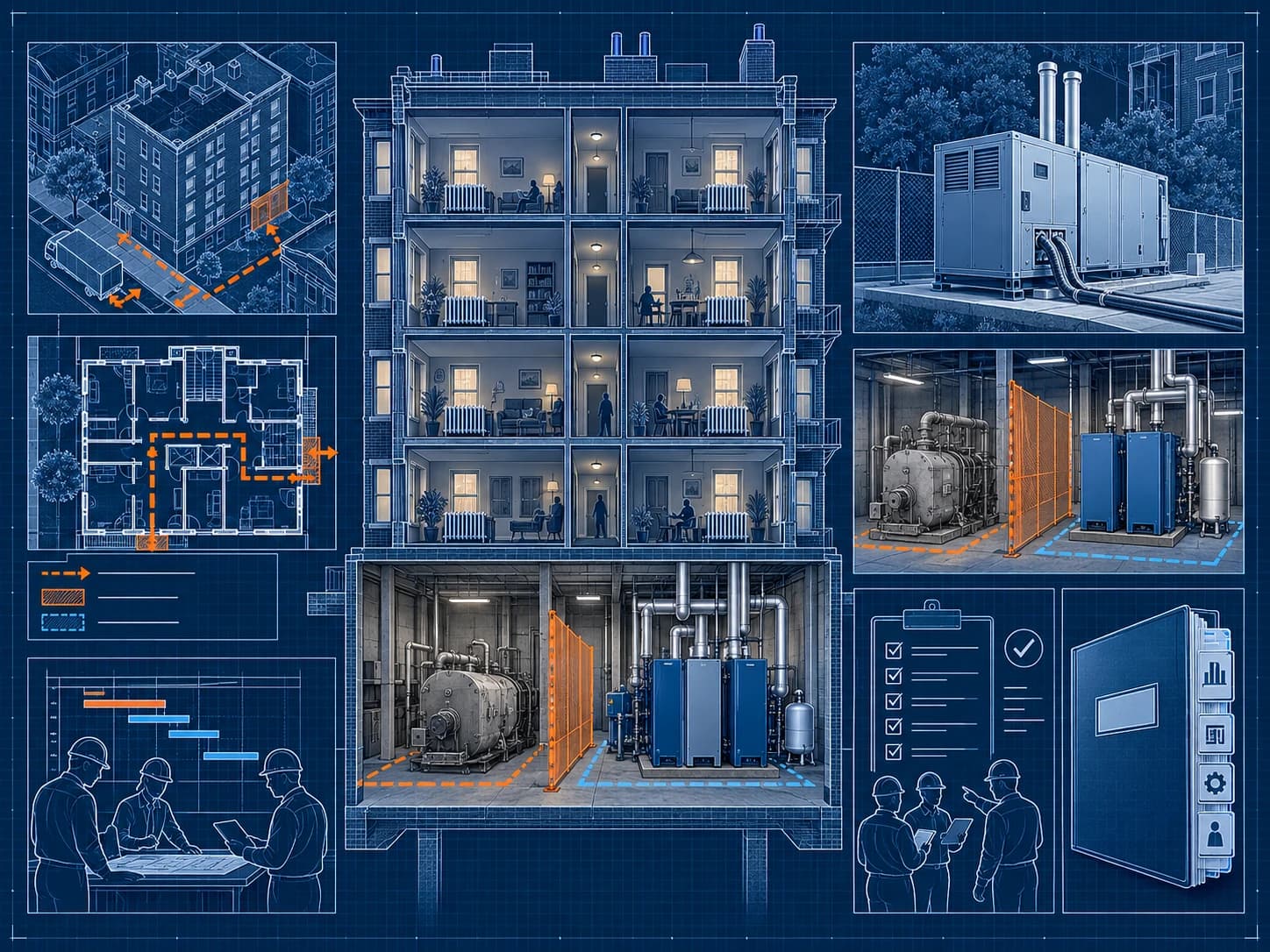
Replacing a heating plant in an occupied NYC building starts with a service-continuity plan. Before equipment is removed, the owner and project team need to agree on what will remain operating, which services may be interrupted, who coordinates access, and what evidence permits each stage to proceed. A delivery date or installation schedule alone does not answer those questions.
The useful owner document is a phase-by-phase plan with named responsibilities, readiness checks, and a response if a stage cannot proceed. The design and installation details belong to the qualified project team; this guide helps an owner ask for a complete plan without prescribing a universal construction sequence.
Define the services the project must protect
List space heating and domestic hot water separately. Record which equipment serves each, which areas share it, and which assumptions still need a site survey. A proposal that says “replace the boiler” may leave the hot-water dependency unclear.
NYC HPD's heat and hot-water guidance requires year-round hot water and heat during the October 1–May 31 season under specified temperature conditions. Plan the project around those obligations; do not treat planned construction as permission to leave occupied areas without required services.
An off-season project still needs a domestic-hot-water plan. A multi-boiler plant still needs a professional assessment of whether the remaining equipment and shared systems can support the proposed stage. Neither calendar timing nor boiler count proves continuity.
Separate the capital decision from the construction plan
Use the heating-plant capital-planning guide to compare options, scope, and budget. This guide begins when the team must turn the selected scope into a workable occupied-building sequence.
Ask for a plan that identifies the equipment and shared systems affected at each stage. It should distinguish work that can happen while existing service remains available from work that requires a controlled interruption. Have the project team explain the basis for that distinction rather than accepting a generic promise of “no downtime.”
For the permit, testing, and turnover record sequence, use the NYC boiler replacement guide. Keep those records connected to the construction schedule without treating one inspection as proof that every project obligation is complete.
Compare the proposed phasing options
Austin's heating-plant service page describes staged work, temporary boiler arrangements, and off-season planning as possible approaches. They are options to assess, not interchangeable promises.
| Proposed approach | Questions for the project team |
|---|---|
| Staged equipment replacement | What remains operating? Which shared piping, controls, electrical supplies, or other systems could still interrupt service? |
| Temporary service | What services and loads does it cover? Who designs, approves, installs, operates, monitors, and removes it? |
| Off-season work | How is hot water maintained? What happens if weather or delivery conditions change? |
| A defined interruption | What must be ready before it starts? Who authorizes it, communicates it, and handles an overrun? |
Request the assumptions and exclusions in writing. A rental-equipment allowance is not a complete temporary-service plan. The team must resolve the actual site's equipment location, access, utility interfaces, required approvals, operating responsibilities, and removal scope.
Do not improvise temporary heating or connect rental equipment from an online diagram. Have the responsible professionals determine the lawful and safe arrangement for the building. The illustration above is conceptual, not an installation design.
Make readiness checks part of the schedule
A useful schedule shows decisions and evidence as well as dates. Adapt this owner checklist with the project team:
- Before procurement: confirm the agreed design basis, equipment scope, interfaces, and items still awaiting approval.
- Before mobilization: confirm delivery and removal routes, work areas, access coordination, and the plan for occupied areas.
- Before an interruption: confirm required equipment, personnel, approvals, communications, and contingency arrangements are ready.
- Before changing service arrangements: require the responsible professionals to document the applicable checks and authorize the transition.
- Before accepting handover: collect operating information, test and inspection records, training arrangements, and a list of unresolved items with owners.
These are planning questions, not a substitute for required inspections or a technical startup procedure. Ask who has authority to stop or postpone a stage if its prerequisites are missing. Avoid relying on an assumed inspection appointment or unconfirmed delivery when communicating a firm interruption window.
Give occupants one clear communication route
The managing agent should identify who issues updates, receives access responses, and handles service complaints. Keep contractors' work coordination and resident communication connected so occupants do not receive conflicting instructions.
An owner communication plan can record:
- The areas and services expected to be affected, with uncertainty stated plainly.
- The access needed and how occupants arrange it with management.
- The current work window and how changes will be communicated.
- A building contact for service problems during the work.
- Any assistance requests that management needs to coordinate privately.
Use building-specific notice and access requirements supplied by the responsible management and professional team. This guide does not set a universal notice period or authorize entry into an apartment. Keep personal circumstances and apartment contact details out of public project updates.
Prepare for a stage that cannot finish as planned
Ask the team to identify its response to delayed equipment, unavailable access, failed checks, unexpected existing conditions, or a change in weather. The plan should name the decision-maker, the condition that triggers escalation, and the practical next action.
A contingency may be postponing a planned interruption until prerequisites are met. In other circumstances, a professionally designed alternative may be necessary. Do not assume the old equipment can be returned to service after removal or that temporary equipment can be supplied immediately.
During the work, keep one issue log: reported condition, time, affected area, responsible person, action, and confirmation of resolution. Monitoring and complaint handling help the team respond; they do not replace the duty to provide required service.
Verify the result beyond the boiler room
Ask how the team will establish that the completed work serves the intended occupied areas and how unresolved complaints will be investigated. A boiler producing heat is not, by itself, evidence that every apartment receives the intended service.
The handover file should identify the installed equipment, applicable inspection and test records, operating instructions, warranties, maintenance responsibilities, and outstanding exceptions. Have the professionals explain what is ready for operation and what remains subject to separate confirmation.
If a project changes gas work or utility interfaces, coordinate that scope through the responsible team and Austin's gas-piping services. If emissions planning affects equipment selection, resolve it through the building's Local Law 97 review; do not infer compliance from a replacement alone.
Start with the building's constraints
Bring the equipment inventory, existing service records, known access limitations, and the proposed project scope to the first discussion. Request a heating-plant project review so the phasing plan can be developed around the actual building, its occupants, and the services that must be maintained.
Common Questions
Can a boiler be replaced while a building remains occupied?
A project may be planned around occupied areas, but the actual service-continuity and construction sequence must be assessed for the building. Do not assume staged equipment or temporary service is feasible without professional review.
Does off-season work eliminate the need for a service plan?
No. Domestic hot water, access, shared systems, and changing project conditions still need to be addressed. The project team should state what remains operating during each stage.
Does renting a temporary boiler complete the contingency plan?
No. The team must resolve scope, location, interfaces, required approvals, operation, monitoring, and removal for the actual property.
What should owners receive at handover?
Collect equipment and operating information, applicable test and inspection records, warranties, maintenance responsibilities, and an exceptions list identifying unfinished work and its responsible parties.