
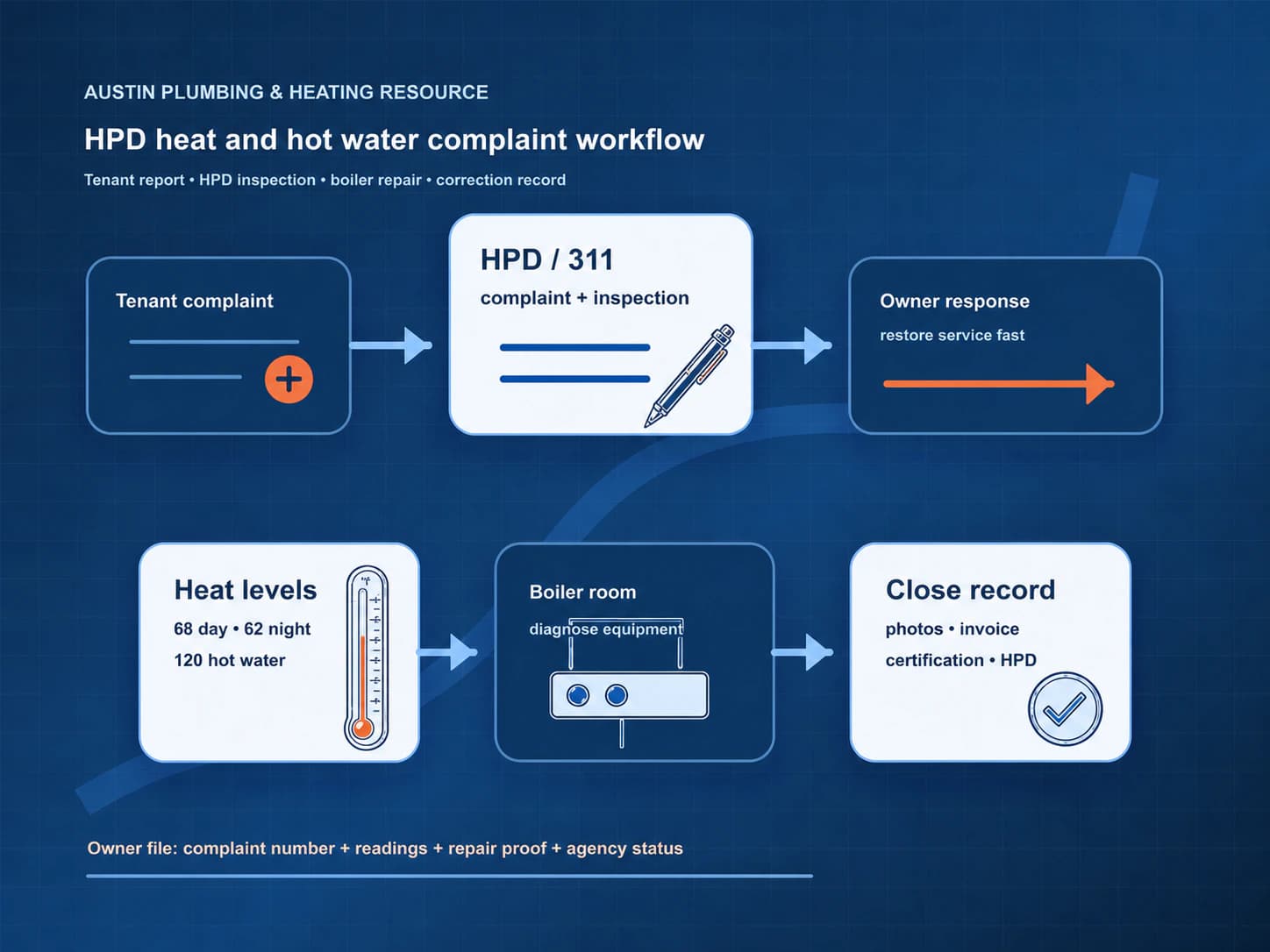
An HPD heat or hot water complaint should trigger two tracks at once: restore the tenant service immediately, then build the repair and agency record needed to show what was corrected. Owners and managers should confirm the affected apartments, dispatch qualified service, preserve readings and repair evidence, and check whether the complaint exposed a broader boiler, DOB, utility, or filing issue.
Key takeaways
- HPD heat and hot water complaints are owner-response events first, paperwork events second.
- Confirm the tenant condition, restore service, document readings, and preserve repair records before debating the violation record.
- A recurring heat or hot water complaint often points to a boiler, domestic hot water, control, gas, or filing issue that should be reviewed before heating season pressure builds.
What should an owner do first after an HPD heat complaint?
Respond as if the complaint could become an immediately hazardous record. HPD says tenants should contact the landlord first, then file with 311 if the landlord is unresponsive; after a heat or hot water complaint is filed, HPD attempts owner contact, may contact the tenant, and may inspect if service is not restored or the tenant cannot be reached (NYC HPD, Heat and Hot Water Information, retrieved 2026-07-12).
The first owner move is not to argue with the complaint. Confirm the apartment, line, boiler, or building condition. Call the super, check the boiler room, and get a qualified heating contractor or Licensed Master Plumber on site when the condition affects a boiler, gas-fired equipment, domestic hot water, or distribution piping.
Document what you find in plain language: time of tenant report, apartment affected, inside temperature if available, hot water temperature if tested, boiler status, service call time, repair notes, photos, and tenant communication. That record matters if HPD inspects, if the condition repeats, or if a later buyer, lender, or agency reviewer asks why heat complaints kept appearing.
For active no-heat or no-hot-water conditions tied to boiler operation, Austin's boiler repair service is the service lane. If the complaint also exposes open boiler filing, DOB, or HPD records, the issue may need compliance handling through annual boiler inspection and DOB filing or broader violation review.
What heat and hot water levels does HPD use?
HPD and 311 publish the same core thresholds: heat season runs from October 1 through May 31; between 6:00 AM and 10:00 PM, inside temperature must be at least 68 degrees Fahrenheit when outside temperature falls below 55 degrees; between 10:00 PM and 6:00 AM, inside temperature must be at least 62 degrees regardless of outside temperature. Hot water must be provided year-round at a constant minimum temperature of 120 degrees Fahrenheit (NYC 311, Heat or Hot Water Complaint in a Residential Building, retrieved 2026-07-12).
For owners and managers, those numbers are the inspection frame. They do not tell you why the building failed. A below-threshold apartment could be caused by a boiler shutdown, bad aquastat, failed circulator, steam balancing issue, closed valve, domestic hot water mixing problem, gas interruption, or tenant-space access problem.
Use the HPD thresholds to decide urgency, then use a building-system check to decide scope. A one-apartment radiator issue is different from a building-wide boiler failure. A no-hot-water condition in one line is different from a failed domestic hot water system serving every apartment. Use the multifamily hot-water complaint triage to separate heater output, mixing control, recirculation, and apartment-level faults before authorizing plant work.
| Condition reported | First field check | Record risk to watch |
|---|---|---|
| No heat in one apartment | Radiator, valve, riser, thermostat, access | HPD complaint if tenant calls 311 |
| Building-wide no heat | Boiler, controls, fuel supply, pumps, pressure | HPD violation, ERP risk, possible DOB/utility issue |
| No hot water | Domestic hot water equipment, mixing valve, recirculation | HPD hot water violation and tenant follow-up |
| Repeated heat complaints | Prior HPD records, boiler service history, annual filing status | Pattern evidence, litigation tab, compliance review |
The practical question is simple: is this an isolated service call, or is the building showing a system pattern? The NYC property manager plumbing compliance calendar treats heat-season readiness as a standing management task because repeated fall and winter complaints usually start months earlier.
For a steam building, the room-by-room uneven-heat diagnostic map turns one comparable heating cycle into a radiator, riser, main-side, or whole-building service handoff without guessing which component failed.
How does HPD decide whether to issue a violation?
HPD says it may issue a violation after inspection when the measured condition falls below the required heat threshold for the inspection period. For daytime heat, HPD describes the trigger as an inspection between 6:00 AM and 10:00 PM, outside temperature below 55 degrees, and indoor temperature below 68 degrees. Overnight, HPD describes the trigger as an inspection between 10:00 PM and 6:00 AM with indoor temperature below 62 degrees (NYC HPD, Heat and Hot Water Information, retrieved 2026-07-12).
That inspection sequence matters because an owner may receive a tenant complaint before an HPD violation exists. Do not wait for the violation to post. If HPD reaches the tenant and the tenant says the condition still exists, an inspection can follow without the owner knowing the inspection date.
HPD's general maintenance complaint guidance also says inspectors are not limited to the condition that triggered the complaint. During an inspection, HPD may check for issues such as smoke detectors, carbon monoxide detectors, window guards, self-closing doors, mold, pests, fire escape window obstructions, and related housing-quality conditions (NYC HPD, Report a Quality or Safety Issue, retrieved 2026-07-12).
That is why property managers should send someone who can see the whole condition, not just reset a control. If the boiler is short-cycling, the hallway smells of gas, the domestic hot water is unstable, or the prior annual boiler filing is missing, the complaint is pointing at more than comfort.
What records should property managers collect?
Collect the records that connect tenant service, physical repair, and HPD closeout. HPD says a Service Request number is issued after a complaint, and complaint status can be checked through 311 tools or HPD Online (NYC HPD, Report a Quality or Safety Issue, retrieved 2026-07-12). HPD also says HPD Online can be used to check open heat and hot water violations and litigation related to lack of heat and hot water (NYC HPD, Heat and Hot Water Information, retrieved 2026-07-12).
The file should include:
- Tenant complaint date, apartment, and contact history.
- 311 Service Request number and HPD complaint or violation number if posted.
- Temperature readings, hot water readings, and who took them.
- Boiler or domestic hot water diagnosis.
- Work order, invoice, parts replaced, and service completion time.
- Photos or technician notes showing the corrected condition.
- Any HPD certification, dismissal, reinspection, or litigation notes.
- Related DOB, utility, or annual boiler filing records if the equipment issue points there.
This is the same record discipline Austin uses for plumbing violation work. A clean HPD file should answer two questions: was the tenant condition fixed, and does the agency record reflect that correction? If the answer to either question is unclear, check the property record before the next cold day.
When does a complaint become a boiler or DOB issue?
A heat complaint becomes a boiler or DOB issue when the field condition involves covered boiler equipment, gas piping, fuel service, unsafe operation, unpermitted work, or annual filing status. HPD handles the tenant heat and hot water obligation. DOB handles many boiler, permit, gas, and equipment records. A single no-heat event can touch both agencies.
Use this split:
| If the problem is... | Start with... | Then check... |
|---|---|---|
| Boiler not firing | Heating service | Annual boiler filing and prior defects |
| Red tag or gas shutoff | Emergency service / LMP | Utility restoration and DOB permit path |
| Failed safety control | Boiler repair | Whether DOB filing or inspection records are affected |
| Repeated HPD complaints | Property-manager record review | HPD Online, boiler records, and service history |
| Tenant-space radiator issue | Super / heating technician | Access records and repeated apartment complaints |
If the boiler was shut down or tagged unsafe, use Austin's boiler red tag guide before treating the complaint as only an HPD paperwork issue. If the annual filing is missing, late, rejected, or defect-related, the NYC annual boiler filing guide explains the DOB side of the problem.
When multiple agencies appear in the same file, Austin's HPD vs. DOB plumbing violations guide is the useful next read. The owner needs one correction plan, but the records may close in different systems.
What happens if the owner does not fix it quickly?
HPD classifies heat and hot water violations as immediately hazardous Class C conditions. HPD's maintenance complaint guidance lists Class C heat or hot water as requiring immediate correction, while other Class C conditions have their own timeframes (NYC HPD, Report a Quality or Safety Issue, retrieved 2026-07-12).
HPD may start a court proceeding related to heat or hot water violations. HPD's current heat and hot water page says the agency can seek civil penalties from the posting date of the Notice of Violation until correction: $250 to $500 per day for each initial heat or hot water violation, and $500 to $1,000 per day for each subsequent violation at the same building during the stated repeat period (NYC HPD, Heat and Hot Water Information, retrieved 2026-07-12).
HPD also describes an inspection fee for repeat inspections: a $200 fee for all inspections after the first two that result in a heat violation within the same heat season, or a hot water violation within a calendar year (NYC HPD, Heat and Hot Water Information, retrieved 2026-07-12).
Those are agency penalties and fees, not the repair cost. If the condition is not corrected timely, HPD says its Emergency Repair Program may correct immediately hazardous violations, and HPD repair charges are billed through the Department of Finance; unpaid charges can become a tax lien against the property (NYC HPD, Emergency Repair Program, retrieved 2026-07-12).
The owner takeaway: do not let a repairable heating condition become an HPD enforcement file. Move quickly, keep the documentation, and confirm the record.
How should managers prevent repeat heat complaints?
Repeat complaints usually mean the building needs a pre-season system review, not just faster callbacks. Start in summer or early fall: test the boiler, verify controls, check domestic hot water performance, review prior HPD complaint history, confirm annual boiler filing status, and identify apartments or risers with repeated heat complaints. Use the NYC heat-season boiler-room preflight to turn that review into an assigned access, equipment, controls, complaint, and records checklist.
For buildings with older steam or hot water systems, the complaint pattern is often more useful than one snapshot. Is the same apartment cold every year? Does hot water fail during peak demand? Does the boiler trip after a utility or gas event? Does HPD Online show complaints that never turned into violations but still reveal tenant friction?
Austin's compliance posture is to connect service work to records. If a building needs boiler repair, schedule it through boiler repair service. If the same building has DOB or HPD records that require a separate agency response, send those records through DOB and HPD violation review so the paperwork path is not left behind after the equipment starts working.
This matters most in large multifamily buildings and older heating stock across the Bronx, Brooklyn, Queens, and Manhattan. The physical systems are different, but the management question is the same: can you prove the owner responded, fixed the condition, and closed the record?
Owner checklist after a heat or hot water complaint
- Contact the tenant, super, and managing agent immediately.
- Confirm whether the issue is one apartment, one line, or building-wide.
- Record heat or hot water readings when available.
- Dispatch qualified heating service or a Licensed Master Plumber for boiler, gas, or domestic hot water conditions.
- Save the 311 Service Request number and check HPD Online for complaint, violation, and litigation status.
- Keep photos, work orders, invoices, and repair notes in the same file.
- Certify or respond to any HPD Notice of Violation only after the condition is properly corrected.
- Check whether the same event triggered DOB, utility, or boiler-filing work.
- Add the building to a pre-season heat and hot water review list if complaints repeat.
When to call Austin
Call Austin Plumbing & Heating when an HPD heat or hot water complaint points to the boiler room, gas service, domestic hot water equipment, recurring tenant complaints, or an open agency record. We can handle the service side and the compliance side together: diagnose the system, correct the heating or hot water condition, review DOB or HPD records, and help the owner keep a defensible closeout file.
If the building has no heat, no hot water, a boiler shutdown, gas odor, carbon monoxide concern, or utility red tag, call (718) 835-3555. For non-emergency planning, use Austin's compliance services to review heat-season readiness, annual boiler filing status, and related DOB or HPD records before the next complaint becomes a violation.
Common Questions
Does every 311 heat complaint become an HPD violation?
No. HPD says it first attempts owner and tenant contact and may close the complaint if service is restored. A violation is issued after HPD inspection confirms temperatures below the required threshold for the inspection period.
How fast does an owner need to correct an HPD heat or hot water violation?
HPD classifies heat and hot water as immediately hazardous Class C conditions. The safe owner response is immediate repair, documentation, and certification according to the Notice of Violation rather than waiting for a later paperwork deadline.
Can HPD make the repair and bill the owner?
Yes. HPD says its Emergency Repair Program may correct immediately hazardous conditions when an owner does not timely correct them, and the City bills the premises for repair work plus related charges.
When should a Licensed Master Plumber be involved?
Bring in a Licensed Master Plumber when the complaint points to a boiler, gas, domestic hot water, fuel, venting, or piping condition, or when DOB permits, boiler filings, utility coordination, or violation closeout records may be involved.