
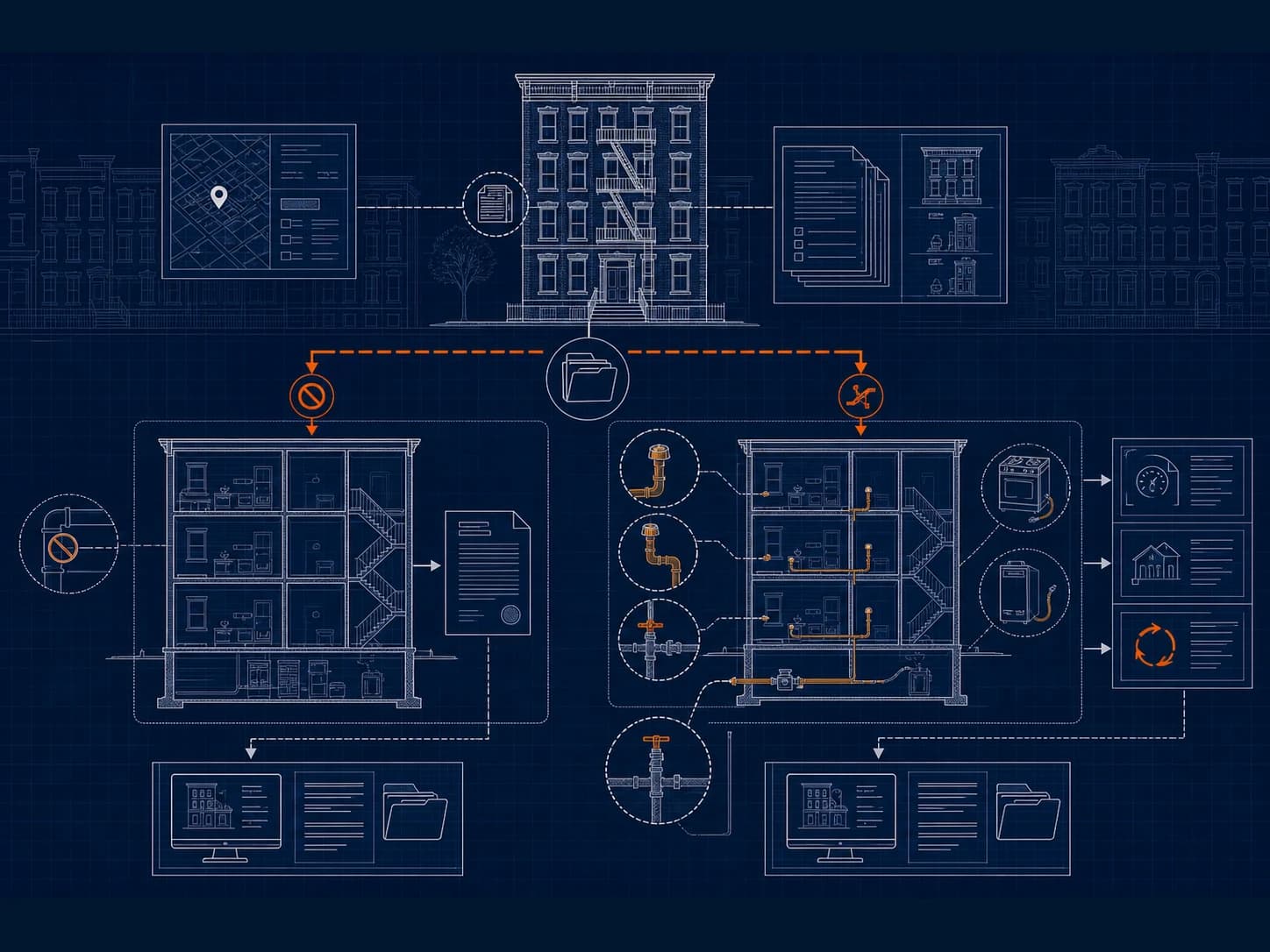
Key takeaways
- No gas piping and no active gas service are different Local Law 152 records. A shutoff, locked meter, inactive account, or removed appliance does not by itself prove the building contains no gas piping.
- The no-piping certification is a one-time path. Under the current rule, a covered building that truly contains no gas piping can submit a certification from an accepted qualified source instead of undergoing the periodic inspection.
- Inactive service is a recurring documentation path. If piping remains, the utility and owner statements required for a fully deactivated building must be submitted in each applicable cycle.
- Start with the building, not the billing account. Confirm property coverage, the physical piping condition, service status, connected appliances, community district, and prior DOB record before choosing a filing path.
A covered NYC building does not leave Local Law 152 simply because nobody receives a gas bill. DOB separates two situations that look similar from the owner's desk but require different evidence:
- the building contains no gas piping system; or
- gas piping remains, but the building is not currently supplied with gas, has been fully deactivated by the utility, and has no appliance connected to the piping.
The distinction matters because the first path uses a one-time no-piping certification. The second avoids the periodic physical inspection only when the owner submits the required inactive-service documentation for that cycle. This guide helps owners, managers, boards, and due-diligence teams assemble the right record without treating a meter condition as proof of the piping condition.
Use the Local Law 152 deadline guide when the open question is the community-district cycle. Use the LL152 gas violation guide when the property already has a missed filing, Notice of Deficiency, unsafe condition, or correction record.
First decide whether the building is covered
No-gas status does not settle applicability. DOB's current periodic gas-piping inspection guidance says Local Law 152 applies to covered buildings based on occupancy and property classification, with exclusions including one- and two-family homes and other buildings classified in Occupancy Group R-3.
Before choosing either no-gas path, collect:
- the building address, borough, block, lot, and BIN;
- the current DOB and Department of Finance classification shown for the property;
- the community district and assigned Local Law 152 cycle;
- the prior LL152 certification, inspection, or deficiency record, if any;
- utility account and service-status records; and
- a building-wide understanding of whether any gas piping or connected gas appliance remains.
Do not decide from unit count alone, a broker statement, a closed account, or the absence of a visible meter. Start with Austin's Local Law 152 address and compliance path, then compare the public record with the field condition.
Use this two-path test
| Property condition | Local Law 152 path | Core evidence | Repetition |
|---|---|---|---|
| The building contains no gas piping system | No-piping certification instead of the periodic inspection | Certification from a source accepted by the current rule and DOB workflow | Once |
| Gas piping remains, but the building is not supplied with gas, is fully deactivated by the utility, and has no appliance connected to the piping | Inactive-service documentation instead of the periodic inspection for that cycle | Utility statement plus owner statement | Each applicable cycle |
| Gas piping remains and service or connected appliances remain active | Standard periodic inspection and certification path | LMP inspection, owner report, and DOB certification record | Each applicable cycle |
| The physical piping or service condition is unclear | Resolve the record and field condition before filing | DOB property record, utility confirmation, and qualified field review | Do not guess |
The test is physical and documentary. “Gas off” belongs in the service-status column. “No gas piping” describes the building itself.
If the building contains no gas piping
The current 1 RCNY §103-10 says the periodic-inspection requirement does not apply when the owner submits a certification that the building contains no gas piping system. The rule identifies a utility company, Registered Design Professional, Licensed Master Plumber, or an individual working under the direct and continuing supervision of an LMP as possible certification sources under the rule's qualifications.
DOB's April 2026 Follow-up #7 highlights two important changes: the no-piping certification is required only once, rather than every four-year cycle, and the certification can now come from a utility company.
That does not make the filing self-certified by the owner. The record must state that the building contains no gas piping, and the submission must follow DOB's current form and signer requirements. The owner should keep:
- the accepted no-piping certification and DOB confirmation;
- the source professional or utility record behind it;
- any permits, sign-offs, or utility documents from prior gas-piping removal work;
- photographs or plans that help reconcile the certification with the building condition; and
- the date and property identifiers attached to the accepted record.
The filing is one-time under the current rule, but the conclusion can become stale if gas piping is later installed or the building record changes. Future renovation and service planning should start from the actual current condition, not the existence of an old certification alone.
If gas piping remains but service is inactive
The inactive-service path is narrower than “the meter is off.” Under NYC Administrative Code §28-318.3.5, all three conditions must align:
- the building is not currently supplied with gas;
- the utility fully deactivated service; and
- no appliance is connected to any gas piping.
The owner then submits two signed statements to DOB:
- Utility statement. It must certify that the building no longer receives gas service, give the last date gas was supplied, certify that the building was fully deactivated from utility service, and give the deactivation date.
- Owner statement. It must certify that the building no longer receives gas service and that no appliances remain connected to the gas piping.
DOB's April 2026 update says the utility statement for this path is required every cycle. That is the central difference from a true no-piping certification, which is submitted once.
If a boiler, water heater, range, laundry appliance, rooftop unit, tenant appliance, or other equipment remains connected, the building does not match the inactive-service condition described by the code. Likewise, a utility lock or account closure without the required full-deactivation statement is not the complete documentation package.
Why a shutoff or removed meter is not enough
Gas service can be inactive for several reasons: an unsafe condition, tenant vacancy, account closure, planned conversion, utility construction, a building-wide repair, or long-term deactivation. Those events do not prove that the gas piping has been removed from the point of entry, cellar, risers, branches, public areas, mechanical spaces, or tenant connections.
Ask five separate questions:
- Does the building contain any gas piping?
- Is the utility still capable of supplying the building without additional restoration work?
- Has the utility documented full deactivation and the relevant dates?
- Is any appliance still physically connected to gas piping, even if it is not operating?
- What did DOB accept for the current or prior LL152 cycle?
If service was shut off because of a safety condition, this guide does not replace the correction and restoration path. Follow the utility notice first, then use Austin's gas shutoff owner guide and licensed gas-piping service for the field, permit, testing, authorization, and utility handoffs that actually apply.
Build one defensible owner file
The best file lets another owner, manager, LMP, design professional, utility representative, or DOB reviewer understand why the selected path applies without reconstructing the history from email fragments.
Include:
- property identifiers and the assigned LL152 cycle;
- the current occupancy/property classification evidence;
- prior LL152 inspection, certification, extension, correction, or deficiency records;
- current utility account, shutoff, removal, or deactivation documentation;
- the utility statement and owner statement for an inactive-service cycle;
- the accepted no-piping certification when that is the correct path;
- relevant gas-removal permits, inspections, and sign-offs;
- a list of former and remaining gas appliances; and
- the DOB NOW submission confirmation and current public-record status.
Keep “document requested,” “document received,” “submitted,” and “accepted” as different statuses. A utility letter in the manager's inbox is not the same as an accepted DOB record.
File through the current DOB NOW path
DOB's July 2026 Follow-up #8 moved Local Law 152 certifications and related transactions to DOB NOW: Safety beginning July 27, 2026. The legacy online portal is retired for new submissions.
For a clean handoff, record:
- the filing type selected in DOB NOW: Safety;
- who prepared and signed each supporting document;
- the submission date and confirmation number;
- any fee or correction request shown in the live filing; and
- the final accepted status in DOB NOW and the public property record.
The older DOB landing page and FAQ still contain some references to the legacy portal and earlier certifier wording. Where they differ, use the current rule and DOB's newer Follow-up #7 and #8 instructions, then confirm the live DOB NOW transaction before relying on a filing package.
If the owner may restore gas later
Inactive-service documentation is not permission to reopen the gas system. The administrative code and DOB guidance treat resumption of service as a separate path. The owner may need a Licensed Master Plumber, permits, inspections, gas authorization, utility documentation, access, and field acceptance based on the actual building and scope.
Before planning reconnection, assemble the prior deactivation file, current piping condition, connected-load and appliance plan, open DOB records, serving-utility case, and intended project scope. Do not promise a restoration date from the LL152 filing alone; DOB compliance and utility turn-on answer different questions.
Where Austin fits
Austin Plumbing & Heating can help an owner determine which record is actually being described: no gas piping, inactive service with piping remaining, a standard LL152 inspection, or a separate safety and restoration case.
Start with a Local Law 152 compliance review when the property classification, community-district cycle, piping condition, utility documentation, or prior filing does not line up. Austin can review the available records, inspect the building condition where licensed field review is needed, and separate the LL152 submission from any gas-piping work or utility-restoration project that must be scoped independently.
Common Questions
Is a building with a locked gas meter considered to have no gas piping?
Not automatically. A locked meter or inactive account describes service status. The no-piping path is for a building that contains no gas piping system; if piping remains, the owner must evaluate the separate inactive-service requirements.
How often is a no-gas-piping certification submitted under Local Law 152?
DOB's April 2026 update and the current rule say a certification that the building contains no gas piping is submitted once. The property should still be checked before relying on an old record, especially after construction or ownership changes.
What does DOB require when gas piping remains but service is inactive?
The current rule requires a utility statement confirming the last supply date and full deactivation date, plus an owner statement confirming no current gas service and no appliances connected to gas piping. DOB says this documentation is required each applicable cycle.
Where are Local Law 152 submissions made now?
DOB moved Local Law 152 certifications and related transactions to DOB NOW: Safety on July 27, 2026. Owners should use the current DOB NOW workflow rather than the retired legacy portal.