Key takeaways
- Confirm whether the building is covered and which community-district cycle applies.
- Treat unsafe conditions, corrective work, and the DOB certification as connected but distinct steps.
- Keep the inspection report, accepted DOB NOW certification, permits, correction records, and utility documents together.
This guide separates the Local Law 152 inspection record from the different permit, safety, and utility steps that may apply when an inspection finds a problem.
Owners often encounter gas issues through different records: a missed Local Law 152 certification, an unsafe condition reported during an inspection, a utility notice, or unpermitted work discovered through a separate DOB inspection. Those records do not all create the same correction path.
Local Law 152 requires periodic inspections of exposed building gas piping in covered properties. The owner must still determine whether the issue is an inspection/certification deficiency, an immediately hazardous condition, a permitted repair, or a utility-controlled restoration.
This guide explains how those paths connect and where they remain separate. The exact document package depends on the building record and the serving utility.
What Is Local Law 152?
Local Law 152 of 2016 requires periodic inspections of gas piping systems in covered NYC buildings. DOB's current guidance excludes one- and two-family homes and other buildings classified in Occupancy Group R-3, and it lists property-classification codes owners can use to verify coverage.
At least once every four years, on a cycle determined by community district, an LMP or qualified individual working under an LMP inspects exposed gas piping from the point of entry through the areas included by the rule. DOB's LL152 FAQs make clear that the visual inspection and leak survey stop at tenant spaces; appliances and piping inside tenant spaces are not part of this periodic-inspection scope. The LMP gives the owner the inspection report within 30 days, and the owner submits the LMP-backed certification to DOB within 60 days.
DOB's Follow-up #8 moves initial certifications, correction certifications, extension requests, inspection notifications, and related LL152 transactions to DOB NOW: Safety on July 27, 2026. The old portal closes after July 24, no submissions can be made July 25 or 26, and a paper GPS2 is no longer required for new submissions after the cutover.
Who Must Comply
Coverage is based on the building's occupancy/property classification, not simply a three-unit threshold or the presence of active gas service. Check DOB's current applicability list and the property classification before deciding that a building is covered or exempt.
A covered building with no gas piping follows a different certification path from a building where piping remains but utility service is fully inactive. The no gas service versus no gas piping guide explains the one-time and recurring documentation records before either condition becomes a missed-filing problem.
The Four-Year Cycle
Buildings are grouped by community district, with staggered deadlines. The current cycle requires compliance by December 31 of the year assigned to your district. For example, buildings in Community Districts 2, 5, 7, 13, and 18 had a December 31, 2025 deadline, while Community Districts 4, 6, 8, 9, and 16 must comply by December 31, 2026.
If you do not know the community district, use the NYC Department of City Planning address lookup and then match the district to DOB's current schedule.
How Gas Violations Happen
Gas violations in NYC don't come from a single source. They arrive through several different paths, each with its own urgency level and consequences.
Path 1: Missed Local Law 152 Filing Deadline
When a covered building reaches the end of its assigned cycle without an accepted certification, DOB can issue a Notice of Deficiency and assess the remedies described in its current gas-piping inspection guidance. Use the building’s DOB NOW record and the current rule—not an estimated fine table—to determine what is outstanding.
Path 2: Conditions Found During Inspection
The periodic inspection can identify corrosion, illegal connections, non-code-compliant conditions, or a gas leak. The LMP records the inspection result and follows the immediate-notification rules when an unsafe or hazardous condition is found.
- Unsafe or hazardous conditions require immediate notification to the owner, serving utility, and DOB, plus immediate corrective action under the applicable code and permit requirements.
- The owner still submits the initial certification within 60 days of inspection.
- When the initial certification identifies conditions requiring correction, DOB requires a correction certification within 120 days of inspection—or within 180 days when the initial certification states that additional time is needed.
Path 3: Utility-Initiated Shutoff
Con Edison and National Grid have their own inspection protocols. A utility technician may discover a gas leak, illegal tap, or unsafe condition during a routine meter read, service call, or leak survey.
- The utility has the authority and obligation to shut off gas service immediately when an unsafe condition is found.
- The utility notice and the condition that caused the shutoff determine the DOB notification, permit, and restoration path.
Path 4: Complaint-Driven Inspections
A tenant smells gas, a neighbor reports construction activity, or someone files a 311 complaint. DOB or FDNY sends an inspector, and the inspection reveals unpermitted gas work, an illegal appliance hookup, or piping that doesn't meet code.
- The result can be a DOB violation and potentially a utility shutoff.
- Complaint-driven inspections often move quickly because gas conditions are treated as safety issues.
Path 5: Unpermitted Gas Work
Gas piping alteration and repair can require DOB permit and inspection work under a Licensed Master Plumber, but the filing path depends on the exact condition and scope. Do not infer the permit from the LL152 finding alone; compare the GPS1, field condition, and current DOB permit rules.
- Work that required a permit but was performed without one can create a separate DOB enforcement and legalization problem.
- Unlicensed gas work is a safety and filing issue independent of whether a periodic LL152 inspection is due.
Why Utilities Shut Off Gas - and What Happens Next
When Con Edison or National Grid shuts off gas to your building, it's not punitive - it's a safety measure. The utility is legally obligated to cut service when it identifies a condition that poses a risk of gas leak, explosion, or carbon monoxide exposure.
Common Shutoff Triggers
Common triggers include active gas leaks detected during a survey or service call, illegally installed or modified gas piping, failed pressure tests, appliances vented improperly or connected without permits, and building-wide piping deterioration discovered during infrastructure work.
The Cascade Effect
A shutoff can affect cooking, heat, or hot water depending on what service was isolated. If required heat or hot water is interrupted, HPD obligations may arise separately. A utility shutoff does not by itself prove that DOB opened a particular case; confirm the utility notice and the DOB property record.
The Gas Restoration Process: Step by Step
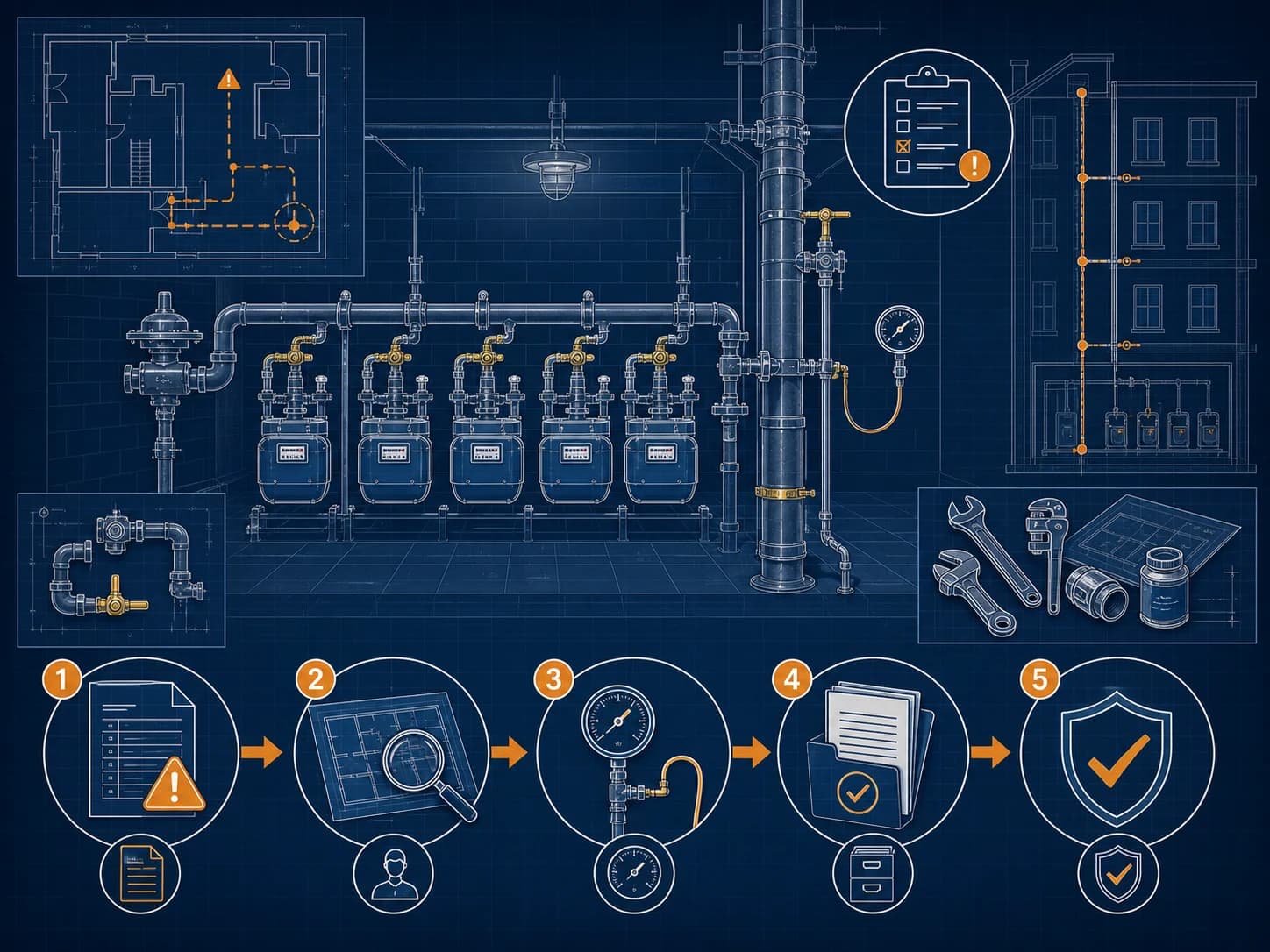
Gas restoration is controlled by the serving utility and varies with the condition, shutoff scope, and DOB record. Start with Austin's licensed gas piping service and the utility notice; do not treat the sequence below as universal.
- Hire a Licensed Master Plumber. The LMP reviews the utility notice, field condition, and building record to identify the required filing path.
- Determine whether DOB filing is required. An emergency notice, plumbing permit, gas authorization request, or other filing may apply depending on the work and record.
- Match the filing scope to the actual correction. The permit and inspection records must describe the work performed.
- Perform the corrective work. The LMP repairs or replaces defective piping, corrects illegal connections, installs proper supports and valves, and brings the work into compliance with the NYC Fuel Gas Code.
- Complete required testing and inspections. Pressure testing, DOB inspection, or other verification applies when required by the filed scope and utility process; it is not created automatically by every LL152 correction.
- Obtain the applicable DOB acceptance or gas authorization. The required record depends on the permit and inspection path.
- Follow the utility's reconnection process. Only the serving utility authorizes restoration after its required documents and field conditions are satisfied.
The Documentation That Matters
Gas restoration depends on a consistent documentation trail. The exact package varies, but owners should expect the LMP to reconcile records such as:
| Record | Why it matters |
|---|---|
| Utility shutoff or warning notice | Identifies the condition and the utility’s restoration requirements. |
| DOB emergency notice or plumbing permit | Authorizes and defines the corrective work when required. |
| Inspection and pressure-test records | Documents the completed field work and test result. |
| Local Law 152 inspection or correction certification | Applies when the shutoff overlaps with the periodic gas-piping inspection record. |
| Photographs, affidavits, and sign-offs | Connect the cited condition with the completed correction. |
| Utility authorization | Confirms that the serving utility approved reconnection. |
Use DOB NOW and the serving utility’s current instructions for the property-specific submission path.
Timelines: How Long Does Restoration Take?
There is no reliable universal restoration timeline. Duration depends on the unsafe condition, permit scope, access, corrective work, inspection availability, document acceptance, and the utility’s reconnection process. Ask for a milestone plan rather than a promised date: assessment, filing, correction, testing, DOB sign-off where required, and utility authorization.
How to Avoid Gas Violations in the First Place
- Know your cycle. Look up your building's community district and note your LL152 filing deadline.
- Schedule before the end of the cycle. Leave time to address access problems or conditions found during inspection.
- Budget for corrections. An LL152 inspection may reveal conditions that need repair, and planning ahead prevents deadline pressure.
- Keep records. Maintain the inspection report, accepted DOB NOW certification, correction certifications, and any separate permit, test, or utility records that applied to the condition.
- Don't skip the follow-up filing. If the inspection identifies conditions for correction, follow the certification path and timing shown in current DOB guidance.
Related next steps
- Confirm the current cycle in the Local Law 152 deadline guide.
- Check the property’s recorded district and owner route with Austin’s Local Law 152 address lookup.
- If service is already off, use the NYC gas-shutoff response guide.
Common Questions
How often are covered NYC buildings inspected under Local Law 152?
DOB assigns covered buildings to recurring four-year inspection cycles based on community district. Owners should confirm the current cycle on DOB’s official gas-piping inspection page.
What happens when an LL152 inspection finds an unsafe condition?
The inspecting Licensed Master Plumber follows the required safety-notification path, and the owner must address the unsafe condition before treating the inspection and certification process as complete.
Is the inspection report the same as the owner certification?
No. The inspection report delivered to the owner and the certification submitted to DOB are separate records. Beginning July 27, 2026, the certification is submitted in DOB NOW and a paper GPS2 is no longer required for new submissions.