
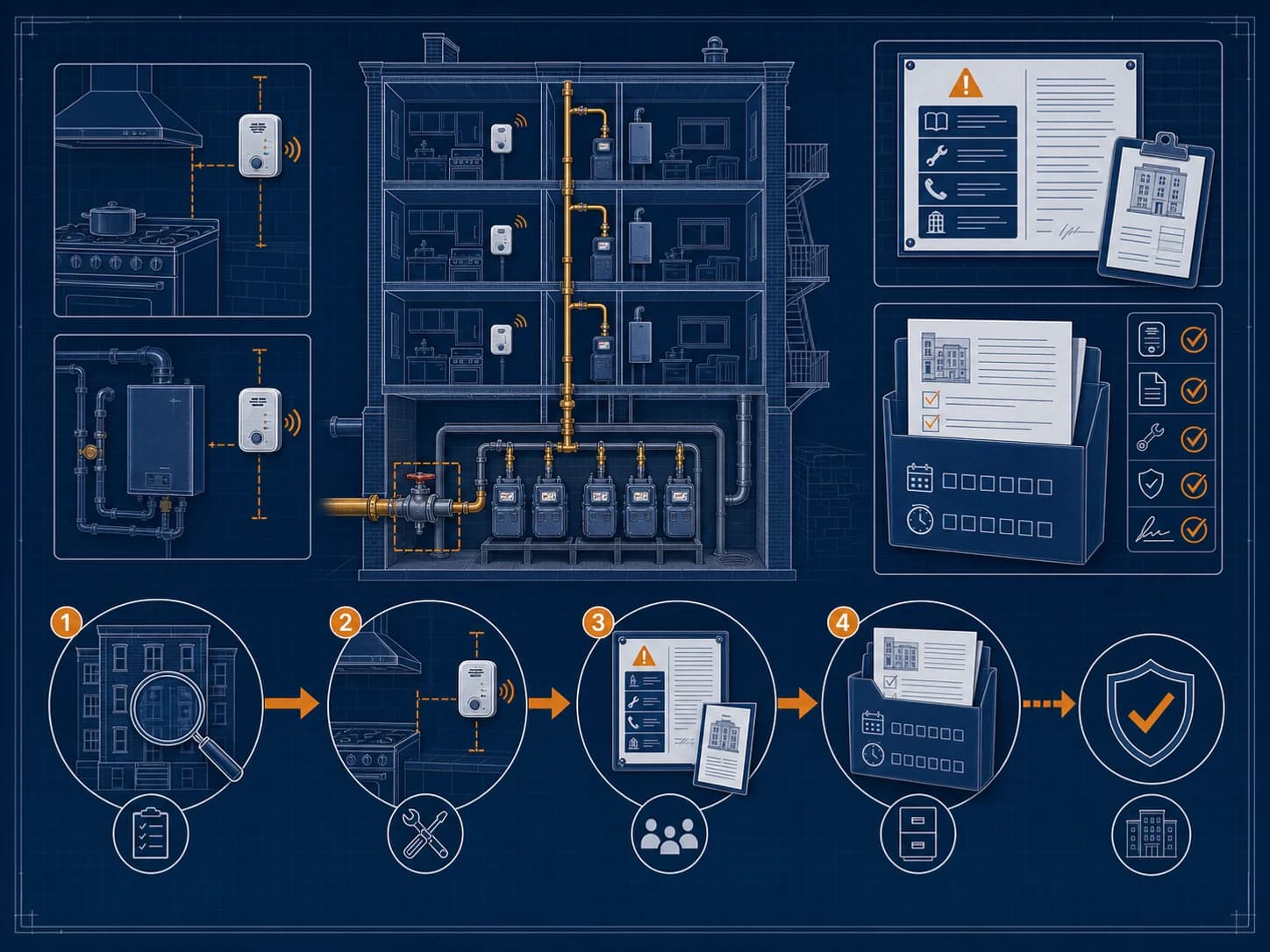
Local Law 157 is a residential gas-safety planning item, not a gas repair shortcut. NYC owners and managers should confirm whether their building is covered, identify where natural gas alarms or a permitted detecting system are required, plan installation before the confirmed January 1, 2027 deadline, give the required occupant notices, and keep the records with the building compliance file. HPD has now adopted the final owner-responsibility, notice, recordkeeping, and exemption rules that take effect with that deadline.
Key takeaways
- DOB's current service notice confirms natural gas alarms must be installed on or before January 1, 2027 and says the deadline will not be extended to 2029.
- The requirement is separate from Local Law 152 gas piping inspections; a building can need both planning tracks.
- HPD's final rules now define owner replacement duties, common-area notices, occupant information, recordkeeping, and a no-gas-piping exemption path.
- If a gas alarm sounds or occupants smell gas, follow emergency instructions first: leave the area, avoid switches or phones inside the affected space, and call 911 or the serving utility from a safe location.
What does Local Law 157 require NYC owners to plan for?
Local Law 157 requires covered residential owners to provide natural gas detecting devices or an approved natural gas detecting system where the law and rules apply. DOB's June 15, 2026 service notice confirms that alarms must be provided and installed on or before January 1, 2027. It also says DOB identified at least four distinct manufacturers of battery-powered alarms, so the availability-based extension to 2029 will not apply (NYC DOB, Deadline to Install Natural Gas Alarms Service Notice, retrieved 2026-09-02).
The owner task is bigger than buying a device. A practical plan should answer five questions:
- Which parts of the building are covered?
- Which dwelling units or spaces contain fuel-gas-burning appliances?
- What device or detecting-system option applies to the occupancy?
- What notices and occupant instructions have to be provided?
- Where will the owner keep installation, maintenance, useful-life, replacement, and reimbursement records?
For property managers, this belongs in the same compliance file as Local Law 152 gas piping inspections, annual boiler records, HPD detector records, and open violation checks. The devices are different, but the management problem is the same: do not wait until a tenant complaint, sale review, or enforcement notice forces a rushed answer.
Which buildings and occupancies should owners check first?
DOB's natural gas detection FAQ says Local Law 157 of 2016, Local Law 102 of 2025, and the related rule apply to R-1, R-2, and R-3 occupancies under 1 RCNY Section 908-02 (NYC DOB, Natural Gas Detection Devices FAQs, retrieved 2026-09-02). In plain English, owners should first review residential occupancy, dwelling-unit layout, gas appliances, and whether the building is a Class A or Class B multiple dwelling or another covered residential occupancy.
HPD's adopted exemption rule says the natural gas detector duty does not apply to a building without gas piping. It also says an owner seeking that exemption must submit supporting documentation through the electronic portal or paper process HPD makes available. HPD's public detector guidance still says more information about that filing process will be provided later in 2026, so owners should not invent a form or submission route (NYC HPD, Final Natural Gas Detector Rule Amendments, retrieved 2026-09-02; NYC HPD, Detectors, retrieved 2026-09-02).
Do not rely on borough, building age, or a prior smoke-detector checklist alone. A multifamily building with gas stoves, a mixed-use building with apartments above a store, a hotel or Class B multiple dwelling, and a smaller residential property can have different compliance questions.
Use this first-pass screen before ordering devices:
| Building condition | What to verify | Why it matters |
|---|---|---|
| Dwelling units with gas stoves or other fuel-gas appliances | Appliance rooms and required alarm locations | DOB placement rules are tied to fuel-gas-burning appliances in the dwelling |
| Class B multiple dwelling | Whether individual alarms or a line-operated zoned system applies | DOB describes a separate option for certain Class B multiple dwellings |
| Existing building with TCO or CO before January 1, 2027 | Power-source allowance under DOB rules | DOB's FAQ distinguishes buildings completed before and after the deadline |
| Building without obvious in-unit gas appliances | Central equipment rooms, public spaces, and occupancy details | Do not assume the answer before checking the actual occupancy and gas setup |
| Dwelling unit directly above gas piping or a gas appliance | Whether DOB's above-area alarm rule applies | DOB's FAQ says an alarm is required even when that dwelling unit has no gas piping or appliance |
| Building with no gas piping | HPD exemption eligibility and the current filing method | The adopted exemption exists, but HPD has not yet named the public submission route |
If the building has an active gas service issue, do not treat Local Law 157 planning as the emergency response. Start with the gas shutoff owner guide or call for urgent service if gas odor, heat, hot water, or tenant safety is involved.
Where do the alarms go?
DOB's FAQ says that when a fuel-gas-burning appliance is installed within a dwelling, the natural gas alarm must be installed in the same room as the appliance, at least 3 feet but not more than 10 feet from the appliance measured horizontally. HPD's adopted notice adds that the alarm must be on the ceiling or wall no more than 12 inches below the ceiling. Where the space cannot accommodate the 3-foot minimum, or the manufacturer's instructions or NFPA 715-2023 require a different location, the adopted rule directs the installation to follow those controlling instructions (NYC DOB, Natural Gas Detection Devices FAQs, retrieved 2026-09-02; NYC HPD, Final Natural Gas Detector Rule Amendments, retrieved 2026-09-02).
That means the owner should not reduce the requirement to "one detector per apartment" without a room-by-room check. A kitchen with a gas range, a utility room with gas-fired equipment, and a hotel or Class B setup may require different placement or system decisions.
Use a unit survey that records:
- Apartment or space number.
- Gas appliance type and location.
- Proposed alarm location.
- Device model and listing information.
- Installation date.
- Useful-life or replacement date.
- Whether occupant notice was delivered.
- Whether any exception, manufacturer instruction, or NFPA/DOB placement issue affected the final location.
The goal is not to create extra paperwork. It is to make sure that, if a tenant, HPD inspector, buyer, board member, or managing agent asks why a device is where it is, the answer is tied to the rule and the room layout.
Installer responsibility depends on the equipment. DOB says battery-powered or plug-in AC alarms may be installed by the owner, building maintenance staff, an occupant, or another installer. Hard-wired alarms require a New York City licensed electrical contractor and required permits. A Class B line-operated zoned detecting system also requires FDNY plan review and inspection (NYC DOB, Natural Gas Detection Devices FAQs, retrieved 2026-09-02).
Is this the same as Local Law 152?
No. Local Law 157 and Local Law 152 both sit in the gas-safety cluster, but they are different owner obligations.
| Requirement | Primary question | Typical owner file |
|---|---|---|
| Local Law 157 | Are required natural gas alarms or detecting systems installed, noticed, maintained, and replaced? | Device inventory, installation records, notices, useful-life dates |
| Local Law 152 | Has the covered building completed the periodic gas piping inspection and GPS certification cycle? | GPS1, GPS2, deficiency correction, DOB submission, LMP records |
| Gas shutoff response | Has an unsafe gas condition been corrected and utility restoration authorized? | Utility notice, permits, pressure test, DOB signoff, restoration authorization |
The overlap is practical. A property manager reviewing gas safety before a sale, refinance, board meeting, or compliance audit should check all three tracks together. Use Austin's Local Law 152 deadline guide for the inspection-cycle calendar, and use the Local Law 152 gas violation guide when inspection findings or unsafe gas piping conditions already exist.
What notices and occupant records matter?
HPD's final adopted rules require a readily visible common-area notice for Class A multiple dwellings and private dwellings, with an approved natural gas detector notice provided in the rule. A compliant digital sign may be used instead of the physical notice only under the rule's conditions; if it stops working, the owner must immediately display the physical notice. Owners must also give at least one adult occupant of each dwelling unit information about gas-leak risk, testing and maintenance, what to do when an alarm sounds, useful life, and owner and occupant replacement duties (NYC HPD, Final Natural Gas Detector Rule Amendments, retrieved 2026-09-02).
HPD and NYC311 currently describe reimbursement of $25 for each standalone natural gas alarm, $50 for a two-function combined device, or $75 for a combined smoke, carbon monoxide, and natural gas device when the charge applies. Occupants have one year to pay; Class B occupants are not required to reimburse the owner (NYC HPD, Detectors, retrieved 2026-09-02; NYC 311, Natural Gas Detectors, retrieved 2026-09-02).
Owners should keep the reimbursement and notice issue conservative: follow HPD's current notice language, keep copies of delivered notices, and do not rely on informal texts or a super's verbal reminder as the only record. The adopted rule specifically requires the notice-posting date, the manufacturer's suggested useful life, and records showing that the devices comply with applicable laws and rules to remain on the premises or in the owner or managing agent's business office and be available to HPD, DOB, FDNY, or DOHMH on request.
Who should be involved in the work?
Local Law 157 planning can involve several roles. Owners and managing agents coordinate access, notices, device inventory, and records. An electrical contractor may be needed when the selected device or system requires electrical work or permits. A Licensed Master Plumber is not a substitute for DOB's device rules, but the LMP is useful when the alarm plan overlaps with gas piping conditions, Local Law 152 findings, appliance connections, utility shutoffs, boiler rooms, or fuel-gas safety questions.
Bring Austin Plumbing & Heating into the file when the detector plan exposes a building-system question:
- Gas appliances were installed without clear permit history.
- A tenant or super reports gas odor, pilot-light, or appliance-connection issues.
- The building has open DOB, HPD, OATH, or utility gas records.
- The owner is also due for Local Law 152 inspection or correction work.
- A sale, refinance, or board review needs a clean explanation of gas-safety compliance.
For device-only purchasing and posting, use the current DOB and HPD rules. For gas piping, utility, boiler, or DOB filing issues, use Austin's compliance services before the alarm checklist hides a deeper gas-safety problem.
Owner checklist before January 1, 2027
- Confirm the building's occupancy and covered spaces against the current DOB/HPD guidance.
- Survey every dwelling unit or covered space with gas-fired equipment.
- Identify device, placement, power, and system requirements before ordering in bulk.
- Coordinate access with tenants and supers.
- Confirm who may install the selected battery, plug-in, hard-wired, or zoned-system option and which permits or FDNY reviews apply.
- Install the devices or approved detecting system according to DOB rules, manufacturer instructions, and the final HPD placement rule.
- Post the approved common-area notice and deliver the required adult-occupant information.
- Record the notice date, device model and compliance evidence, useful-life date, replacement plan, and any reimbursement record.
- If the building has no gas piping, verify the HPD exemption process before claiming an exemption.
- Add the building to the property manager plumbing compliance calendar.
- Check whether the building also has Local Law 152, gas shutoff, boiler, DOB, HPD, or OATH records that need separate closeout.
When to call Austin
Call Austin Plumbing & Heating when Local Law 157 planning touches gas piping, DOB records, a utility notice, boiler or water-heater equipment, Local Law 152 inspection status, or an owner/buyer review that needs a licensed trade perspective. The alarm requirement is a device-and-notice obligation, but the building conditions around it can expose the same gas-safety records that delay sales, refinancing, tenant operations, and compliance closeout.
If gas odor, a natural gas alarm, or a utility red tag is active now, treat it as an emergency and follow 911 or utility instructions first. For non-emergency planning, use Austin's compliance services to review gas-safety records, Local Law 152 status, and the owner documentation needed before the Local Law 157 deadline.
Common Questions
When is the Local Law 157 natural gas alarm deadline?
DOB's June 15, 2026 service notice confirms that natural gas alarms must be provided and installed on or before January 1, 2027 and says the manufacturer-availability test was met, so the date will not be extended to 2029.
Does Local Law 157 replace Local Law 152 gas piping inspections?
No. Local Law 157 concerns natural gas alarms in covered residential occupancies. Local Law 152 concerns periodic gas piping inspections, GPS records, and correction of gas piping conditions.
Can owners use a combined smoke, carbon monoxide, and natural gas alarm?
A smoke- or carbon-monoxide-only alarm does not satisfy the natural gas requirement, but HPD says a compliant combined device may be used. The combined alarm still has to meet the natural gas listing, installation, placement, and power requirements.
Who keeps the installation and replacement records?
HPD's adopted rules require owners to keep the notice-posting date, the manufacturer's suggested useful life, and records showing that each device meets applicable laws and rules. Keep those records on the premises or in the owner or managing agent's business office and make them available to the named agencies on request.