
Key takeaways
- Local Law 32 prohibits NYC boilers from burning No. 4 oil on or after July 1, 2027.
- The law bans one fuel grade. It does not require every building to choose natural gas.
- Confirm utility capacity and the building's mechanical constraints before ordering equipment.
- Build backward from a complete, tested, signed-off plant rather than from the demolition date.
- Keep fuel, boiler, chimney, tank, utility, DOB, and LL97 decisions in one owner file.
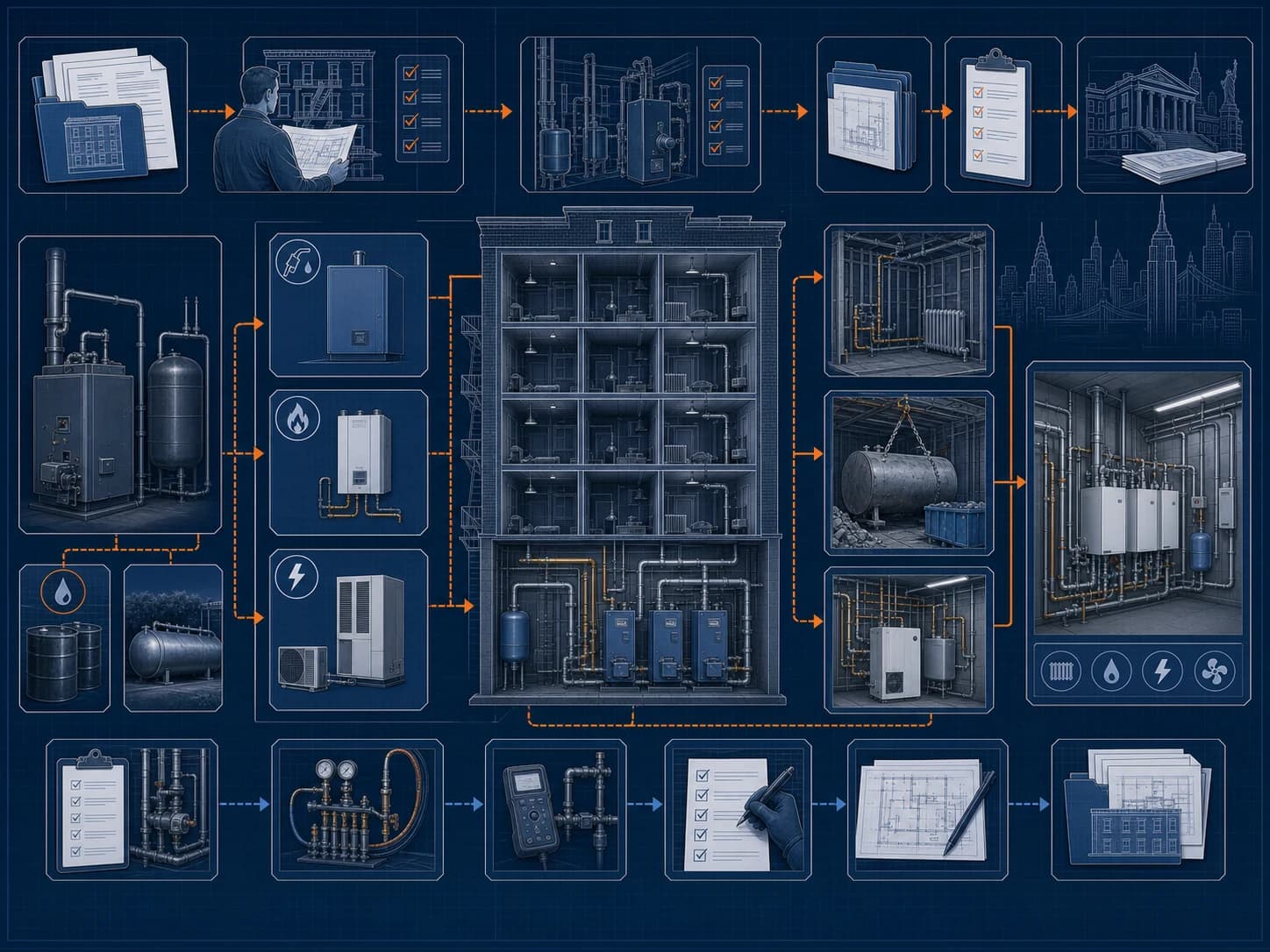
The No. 4 oil deadline is fixed, but a conversion schedule is building-specific. An owner may need to choose a replacement fuel, confirm utility capacity, scope the boiler and burner, address the chimney and tank, coordinate occupied-building work, pass inspections, and assemble a closeout file. Missing one track can hold the others.
This guide turns that work into an owner-side sequence. It supports Austin's oil-to-gas conversion service, but it does not assume gas is available or right for every property. It also avoids a universal project duration because utility work, design, equipment, access, inspections, and seasonal constraints vary by building.
What No. 4 oil deadline are NYC owners planning around?
New York City Local Law 32 says no person may cause or permit a boiler to burn No. 4 fuel oil on or after July 1, 2027. It also says no work permit, certificate of operation, or registration for a boiler to burn No. 4 oil may be issued or renewed on or after June 30, 2024 (New York City Council, Local Law 32 of 2023, retrieved 2026-07-20).
That makes the owner decision more precise than "replace the boiler by 2027." The finish line is a heating plant that can lawfully operate without No. 4 oil, with every required utility, permit, inspection, testing, and record step complete.
The law does not order every building to use natural gas. A building might evaluate No. 2 oil, gas, electric equipment, or a phased hybrid plan. Each path has different service, equipment, venting, tank, electrical, and compliance consequences. The right answer has to be established for the property before procurement.
Start with one owner decision file
The fastest way to lose control of a conversion is to let the utility application, boiler scope, tank work, and board approval live in separate inboxes. Build one decision file before asking for final prices.
Collect:
- Current boiler and burner make, model, capacity, age, fuel, and operating condition.
- Boiler, burner, fuel-storage, certificate, registration, annual inspection, and open-job records.
- At least two recent heating seasons of fuel use and peak-load information.
- Chimney, breeching, combustion-air, boiler-room, tank, and meter-location conditions.
- The serving gas and electric utilities, existing services, and known capacity constraints.
- Building occupancy, heat and hot-water obligations, access rules, and acceptable outage windows.
- Local Law 97 status, current emissions analysis, and the building's applicable compliance pathway.
- Board, lender, insurer, managing-agent, design-team, and procurement approvals that can hold the job.
Do not treat a missing record as proof that no requirement exists. DOB's owner guidance says boiler work ranges from limited work by a Licensed Oil Burner Installer or Licensed Master Plumber to projects that require a Registered Design Professional and approved plans (NYC DOB, Project Requirements Owner: Boiler, retrieved 2026-07-20).
The initial walkthrough should produce a written gaps list. That list is more useful than a premature price because it tells the owner what must be verified before a path can be approved.
Which path replaces No. 4 oil?
Compare paths against the same building facts. A fuel-only answer can miss the plant, distribution system, domestic hot water, chimney, electrical service, and emissions plan.
| Path to evaluate | Confirm before selection | Common owner-side dependencies |
|---|---|---|
| No. 2 oil | Burner compatibility, tank condition, venting, certificate and registration path, operating plan | Oil-burner scope, tank and piping condition, emissions analysis, future plant plan |
| Natural gas | Utility availability, service size and pressure, connected load, point of entry, meter location, gas piping, boiler or burner, chimney | Utility ruling, owner agreement, street or service work, DOB filings, inspections, meter set |
| Electric or hybrid | Building heat load, electrical capacity, distribution temperatures, domestic hot water, resilience, phasing | Utility electric upgrade, design, equipment space, controls, envelope or distribution work |
For gas, confirm service before equipment is ordered. Con Edison's current customer guide says an application should be made as far in advance as possible and warns that the requested type or size of gas service may not be available at a specific location. It directs customers to verify availability and proximity before ordering equipment or starting piping work (Con Edison, Natural Gas Service Customer Installation Guide, retrieved 2026-07-20).
National Grid's NYC installation commitment form also treats service installation as a coordinated project milestone. It requires job-site readiness information and notes that buried utilities, enclosure, final grade, debris, scaffolding, and photos can affect scheduling (National Grid, Commitment Form for a Gas Service Installation, retrieved 2026-07-20).
Austin's licensed gas piping practice can handle the building-side assessment and utility coordination when gas remains a viable path. A utility application is a request for a service determination, not a promise of capacity, price, approval, or installation date.
How should owners work backward from July 1, 2027?
Work backward from turnover, not demolition. The plant should be operational, tested, accepted, documented, and ready for the next heating obligation before the old fuel is unavailable.
| Backward-planning gate | Owner deliverable | Do not advance until... |
|---|---|---|
| 1. Turnover and closeout | Signed-off jobs, required inspection results, utility acceptance, startup records, tank documents, manuals | The owner can identify every open item and responsible party |
| 2. Testing and startup | Test plan, inspection requests, utility coordination, controls and combustion setup | Required prerequisites and witnesses are scheduled |
| 3. Construction | Approved scope, outage and tenant plan, site logistics, temporary-service decisions | Equipment, access, shutdowns, and safety responsibilities are coordinated |
| 4. Procurement and filings | Approved design, utility ruling, permits, equipment schedule, contractor scopes | The selected system matches confirmed building and utility conditions |
| 5. Feasibility and owner approval | Options analysis, budget, funding path, LL97 review, board decision | The owner has selected a defensible path rather than a preferred fuel in isolation |
| 6. Existing-condition file | Records, field survey, loads, chimney, tank, distribution, utilities, open items | Unknowns that can change the path are listed and assigned |
This is a sequence, not a fixed-duration promise. A straightforward burner change and an occupied-building plant replacement with new utility service are not the same project. Equipment availability, street work, design review, tenant access, inspection calendars, and weather can change the critical path.
The building heating-plant service is the better starting point when the project involves multiple boilers, occupied-building phasing, capital planning, or a larger plant modernization. The No. 4 deadline may trigger the work, but the owner still needs a system that fits the building after 2027.
What must be coordinated with DOB?
The required filing and inspection path depends on the actual scope. DOB says boiler work can involve a Licensed Oil Burner Installer, Licensed Master Plumber, Registered Design Professional, work permit, and special or progress inspections depending on the project (NYC DOB, Project Requirements Owner: Boiler, retrieved 2026-07-20).
DOB's boiler filing materials treat boiler, burner, fuel source, chimney, gas piping, and fuel storage as connected job components. Its DOB NOW training includes separate fuel-storage abandonment and removal categories and shows that a boiler project may trigger related technical reports and inspections (NYC DOB, DOB NOW Build Boiler Equipment Industry Session, retrieved 2026-07-20).
New boiler installations, certain major component replacements, and fuel-burner replacements require a DOB First Test before use. DOB says a failed First Test must be corrected and reinspected before the job can be approved and signed off (NYC DOB, First Test Requirements, retrieved 2026-07-20).
Use the annual boiler inspection and filing guide to keep the operating boiler's annual record separate from the replacement-job inspection and sign-off. A conversion should not leave the old boiler, tank, or job record open after the new plant starts.
How should Local Law 97 affect the conversion decision?
Local Law 97 should be evaluated before the owner locks the equipment path, but a No. 4 fuel change is not automatic LL97 compliance. DOB says most buildings over 25,000 square feet face emissions limits that began in 2024 and become stricter in 2030. It also explains that different buildings can have different compliance pathways and exceptions (NYC DOB, LL97 Greenhouse Gas Emissions Reduction, retrieved 2026-07-20).
Ask the building's qualified LL97 professional to show how each proposed plant affects the property's applicable limit, annual reporting, and future capital plan. Then ask the mechanical team what the modeled option requires in the boiler room, chimney, gas service, electrical service, domestic hot water, and distribution system.
Keep this boundary clear:
- The LL97 professional establishes the building's compliance analysis and required attestation.
- The project team turns the selected mechanical scope into design, filings, procurement, installation, testing, and closeout.
- The owner controls the decision, funding, access, schedule, records, and ongoing operating plan.
Do not advertise an incentive, adjustment, deduction, or financing program as available until the building's current eligibility is verified. Do not promise that one fuel switch eliminates penalties or future work.
What causes No. 4 oil projects to stall?
Ordering before the utility ruling. A preferred boiler does not create gas or electric capacity. Confirm service conditions first.
Treating the project as boiler-only. Burner, chimney, gas piping, electrical work, controls, tank, distribution, and domestic hot water can change the scope.
Leaving the old record open. Physical removal does not automatically close a DOB job, boiler record, certificate, registration, tank record, or annual inspection issue.
Scheduling from the installation date. Work backward from inspection, startup, utility acceptance, and sign-off. Construction is only one gate.
Ignoring occupied-building operations. Heat, hot water, tenant notice, access, dust, noise, fuel delivery, and temporary-service decisions need named owners.
Calling a fuel switch an LL97 plan. A covered building needs its current emissions and compliance path reviewed. The plant decision belongs inside that analysis.
The property-manager plumbing compliance calendar is a useful model for keeping annual operating obligations beside capital-project milestones.
Owner closeout checklist
Before the project team leaves, ask for a closeout index that states what was required, what was completed, and what remains open. Austin's oil-to-gas conversion closeout checklist organizes that owner handoff across utility, DOB, chimney, tank, commissioning, and turnover records.
- Final approved scope and as-built information.
- DOB job numbers, permits, inspection results, and sign-off status.
- First Test result when required.
- Utility service, meter, and acceptance records for the selected path.
- Startup, combustion, controls, balancing, and commissioning records that apply.
- Fuel-tank abandonment or removal records that apply.
- Chimney, liner, gas, electrical, and special-inspection documentation that applies.
- Equipment schedules, manuals, warranties, and maintenance requirements.
- Updated boiler-room contacts and emergency procedures.
- Remaining LL97, annual boiler, energy benchmarking, or other ongoing obligations.
The project is not closed because the building has heat. It is closed when the system operates, required authorities have accepted their parts, and the owner can prove the final condition.
When to discuss a conversion plan with Austin
Austin Plumbing & Heating can review the boiler room, records, fuel path, gas scope, tank and chimney questions, DOB work, and project handoffs with NYC Licensed Master Plumber oversight. The first useful deliverable is a building-specific gaps list and conversion sequence, not a universal deadline countdown.
Bring the current boiler and burner information, fuel records, utility account details, DOB records, tank information, and any LL97 analysis already prepared. Start with Austin's oil-to-gas conversion service to discuss the building and determine which feasibility questions need answers before the owner commits.
Common Questions
When does NYC's No. 4 oil ban take effect?
Local Law 32 prohibits boilers from burning No. 4 fuel oil on or after July 1, 2027, except for an earlier deadline that applied to City properties and public schools. The law also stopped new or renewed work permits, certificates of operation, and registrations for No. 4 boilers on or after June 30, 2024.
Does the law require every No. 4 oil building to convert to gas?
No. The law prohibits No. 4 oil; it does not prescribe one replacement fuel. Owners should compare the building-specific feasibility of No. 2 oil, natural gas, electric or hybrid systems, and related plant work before selecting equipment. Utility capacity, electrical service, chimney, tank, occupancy, and LL97 exposure can change the answer.
Should an owner order a boiler before applying for gas service?
No. Con Edison tells customers to confirm gas availability and proximity before ordering equipment or starting piping work. A licensed project team should establish the serving utility, available service and pressure, connected load, point of entry, meter arrangement, and any customer or utility construction before equipment is committed.
Will switching from No. 4 oil automatically satisfy Local Law 97?
No. A fuel change can affect a covered building's emissions, but LL97 compliance depends on the building's applicable pathway, annual emissions, reporting, and any approved adjustments or deductions. Treat the conversion as one mechanical decision inside a building-wide plan, not as a universal compliance guarantee.
What closeout records should the owner receive?
The closeout file should match the approved scope and may include signed-off DOB jobs, inspection and test records, First Test results when required, utility acceptance, startup and commissioning records, fuel-tank abandonment or removal documentation, equipment manuals, warranties, and an updated boiler-room operating file. The exact package varies by project.