Key takeaways
- A boiler startup and shutdown program is a building-specific service scope, not a universal checklist or a promise that the plant will run without interruption.
- Put the equipment, seasonal visits, test categories, exclusions, repair authority, recheck rules, and final records in writing before comparing proposals.
- Keep management's readiness walkthrough, contracted maintenance, and the DOB annual boiler inspection in separate lanes, even when their dates are close.
- Define “shutdown” for the actual plant. Multi-boiler rotation and year-round domestic hot water can change what stays in service after heat season.
An annual boiler startup and shutdown program should tell a property manager exactly what equipment is covered, what the seasonal visits produce, who can authorize added work, and what proof closes each visit. It should not rely on the words “startup,” “tune-up,” or “shutdown” to carry a scope that was never written.
That distinction matters in NYC. HPD heat season begins October 1, but the building may have year-round domestic-hot-water duties, rotating boilers, open service recommendations, or a separate DOB inspection schedule. Use this guide to compare written programs, then use Austin's building maintenance contract service to scope the actual plant.
What is a startup and shutdown program—and what is it not?
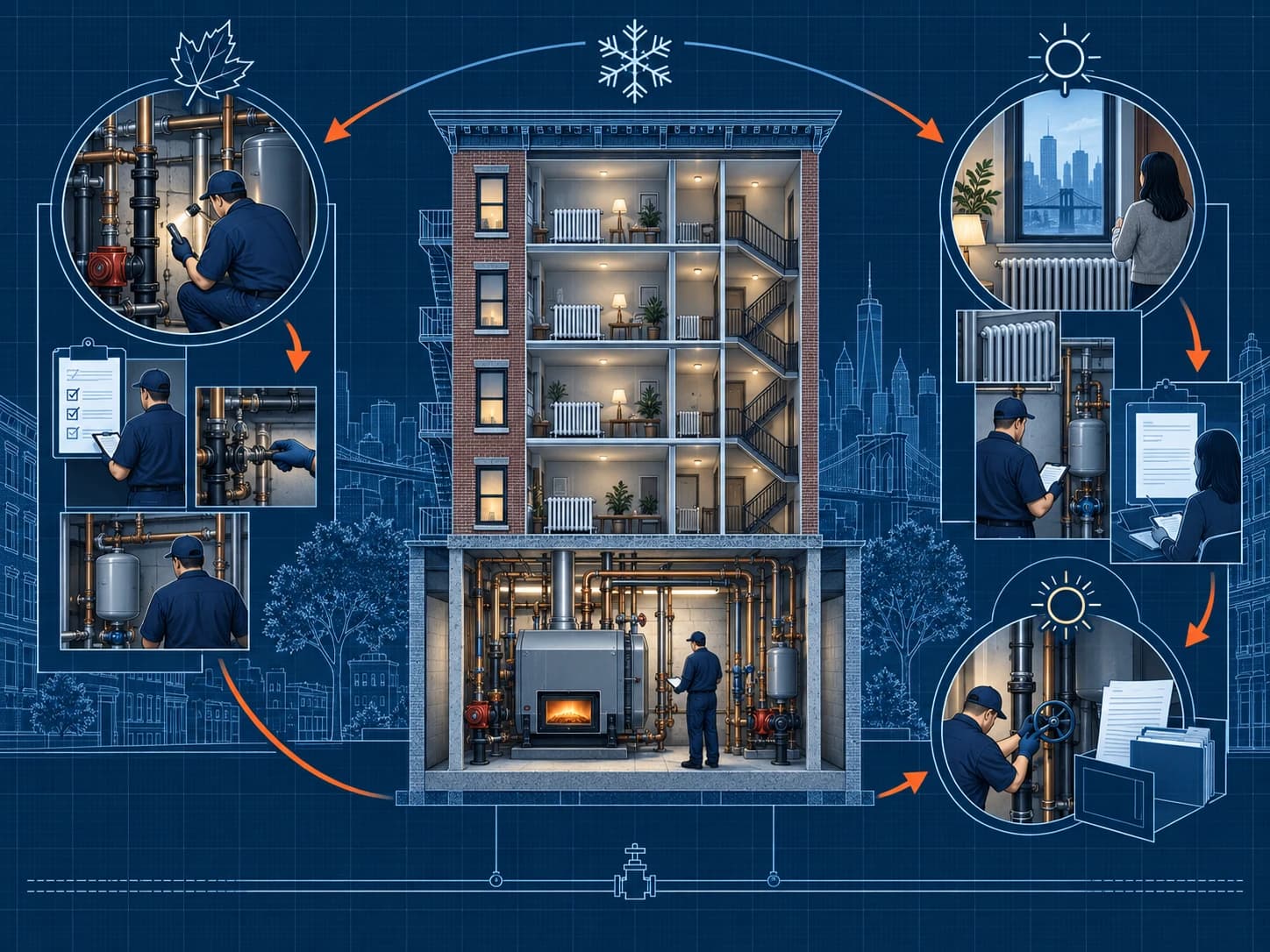
A seasonal program is a private operating and maintenance agreement built around the building's heating cycle. It can coordinate planned service, named equipment, records, and follow-up. NYC does not make that private program a substitute for a required DOB annual inspection, a manager's readiness walkthrough, or emergency response.
Keep three lanes visible:
| Lane | Primary purpose | Typical owner record |
|---|---|---|
| Manager readiness | Confirm access, contacts, complaint history, and known open items | Dated gaps list and assignments |
| Contracted seasonal service | Perform the agreed startup, operating, and shutdown scope | Work order, findings, authorizations, recheck, and open-item log |
| DOB annual boiler compliance | Complete the applicable qualified inspection and reporting process | Inspection report, filing status, and defect-correction records when required |
DOB says the annual inspection cycle runs from January 1 through December 31 and that covered-boiler reports are due within 14 calendar days of inspection. It also defines who may inspect covered low- and high-pressure boilers (NYC DOB, Boiler Compliance, retrieved 2026-09-26). Austin's annual boiler filing guide explains that compliance lane.
The practical rule is simple: if one appointment is expected to include more than one lane, the proposal should name every lane, responsible party, deliverable, and filing separately.
Which building facts should shape the written scope?
The scope should start with the plant that exists, not a standard package name. Boiler count, fuel, steam or hydronic distribution, domestic-hot-water dependency, controls, prior failures, access, and known open items can change the schedule and the work record management needs.
Give the contractor a short plant brief before asking for a final scope:
- Boiler, burner, fuel, control, and distribution-system identification.
- Which equipment serves space heat, domestic hot water, or both.
- Boiler rotation, lead-lag sequence, and any equipment intentionally held in reserve.
- Recent no-heat, uneven-heat, leak, control, water-line, venting, or combustion-service history.
- Open repair recommendations, DOB defects, violations, permits, utility conditions, or access restrictions.
- The building's normal occupied hours, after-hours access, outage limits, resident-notice rules, and approval contacts.
- Which management, super, contractor, insurance, or design records must be included in the closeout file.
Do not turn this intake into a diagnosis. A manager can identify equipment and collect records without deciding which settings, parts, or tests the plant requires. DOB's owner guidance says boiler work must be performed within the applicable Licensed Master Plumber or Licensed Oil Burner Installer scope, and larger work may require permits and a Registered Design Professional (NYC DOB, Project Requirements Owner: Boiler, retrieved 2026-09-26).
What should the startup work order name?
The startup work order should name the equipment, service categories, required records, repair-authorization boundary, and acceptance step. A phrase such as “full startup” is useful only when the agreement defines what that means for this building and what happens when the technician finds a problem.
Austin's current maintenance-contract scope describes pre-season work around combustion, controls, safeties, venting, steam-specific checks where applicable, and multi-boiler scheduling (Austin Plumbing & Heating, Maintenance Contracts, retrieved 2026-09-24). A building-specific work order should turn those categories into a clear deliverable without inviting unqualified staff to perform them.
Confirm these points in writing:
- the boilers, burners, controls, pumps, domestic-hot-water equipment, and other included components;
- the service and test categories included for each item;
- what operating readings or observations will be recorded;
- which access, tenant, utility, or prior-repair information management must provide;
- whether cleaning, consumables, parts, balancing, repairs, permits, filings, or return visits are included or separately authorized;
- who may approve additional work and whether approval must be written;
- what result triggers a recheck, escalation, or do-not-operate instruction; and
- the record management receives when the agreed work is complete.
The agreement should not guarantee an uninterrupted winter. It should make the planned work, exceptions, and next actions visible before cold weather turns an unclear scope into an emergency invoice.
What should “shutdown” mean for this building?
“Shutdown” needs a building-specific definition. It may mean an end-of-season condition review, a control transition, a change in boiler rotation, or a documented preservation step. It does not automatically mean that the entire plant, fuel service, or every connected component will be taken offline.
Ask the proposal to answer four questions:
- Which equipment changes operating status after heat season?
- Which equipment must remain available for domestic hot water, redundancy, testing, or another building need?
- What observations, service work, preservation steps, or open deficiencies are recorded at the visit?
- Who approves the final operating arrangement and any later return to service?
This is especially important in multi-boiler plants and systems that share heat and hot-water equipment. HPD states that hot water must be provided year-round at a constant minimum of 120 degrees Fahrenheit, while heat season runs from October 1 through May 31 under separate indoor-temperature rules (NYC HPD, Heat and Hot Water, retrieved 2026-09-26).
A seasonal transition should therefore preserve the building's required service. The written program should describe the outcome, while the qualified professional determines the correct procedure for the actual equipment.
How should multi-boiler plants and open defects be scheduled?
Multi-boiler programs should be organized by device and operating role. The schedule should identify which boiler is lead, lag, reserve, or unavailable; which visit covers each device; and which accepted result allows management to move to the next stage. One plant-level check mark can hide an unresolved boiler.
Use a device schedule with these fields:
| Field | What management should see |
|---|---|
| Equipment ID | The exact boiler, burner, or connected system covered |
| Operating role | Lead, lag, rotating, reserve, domestic hot water, or out of service |
| Planned visit | Startup, in-season follow-up, shutdown, recheck, or separate compliance inspection |
| Open condition | Finding, prior recommendation, access issue, or agency record affecting the visit |
| Authorization | Person allowed to approve added work and the approval method |
| Acceptance evidence | Completed work order, readings, photos where useful, recheck result, and next action |
Keep service findings tied to the compliance record when necessary, but do not collapse the two. If the annual DOB inspection reports defects, use Austin's defect-versus-immediate-shutdown guide to preserve the separate correction, subsequent-inspection, and unsafe-condition paths.
What evidence should management receive after each visit?
Each seasonal visit should leave a dated, building-specific record that another manager or technician can understand. The record should state what was actually performed, what changed, what remains open, and who owns the next action. A generic invoice line is not an operating handoff.
Ask for:
- building address and visit date;
- equipment identifiers and operating roles;
- named service categories, observations, and readings actually completed;
- parts, adjustments, repairs, or temporary measures that were authorized and performed;
- deficiencies, exclusions, or access limits that prevented completion;
- recheck or operating result, without unsupported guarantees;
- photos where they clarify equipment identity, condition, or completed work;
- the next action, responsible person, and target date; and
- separate references to any permit, DOB inspection, filing, violation, utility, or design-professional record.
The property-manager plumbing compliance calendar gives this file a year-round home. Seasonal service records can sit beside, but should not replace, the accepted agency records for covered boiler inspections, gas work, backflow, or other building obligations.
How does the program relate to heat duties and DOB inspections?
The seasonal program supports operations; HPD and DOB define separate owner obligations. HPD's current heat-season rules govern required heat and year-round hot water. DOB's boiler program governs covered equipment, qualified annual inspections, reports, defects, and immediate-shutdown findings. A private contract should coordinate those lanes without claiming to replace them.
For covered low-pressure boilers, DOB says owners must hire an applicable DOB-licensed qualified installer or authorized boiler insurance company for the annual inspection. High-pressure annual inspections are limited to an authorized insurance company. Those distinctions belong in the written compliance scope, not in an assumption that one maintenance vendor or visit automatically covers every boiler record.
Use Austin's boiler inspection and filing service for the DOB lane and heating service for operating diagnosis or repair outside the annual program. If a seasonal visit identifies permit-level work, the scope should pause at the finding and route the project through the applicable licensed and professional requirements.
What should a manager confirm before signing?
Before signing, confirm that the proposal names the plant, seasonal visits, included work, exclusions, authorization path, response terms, records, and compliance boundaries. The best program is not the longest checklist. It is the one that management, the service team, and ownership can apply to the real building without guessing.
Use this final review:
- Does the equipment schedule match the boiler room and current operating roles?
- Are startup, in-season follow-up, shutdown, and recheck visits clearly separated?
- Does “shutdown” preserve every heat, hot-water, redundancy, and operating need the building still has?
- Are tests, service categories, parts, repairs, permits, filings, and return visits included or excluded by name?
- Is added-work authority assigned to a real person with a documented approval method?
- Are emergency and priority-response terms written rather than implied?
- Does each visit end with a usable record and assigned open items?
- Are DOB inspection and filing responsibilities stated separately for each covered boiler?
Austin Plumbing & Heating can review the plant and build a written annual scope around its equipment, seasonal sequence, service history, compliance calendar, and management requirements. Start with Austin's maintenance contracts for NYC buildings to request a building-specific program rather than comparing undefined package names.
Common Questions
Is a seasonal boiler startup visit the same as the annual DOB boiler inspection?
No. A startup visit is a privately defined maintenance and operating service. DOB's annual inspection is a separate compliance process for covered boilers, with qualified-inspector and reporting rules. If both services are planned near each other, the agreement should identify each deliverable and record separately.
Can the same appointment include startup service and a DOB inspection?
It may be possible when the correct qualified people, scope, timing, and records are arranged, but one activity does not automatically satisfy the other. The work order should state what maintenance was performed, what inspection was conducted, who performed each task, and what filing follows.
Does boiler shutdown mean turning off the whole plant?
Not necessarily. The written scope should define what shutdown means for that building, especially where boilers rotate, equipment remains available, or the plant also produces domestic hot water. Management should not assume that an end-of-season visit means every boiler, pump, control, or fuel service is taken offline.
What if the boiler plant also produces domestic hot water?
Identify that dependency before scheduling any seasonal transition. NYC owners must provide hot water year-round, so the program should state which equipment remains in service, what can be isolated, how the operating arrangement changes, and who approves a different sequence for the actual plant.
What should management receive after each seasonal visit?
Ask for a dated record naming the building, equipment served, work performed, readings or observations actually taken, repairs authorized, deficiencies left open, recheck results, and the owner of each next action. Keep any DOB inspection report or filing confirmation as a separate compliance record.