
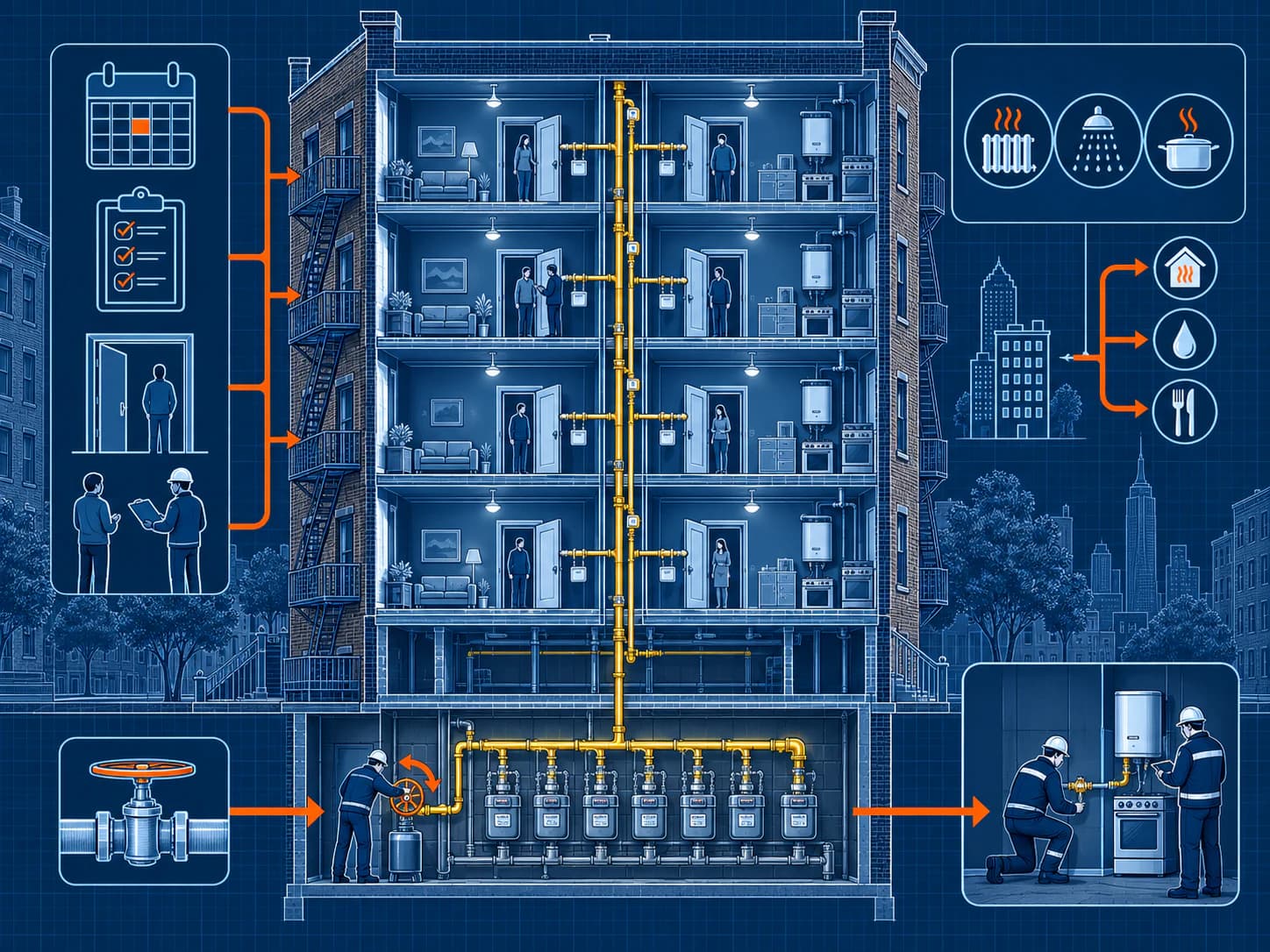
Key takeaways
- Safety comes before scheduling. A suspected leak or unsafe condition is an emergency; leave the area and call 911 or the serving utility from a safe location.
- Build two access plans. The plumber may need apartments during investigation and repair, while the utility may need a separate visit for inspection, meter turn-on, and appliance relighting.
- Map the services, not just the gas riser. Record whether the shutdown affects cooking, heat, domestic hot water, laundry, commercial equipment, or only one isolated section.
- Temporary arrangements must be building-specific. Do not promise portable heat, cooking equipment, hot water, or relocation until qualified professionals confirm the safe and lawful plan.
- A passed repair is not a restoration date. DOB and utility approvals remain separate, and missed access can keep part of the building off.
A building-wide gas shutdown is both a safety project and an occupied-building logistics project. The physical work may involve a meter bank, house piping, risers, branches, appliances, permits, tests, and inspections. Management also has to coordinate residents, access, essential-service notices, lawful alternatives, and verified updates without promising a restoration date it does not control.
This guide is for the period before a controlled shutdown or immediately after an emergency shutoff has made the building safe enough to plan repairs. If gas odor or another dangerous condition is present, stop coordinating the schedule, leave the affected area, and follow the utility's emergency instructions. Use the separate gas-shutoff response guide for that first response.
Start with one shutdown scope, not one date
Before sending a tenant notice, create a service map that the property manager, super, Licensed Master Plumber, design team when required, and serving utility can all use. A calendar date without a defined boundary creates avoidable confusion: residents do not know whether their apartment is affected, the plumber does not have a confirmed access list, and management cannot describe temporary arrangements accurately.
Record these items in one shutdown register:
| Decision | What to record | Who confirms it |
|---|---|---|
| Shutdown boundary | Whole building, one riser, one meter bank, common equipment, or a defined group of apartments | Licensed Master Plumber and serving utility |
| Affected services | Cooking gas, heat, hot water, laundry, commercial cooking, or other gas-fired equipment | Manager, super, and project professionals |
| Work path | Emergency response, planned repair, alteration, inspection, or restoration after a utility shutoff | Licensed Master Plumber and DOB filing team |
| Access points | Cellar, meter room, boiler room, commercial spaces, and every apartment that may need entry | Licensed Master Plumber and utility |
| Occupancy constraints | Vacant units, mobility or communication needs, commercial operating hours, pets, and lawful key-control limits | Manager with occupants and counsel as needed |
| Restoration checkpoints | Repair complete, required DOB inspections, gas authorization, utility inspection or leak test, meter turn-on, appliance relight | Licensed Master Plumber and utility |
NYC DOB's utility service restoration guidance places licensed repair work, DOB inspections, gas-restoration authorization, and utility inspections on distinct lines. Treat them that way in the project tracker. “Plumber finished” and “gas restored” are not the same milestone.
Separate repair access from restoration access
Most managers need at least two apartment-access schedules. The first supports investigation, isolation, repair, and the inspections tied to the licensed work. The second supports the serving utility's restoration process. The people entering, the units needed, and the timing may differ.
Con Edison's current gas-restoration sequence says apartment-building crews may need to visit each household to restore cooking gas. It also warns that a missed apartment can delay other apartments. National Grid's restoration guidance describes meter shutoff, system safety checks, meter turn-on, and appliance relighting; it requires an adult to be present for relighting and says its technicians will not use a locksmith to enter an unoccupied unit.
Build the access roster by apartment and purpose:
- Confirm the occupant's name, preferred contact method, and whether the apartment is occupied.
- Mark which gas-fired appliances are present without asking residents to test or move them.
- Record whether the plumber needs entry before or during the repair.
- Record whether the utility expects entry for inspection, meter work, or relighting.
- Identify an authorized adult for each required window.
- Use the building's lawful key and access procedure; do not assume a super may enter every unit without notice or consent.
- Create an escalation path for units that do not respond, using management and legal guidance rather than improvising entry.
Do not call the roster complete because every resident received an email. Completion means every required unit has a confirmed access method for the correct visit.
Give residents a service plan they can actually use
A useful notice names the affected service, the reason for the interruption, the expected start and end window, who needs access, how workers will be identified, and where verified updates will appear. It should also explain what management has and has not confirmed.
NYC311's Essential Service Interruption Notice Rules say a residential owner must post a notice for a planned interruption of heat, hot water, cold water, gas, or electricity expected to last at least two hours. The notice is posted in English and Spanish at least 24 hours before a planned interruption, remains posted until service returns, and is updated as needed. Emergency work does not require advance notice, but the notice should be posted as soon as possible after work starts.
If permitted work occurs in an occupied building and a Tenant Protection Plan applies, DOB's Tenant Protection Plan guidance requires the plan to describe anticipated service disruptions, their expected duration, steps to minimize them, and alternate arrangements for the affected service. Confirm the filing-specific requirement with the project team rather than assuming every shutdown follows the same TPP path.
Use one resident update format throughout the event:
- what changed since the last update;
- which service and apartments are affected;
- the next confirmed field or agency checkpoint;
- the next access window, if confirmed;
- the temporary arrangement currently available;
- the next update time; and
- a management contact for access or accommodation coordination.
Avoid “gas will be back tonight” unless the serving utility has confirmed that result. A better update names the next checkpoint: for example, “DOB inspection requested,” “utility visual inspection scheduled,” or “relight access being confirmed.”
Plan alternatives around the lost service
Temporary-service planning starts with the actual consequence of the shutdown. Cooking gas, domestic hot water, and central heat need different responses. A building may lose one, two, or all three, and a restaurant or other commercial tenant may have additional operating constraints.
For each affected service, record:
- the code, lease, housing, insurance, fire-safety, and permit questions that need review;
- the expected interruption window and the trigger for extending the plan;
- the building's electrical, water, venting, fuel, and space limitations;
- the proposed alternative and the professional responsible for approving it;
- the residents who may need an accommodation or relocation discussion; and
- the person authorized to communicate changes.
Do not distribute plug-in heaters, cooking devices, fuel-burning equipment, or extension cords as a generic fix. The safe option depends on equipment listing, circuit capacity, placement, fire protection, ventilation, supervision, and the building-specific plan. If heat or domestic hot water is affected, use the HPD heat and hot-water guide to keep the essential-service obligation visible while the project team defines the lawful temporary arrangement.
HPD's current heat and hot-water guidance states that hot water is required year-round and that heat requirements apply during the October 1 through May 31 heat season. A gas repair schedule does not suspend those responsibilities. Escalate the continuity plan early when the shutdown affects a gas-fired boiler or water heater.
Track the licensed-work, DOB, and utility lanes separately
NYC DOB's gas-cut guidance explains that the owner hires a Licensed Master Plumber, the plumber files the applicable Emergency Work Notification or Limited Alteration Application, completes the work, and submits the gas-authorization request after the required work and inspections. The exact filing and inspection path depends on why service stopped and what the field condition requires.
Use a handoff table instead of a single percentage-complete number:
| Lane | Owner question | Evidence to retain |
|---|---|---|
| Safety and isolation | Is the affected system safe and correctly isolated? | Utility notice, emergency record, field findings, isolation map |
| Licensed scope | What must be repaired, tested, or replaced? | Written scope, approved filing, permit, change records |
| DOB | Which inspections and authorization records apply? | Inspection results, objections and corrections, accepted gas-authorization record |
| Utility | What does the serving utility require before turn-on? | Utility case number, accepted documents, field appointments and results |
| Apartment access | Which units need entry at each stage? | Unit roster, notices, confirmations, missed-access log |
| Relight and closeout | Which meters and appliances were restored, deferred, or left off? | Unit-by-unit restoration result, door tags, follow-up appointments, final resident update |
Austin's gas authorization, plumbing sign-off, and utility restoration guide explains why those records cannot substitute for one another. The gas-piping service page is the primary route when the building needs licensed assessment and a project-specific restoration scope.
Run a go/no-go meeting before controlled work
Hold one short meeting with management, the super, the Licensed Master Plumber, and other required project professionals before a planned shutdown. The meeting should end with a written go/no-go decision, not a general statement that everyone is “ready.”
Confirm:
- the serving utility and active case or coordination contact;
- the exact shutdown boundary and affected services;
- the current filing, permit, and inspection plan;
- meter-room, cellar, roof, commercial-space, and apartment access;
- the resident notice and update cadence;
- the approved temporary-service or accommodation plan;
- emergency contacts and stop-work authority;
- the rule for scope changes discovered after opening walls or testing; and
- the restoration-day roster and unit-by-unit closeout record.
If one required apartment remains unconfirmed, elevate that issue before the shutdown. If the unsafe condition requires immediate action, do not delay the safety response; shift the access plan into emergency mode and communicate what is known as soon as possible.
Close the event apartment by apartment
Restoration is not complete because the main valve is open or most apartments have service. Keep a unit-level result for every required meter and appliance. Mark each unit restored, intentionally left off, inaccessible, failed inspection, or scheduled for follow-up. Record who made that determination and what the occupant was told.
National Grid says its technicians test lines and relight appliances as the final restoration step. Con Edison similarly separates repair approval, visual inspection, leak testing, and turn-on. Management should preserve the utility's actual field result instead of translating it into a broader promise.
After the last field visit:
- Reconcile the utility result with the apartment roster.
- Contact every unit left off or missed and schedule the correct follow-up.
- Post a final building update that distinguishes restored areas from open items.
- Preserve the DOB, plumber, utility, tenant-notice, access, and temporary-service records together.
- Review any recurring access or communication failure before the next planned outage.
The goal is not simply to get gas back. It is to move from a safety event to a documented repair, a controlled utility restoration, and a closeout file that explains what happened in every affected part of the building.
Common Questions
Can a manager delay an emergency gas shutoff until every apartment is ready?
No. If anyone smells gas or an unsafe condition is suspected, occupants should leave the area and call 911 or the serving utility from a safe location. Access planning applies after the immediate safety response begins or before controlled work; it must never delay an emergency shutoff.
Why can one missed apartment delay gas restoration?
The serving utility may need access to individual apartments to inspect, turn on a meter, or relight appliances. Con Edison warns that a missed apartment can delay other apartments in the building, while National Grid requires an adult to be present for its relight process.
Does passing a plumber's pressure test mean the utility will restore gas that day?
Not by itself. The required repair, DOB filing and inspection path, gas-authorization record, and serving-utility inspections or tests are separate checkpoints. The utility controls its final restoration and relight process, so managers should not promise a turn-on date until the utility confirms it.
What should a tenant access notice include?
State the affected service, why access is needed, the apartments or areas involved, the expected date and access window, who will enter, how credentials will be verified, how to arrange an authorized adult or lawful access method, and where management will post verified updates.
Must every gas interruption use the same temporary-service plan?
No. The plan depends on whether cooking gas, domestic hot water, heat, or several services are affected; the season; the building's electrical and mechanical capacity; the expected duration; and the permit or Tenant Protection Plan requirements. Use project-specific professional and legal review.