Key takeaways
- Gas authorization, plumbing sign-off, and utility restoration are not three names for one approval. Each has a different decision maker and proves something different.
- An approved gas authorization does not automatically close the plumbing work. Final sign-off still depends on the job record, required inspections, tests, objections, and documents.
- DOB does not open the meter. Con Edison or National Grid controls its own field checks and the final decision to restore service.
- Track records, not verbal status updates. Ask for the exact permit, inspection, request, and utility case numbers at every handoff.
An NYC gas project can look finished in the basement and still be waiting on three different approvals. DOB may approve gas authorization for a particular end use. The plumbing permit may still need final sign-off. The serving utility may still require its own documents, access, visual inspection, or leak test before it restores service.
That distinction matters because “DOB passed it,” “the plumber signed off,” and “the utility has the paperwork” do not describe the same milestone. This guide shows building owners and project teams what each approval controls, what it does not prove, and how to identify the handoff that is actually holding up service.
If gas is currently off because of a leak or unsafe condition, begin with the NYC gas-shutoff response guide. This article is for coordinating the records after the immediate safety response is underway.
What are the three approvals?
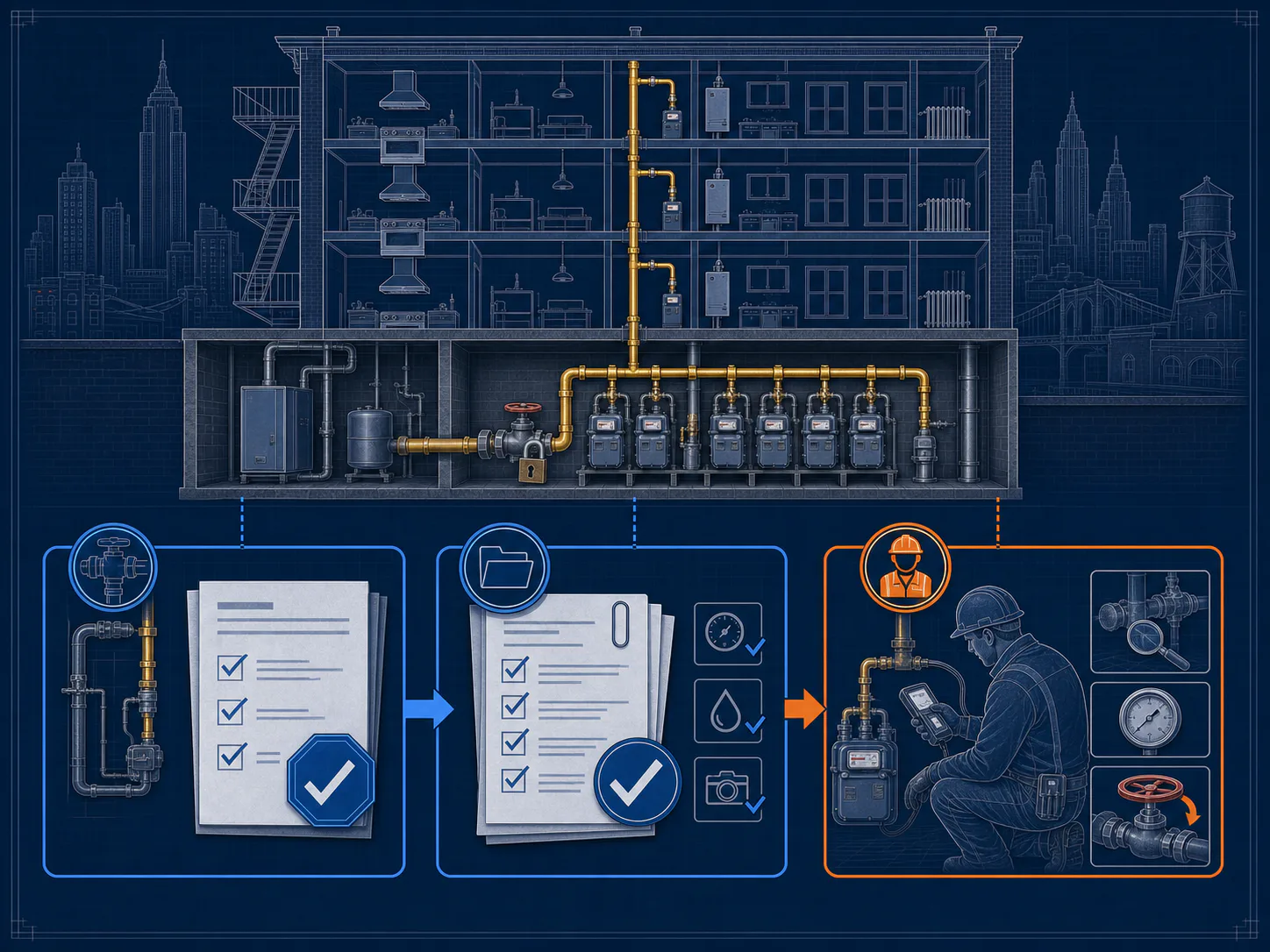
The simplest way to understand the process is to ask who controls each record and what decision that record answers.
| Approval or milestone | Who controls it | What it answers | What it does not prove |
|---|---|---|---|
| DOB gas authorization | NYC Department of Buildings | Whether the applicable gas end use may advance after the required gas inspection result and supporting documents | That every plumbing work item is closed or that the utility has restored service |
| Plumbing work type sign-off | NYC Department of Buildings | Whether the plumbing permit or work type has completed its required inspection, testing, objection, and closeout path | That the utility has completed its own field checks or opened the meter |
| Utility restoration | Con Edison or National Grid | Whether the utility accepts its required package and field conditions for reconnection or turn-on | That every DOB job, Letter of Completion, violation, or Local Law 152 record is closed |
The three records often move in sequence, but the exact order depends on the filing type, work scope, emergency-work path, gas end use, and serving utility. Ask the Austin gas piping team to map the project-specific record path instead of relying on a generic timeline.
What does DOB gas authorization prove?
A DOB gas authorization is a specific approval within DOB NOW: Inspections. It is tied to the relevant permit record and gas end use. It is not a broad declaration that the whole project is complete.
DOB's current plumbing project requirements list prerequisites that can apply to gas authorization, including completed venting and safety-control work, required fire-protection approvals, current gas testing, boiler sign-off, affidavits, and other scope-specific documents. The applicable package depends on the equipment and filing.
DOB's gas-authorization workflow manual states that at least one gas-finish inspection result must pass before a gas authorization request is submitted. When DOB approves the request, the system generates a Gas Authorization Approved Report. If DOB denies the request or asks for more documents, the request record shows the rejection or missing-document issue.
What gas authorization does not close
Gas authorization does not automatically mean that:
- every plumbing inspection is complete;
- every certifiable objection is resolved;
- the plumbing work type is signed off;
- a Letter of Completion has been requested or issued;
- a related violation is dismissed;
- a Local Law 152 certification is accepted; or
- Con Edison or National Grid has completed its own restoration steps.
That is why an owner should ask for the actual approved report and the permit number it belongs to. “Gas authorization submitted” is only a request status. It is not the same as “approved,” and neither phrase proves utility restoration.
What does final plumbing sign-off prove?
Plumbing sign-off is DOB's closeout decision for the applicable plumbing work record. DOB says Licensed Master Plumbers need all required inspections and tests completed and final plumbing sign-off. After sign-off or notification of completion in DOB NOW: Inspections, the applicant can request a Letter of Completion in DOB NOW: Build when that closeout document applies.
The DOB NOW: Inspections FAQ also shows why project teams should not treat a single “Pass/Final” result as the whole closeout. The inspection report can support a sign-off request, but DOB tells users to contact the issuing unit when the pass result is not reflected in required items.
For a larger new-building or alteration job, plumbing sign-off can also be part of the TCO or Final CO path. DOB's current Inspections Resources page publishes separate instructions for those job-level requests. The applicant of record, owner, and delegates may have different responsibilities from the LMP who completed the permit work.
What plumbing sign-off does not authorize
Final plumbing sign-off does not authorize someone to remove a utility lock, open a meter, or relight appliances. It also does not replace the utility's integrity, leak, access, meter, or appliance checks.
The closeout question and the restoration question should therefore stay on separate lines in the project tracker:
- DOB closeout: What remains open on the permit or job record?
- Utility turn-on: What remains open on the utility case?
What does utility restoration prove?
Utility restoration is the serving utility's decision to return gas to the affected service, meter, riser, or appliances after its requirements are satisfied. DOB approval is a required input when the project path calls for it, but DOB does not perform the utility's final turn-on.
Con Edison's gas-restoration guide describes a separate utility sequence after the licensed plumber completes repairs and receives the applicable Buildings Department approval. Con Edison performs a visual inspection, schedules a leak test, and restores service only when its field checks pass. The utility warns that another repair can send the case backward.
Con Edison's current Gas Yellow Book goes further for project teams. It says a valid Emergency Work Notification or gas authorization must be received before restoration after inside customer-piping repairs in NYC, and it distinguishes the utility's integrity test from the LMP pressure tests. Larger buildings, risers, inside-service-line conditions, and utility-jurisdiction piping can add forms, access, and operator-qualification requirements.
National Grid publishes its own gas service forms and paperwork. Its Gas Reconnection Request is limited to the described reconnection case where piping was cut or capped, the meter was removed, and there was no change in inside gas plumbing or equipment. A changed load, equipment change, altered inside plumbing, warning tag, or locked-meter condition can follow a different utility path.
The owner-facing rule is practical: identify the utility first, then use that utility's current case requirements. Do not send Con Edison paperwork to a National Grid project or assume a utility form covers work outside the form's stated conditions.
Can these approvals happen in a different order?
Yes. The project-specific sequence can differ, especially when emergency work, multiple permits, different gas end uses, an active TCO or CO request, or a building-wide restoration is involved.
For example, an approved gas authorization may allow a restoration handoff while other non-gas plumbing closeout items remain open. An emergency-work record may be part of the utility package in a qualifying case. Conversely, a passed gas inspection may still be insufficient because DOB requested another document or the utility found a leak, missing valve, corrosion issue, or access problem.
Avoid turning those examples into a universal shortcut. The reliable sequence is the one supported by the current DOB record, the serving utility's case, and the actual field condition.
When the open item is a test that did not hold, use the failed gas pressure-test decision guide to identify the tested boundary, written objection, licensed correction scope, and retest evidence before treating the project as ready for another approval or utility handoff.
How should an owner diagnose a stalled gas restoration?
Use one status sheet that keeps DOB and utility milestones separate. A verbal “we're waiting on the City” is not specific enough to manage the building or explain the delay to residents.
- Identify the shutoff and restoration scope. Is the case one appliance, one meter, one riser, or the whole building? Keep the warning tag, utility notice, and service case number.
- Match the field work to the DOB filing. Record the job, permit, LAA, or Emergency Work Notification number and the exact gas end use covered.
- Check the inspection record. Confirm which gas, roughing, finish, pressure, boiler, fire-suppression, or other inspections were required and which results passed.
- Check the gas authorization request itself. Record whether it is draft, submitted, additional-documents-required, denied, or approved. Save the approved report when issued.
- Track plumbing closeout separately. List open objections, work type sign-off status, job-level TCO or CO sign-off needs, and any Letter of Completion step.
- Confirm the utility package. Ask which forms, test results, photos, affidavits, case updates, and access arrangements the serving utility still needs.
- Plan the field appointment. Confirm meter, cellar, riser, apartment, and appliance access. Con Edison specifically warns that missed apartment access can delay cooking-gas restoration in multifamily buildings.
- Keep the final record set. Save the DOB approvals, utility restoration confirmation, inspection results, test forms, and access log in the building's permanent closeout file.
If the person giving the status cannot name the exact record, ask for a screenshot or PDF from the official system. That is the fastest way to distinguish a missing approval from a missing handoff.
Who should be on the status call?
The smallest useful status call includes the owner or manager, the Licensed Master Plumber, and the person managing the utility case. Add the applicant of record when a larger DOB job, TCO, Final CO, or Letter of Completion is involved.
Ask five questions:
- What exact record is open?
- Who controls the next decision?
- What document or field condition is missing?
- Who owns that missing item?
- What proof will show the stage is complete?
Those questions prevent a common failure: the utility waits for a DOB record, DOB waits for an inspection or applicant action, and the project team assumes the plumber is simply “waiting for a date.”
Where does Local Law 152 fit?
Local Law 152 is a separate periodic gas-piping inspection and certification program. It can overlap with restoration when an inspection found an unsafe condition or when a covered building needs the certification path described in DOB's current guidance.
It does not replace the other records. A GPS1 report, owner-submitted GPS2 certification, correction certification, gas authorization, plumbing sign-off, and utility turn-on each answer a different question. Review the Local Law 152 correction guide and the Austin LL152 service path when the restoration case also touches the periodic-inspection record.
What should the owner do next?
Start by collecting the utility notice, DOB permit and inspection records, and every email or form tied to the restoration case. Then ask the Licensed Master Plumber to map each open item to one of the three approval lanes.
If the field correction, DOB record, or utility handoff still needs licensed coordination, Austin Plumbing & Heating handles NYC gas piping, testing, permits, inspections, and restoration support through its licensed gas piping service.
Common Questions
Is an approved gas authorization the same as final plumbing sign-off?
No. A gas authorization addresses the gas end use and restoration path tied to the applicable permit and inspections. Plumbing sign-off is the separate DOB closeout step for the plumbing work record after required inspections, tests, objections, and documents are complete.
Can the utility restore gas before every plumbing closeout item is finished?
The sequence depends on the permit, emergency-work path, approved gas authorization, and utility requirements. Do not assume a universal order. The project team should identify the exact DOB record needed for restoration and separately track final plumbing closeout.
Does DOB approval require Con Edison or National Grid to turn the gas on?
No. DOB approval is part of the package, but the serving utility controls its own field inspection, leak or integrity test, meter access, and turn-on decision. Additional repair or access work can still be required.
Where does Local Law 152 fit into gas restoration?
Local Law 152 is a separate periodic inspection and certification program. It overlaps when the building is covered or the shutoff followed an LL152 finding, but a GPS2 filing does not replace a gas authorization, plumbing sign-off, or utility turn-on.
What records should an owner keep after gas service is restored?
Keep the utility notice, permit and job numbers, inspection results, approved gas authorization or emergency-work record, pressure-test and utility forms, plumbing sign-off or completion record when applicable, restoration confirmation, and unit-access log.