
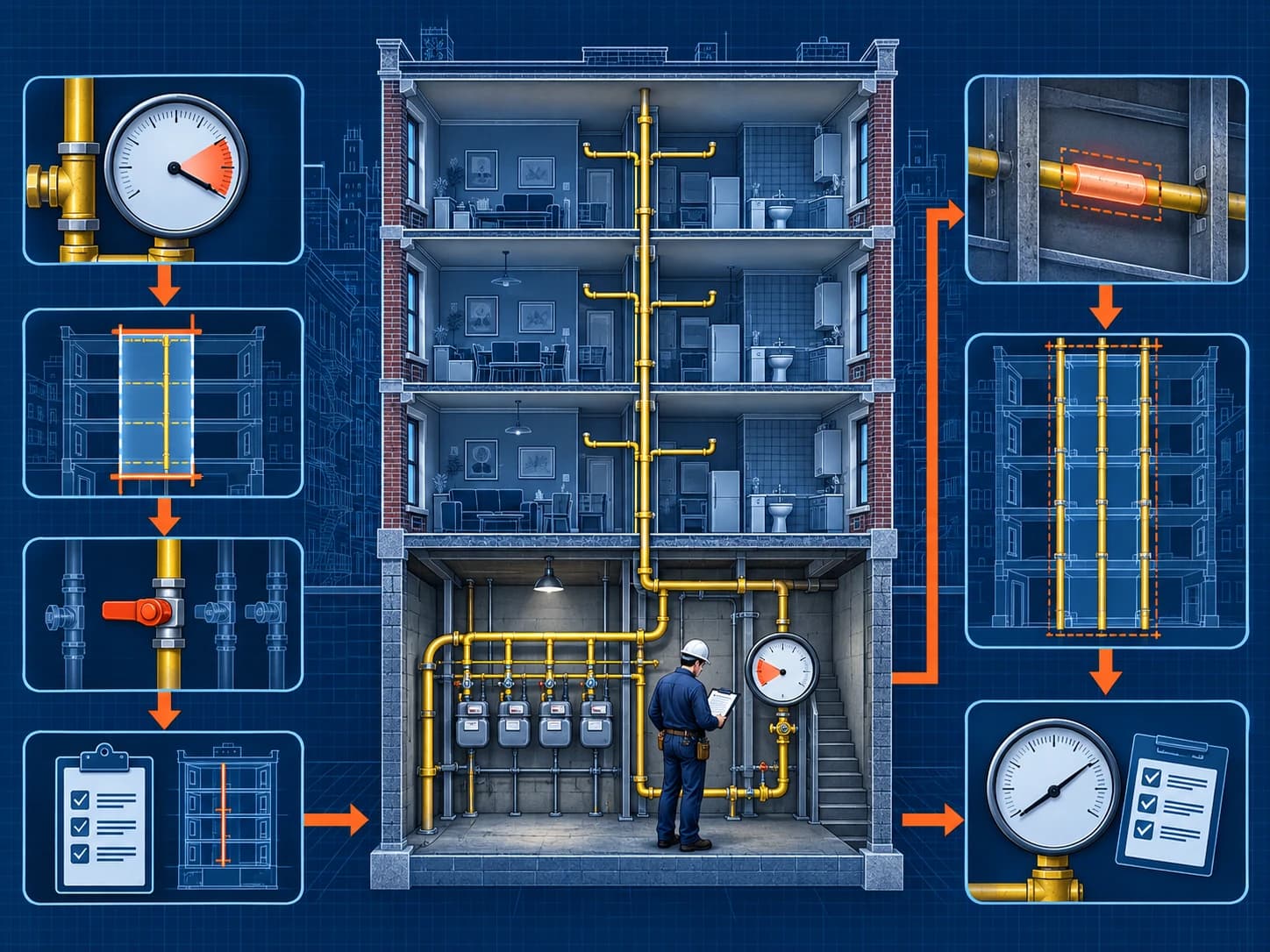
Key takeaways
- A failed test is a stop point, not a complete diagnosis. It shows that the tested piping boundary did not meet the required result. It does not identify the defect or decide how much piping must be replaced.
- The next useful question is what was actually tested. Owners should request the test boundary, filing and inspection record, result, excluded sections, and the Licensed Master Plumber's written next-step scope.
- Repair, retest, DOB acceptance, and utility restoration are separate milestones. A later passing test does not by itself authorize gas turn-on.
- Do not troubleshoot gas piping yourself. An odor, hissing sound, or suspected active leak requires leaving the area and calling 911 and the serving utility from a safe location.
A failed gas pressure test can turn a straightforward restoration or renovation into an open-ended building project. The result matters because the tested piping cannot advance as if it passed. But “the building failed” is too vague to price work, plan access, explain the status to residents, or predict whether one section needs repair or a broader repipe is justified.
For an owner or manager, the useful response is to confirm the safety state, identify the exact tested boundary, separate the failed result from other inspection objections, authorize licensed investigation and correction, then track the retest, DOB, and utility milestones independently.
This guide begins after an LMP- or DOB-connected pressure test or inspection does not pass. It does not cover every utility field leak or integrity test. If the serving utility found the problem during its own field process, use the gas-authorization and utility-restoration guide and confirm the next step against the utility notice or case record.
What does a failed gas pressure test actually prove?
A failed test establishes one limited fact: the piping included in that test did not hold as required under the applicable test and inspection conditions. It does not prove where pressure was lost, why it was lost, whether every connected section is defective, or whether a complete building repipe is necessary.
NYC DOB's current plumbing inspection requirements treat the gas pipe test, gas authorization, required equipment conditions, and final inspection as related but distinct requirements. The gas piping test must cover the meter outlet through the connected appliance, including any section isolations listed for the project. That makes the documented test scope part of the result.
Before approving more work, ask the Licensed Master Plumber for a plain-language record of:
- the DOB job, permit, and inspection request tied to the test;
- the riser, branch, meter group, appliance line, or other section included;
- any sections formally isolated or excluded;
- whether the objection is pressure loss, material or location, filing mismatch, incomplete work, or another issue;
- who witnessed or recorded the result; and
- the proposed investigation and correction scope.
That record turns “failed test” into a project status the owner can manage.
Is this a controlled test failure or an active gas emergency?
Treat those as different conditions. A controlled pressure-test failure on piping that is safely out of service belongs in the licensed repair and inspection workflow. Gas odor, hissing, a damaged live line, fire, or another suspected active release belongs in the emergency workflow first.
NYC HPD's gas-safety guidance says occupants who suspect a gas leak should leave the building, avoid switches, flames, and phones inside, then call 911 and the gas utility from a safe distance. Do not delay that response to contact a contractor or inspect the piping yourself.
Once the immediate condition is controlled, preserve the utility warning tag or notice, emergency record, shutoff boundary, and contact or case number. Austin's gas-shutoff response guide explains the safety-first path. The pressure-test decision begins only after the building is safe enough for the Licensed Master Plumber and project team to assess the system.
Why can an NYC building fail the gas-test inspection?
Pressure loss is one reason, but it is not the only inspection problem an owner may hear described as a failed gas test. NYC HPD's current owner gas guidance lists a test that does not hold, unapproved material, piping or meters in a prohibited location, and work that does not match the application among typical failure issues.
Those conditions lead to different next decisions:
| Recorded issue | Owner's next question | Useful evidence |
|---|---|---|
| Test did not hold | Which tested section lost pressure, and how will the LMP narrow the scope safely? | Test record, isolation map, field findings |
| Material or installation objection | Which condition conflicts with the approved documents or applicable requirement? | Inspection objection, approved filing, photos |
| Location objection | Does the approved route or meter arrangement need correction or redesign? | Plans, inspection notes, utility requirements |
| Work differs from the application | Must the filing be amended before work or inspection continues? | Approved scope, change log, revised filing plan |
Do not translate every objection into “there is one leak.” The written inspection result and the filed scope should control the next conversation.
How is the repair scope defined after the test fails?
The Licensed Master Plumber should define the appropriate, code-compliant, project-specific test and repair scope from the approved filing, inspection conditions, field findings, and any permitted section isolation. The owner should expect a documented choice among accessible localized correction, sectional replacement, and a broader repipe—not an unsupported assumption in either direction.
The scope can change when the team finds concealed or inaccessible piping, widespread corrosion, undocumented alterations, noncompliant materials or routing, several failing sections, or a filing that does not match what exists. In an older multifamily building, apartment access and finishes may also determine whether the team can investigate and correct one branch without disrupting other service areas.
Ask the LMP to present the decision in a short scope matrix:
- Tested boundary: the exact piping included in the failed result.
- Known findings: observed defects, inspection objections, and uncertain areas.
- Access required: cellar, meter room, risers, apartments, commercial space, and concealed locations.
- Correction options: what each option fixes, excludes, and requires next.
- Filing effect: whether the approved scope or inspection request must change.
- Retest plan: which boundary will be retested after correction.
This is the point to request a written price and milestone plan. It is not the point to promise a restoration date.
What happens after the correction is complete?
Correction moves the project back to verification; it does not move the building directly to gas turn-on. The applicable retest and inspection must pass, DOB records must reach the required state, and the serving utility must complete its own document and field process before it restores service.
DOB's utility service restoration guidance tells owners to make sure the licensed contractor completes required DOB inspections, submits the gas-restoration authorization request, and obtains required utility inspections. Keep those milestones on separate lines.
Con Edison's current restoration sequence places Buildings Department approval before Con Edison's visual inspection and leak test. It also warns that a problem found during its review sends the case back for more repair. National Grid's current forms page distinguishes a narrow reconnection form for a cut or capped pipe with a removed meter and no changes to inside gas plumbing or equipment from projects that need a different submission path.
The owner tracker should show:
| Milestone | Proof to request |
|---|---|
| Correction complete | LMP scope closeout, change record, photos where useful |
| Retest accepted | Test and inspection result tied to the correct job and boundary |
| DOB requirements complete | Inspection status and approved gas-restoration authorization where applicable |
| Utility package accepted | Utility case or reference number and accepted documents |
| Utility field work complete | Visual inspection, leak-test, meter, and access result |
| Service restored | Unit, meter, and appliance outcome, including anything left off |
How should management plan access and communication?
Plan access around each inspection and restoration milestone, not one guessed completion date. The LMP, DOB inspector, and utility may need different rooms, meters, risers, apartments, or equipment. Missing one required area can prevent a complete result even when repair work is finished elsewhere.
For a multifamily building, create one roster showing the unit or area, gas-fired equipment, reason access is needed, responsible party, confirmed window, and result. Do not describe an apartment as complete until the correct visit occurred and the result is recorded.
If the failure affects cooking gas, heat, or domestic hot water, management must separately plan resident updates and building operations. Use the building-wide gas-shutdown access guide for notices, temporary-service planning, and unit-by-unit closeout. Use the heating service hub when the affected gas piping interrupts a building heating system, while keeping gas repair and utility authorization in the licensed gas lane.
A useful update says what passed, what failed, who controls the next milestone, which access is still needed, and when management will provide the next verified update. Avoid “gas will be back tomorrow” unless the serving utility has confirmed the actual field plan.
Where does Local Law 152 fit?
Local Law 152 and a gas pressure test answer different questions. LL152 is the periodic visual inspection and certification path for covered building gas piping. A pressure test is a separate test that can be required during permitted work, correction, or service restoration.
DOB's current gas piping inspection guidance requires immediate notification and correction when an LL152 inspection identifies an unsafe or hazardous condition. That correction may lead to permits, testing, or a utility-controlled restoration, but those steps depend on the actual condition and work scope.
When both paths touch the same building, keep both record sets visible. Track the LL152 inspection report and certification separately from the permit, gas test, inspection objection, gas-authorization request, and utility case. Austin's Local Law 152 service path is the right bridge for the periodic-inspection record; the licensed gas-piping service remains the primary route for the failed-test repair and restoration scope.
What should be in the final owner closeout file?
The final file should explain the original test boundary, why the project stopped, what changed, which test and inspections later passed, and exactly what the utility restored. A receipt without the supporting records is not enough for future managers, buyers, lenders, or project teams to reconstruct the work.
Keep:
- the original utility notice, warning tag, or project instruction;
- the DOB job, permit, approved scope, and amendment history;
- the failed test or inspection result and defined boundary;
- the LMP's investigation, correction, and replacement scope;
- required photos and concealed-work records;
- the passing retest and DOB inspection results;
- the approved gas-restoration authorization or other applicable DOB record;
- utility submissions, case numbers, field results, and restoration confirmation;
- the apartment-access and relight record; and
- a list of sections or appliances intentionally left isolated, deferred, or outside the project.
If the failure remains unresolved, Austin Plumbing & Heating can review the available records, define the licensed field scope, coordinate required gas work and testing, and track the DOB and utility handoffs. Call Austin at (718) 835-3555 when the building needs a project-specific gas assessment.
Common Questions
Does a failed gas pressure test mean the entire NYC building must be repiped?
No. A failed test shows that the tested boundary did not meet the required result; it does not identify the defect or decide the final repair scope. A Licensed Master Plumber must compare the test boundary, accessible and concealed piping, prior alterations, filing documents, and field findings before recommending a localized repair, sectional replacement, or larger repipe.
Can the owner or superintendent look for the gas leak after a failed test?
No. Do not operate valves, apply test pressure, open piping, or search for a leak as a do-it-yourself task. If gas odor, hissing, or another active danger is present, leave the area and call 911 and the serving utility from a safe location. An LMP should direct the licensed gas assessment and repair, with qualified people working under the supervision required for the project.
Will gas service return as soon as the next pressure test passes?
Not necessarily. A passing test is one project checkpoint. DOB inspections, gas-restoration authorization, utility document review, the utility's visual inspection or leak test, apartment access, meter turn-on, and appliance relighting may remain open. Only the serving utility authorizes final restoration.
How long does it take to correct a failed gas pressure test?
There is no reliable universal timeline. Duration depends on the tested scope, where pressure is being lost, pipe accessibility and condition, whether the approved filing must change, required repairs, retesting, DOB review, utility scheduling, and apartment access. Ask for a milestone plan instead of a promised restoration date.
Is a failed pressure test the same as a Local Law 152 deficiency?
No. Local Law 152 is a periodic inspection and certification program. A pressure test can arise during permitted work or gas restoration. The two paths can overlap when an unsafe condition or repair affects both records, but the LL152 certification does not replace the permit, test, gas-authorization, or utility-restoration process.