
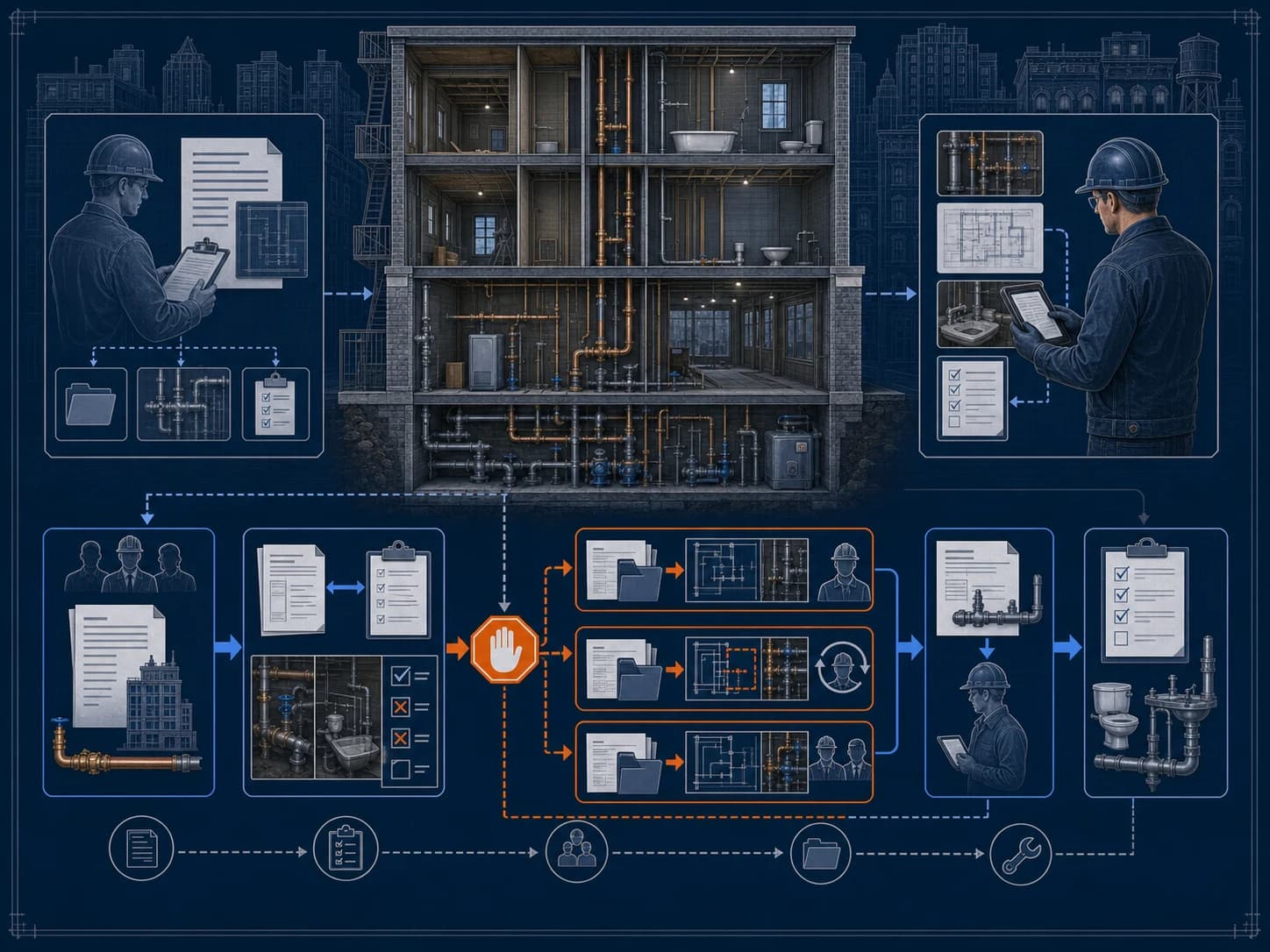
Key takeaways
- A new Licensed Master Plumber can often take over, but “take over” is not one DOB transaction. First identify whether the change affects an LAA applicant, a contractor or licensee on a work permit, or the PE or RA serving as applicant of record.
- The incoming LMP should not accept the job from screenshots alone. The filed scope, approved plans, permits, inspections, objections, test records, and actual field condition need to agree well enough for the new plumber to take responsibility.
- Do not let withdrawal create an unpermitted work gap. DOB says work must stop when a job has no applicant of record or contractor, and no further work may proceed after a contractor-withdrawal request until a new permit is issued to the new contractor.
- Keep contract disputes separate from DOB status. Money owed to the prior contractor, ownership of project files, warranties, and termination rights may affect the handoff, but they do not replace the required DOB record change.
The short answer
Yes, a new NYC Licensed Master Plumber may be able to take responsibility for an unfinished plumbing job. The new plumber does not simply inherit the prior plumber's permit, inspections, or liability through a private agreement. The project team must identify the exact DOB filing and stakeholder being changed, the incoming LMP must decide whether the work and records are acceptable, and the correct DOB supersede or permit-renewal path must be completed before work continues under the new plumber.
DOB's current Supersede and Withdrawal Guide separates several paths that owners often blur together. A permitted Limited Alteration Application has a specific applicant or contractor supersede action. A contractor or licensee on a work permit generally changes through Renew Work Permit with Renew Permit with changes. A PE or RA serving as applicant of record is changed through a separate job-filing supersede request.
Which record is actually changing?
Start with the live DOB record, not the name used in an old proposal. “Plumber of record,” “applicant,” “contractor,” and “permit holder” can describe different fields depending on the filing.
| Open record | Typical stakeholder being changed | Current DOB path to verify |
|---|---|---|
| Permitted LAA | Licensed trade applicant on the LAA | The superseding licensed applicant uses the Supersede action on the LAA filing |
| Plumbing work permit tied to a larger job | Contractor or licensee on the work permit | The incoming contractor uses Renew Work Permit and selects Renew Permit with changes |
| Main job filing | Applicant of record, usually a PE or RA | An eligible new applicant creates an applicant-of-record supersede request; owner attestation and plan requirements may apply |
| Prior BIS permit | Permit applicant on the legacy record | The route may remain a BIS permit-renewal-with-change process or require a current DOB NOW filing and administrative closeout, depending on the record |
| License or plumbing-business change affecting multiple open jobs | LMP and company tied to a portfolio of jobs | DOB Licensing and the plumbing units may require a job-transfer package rather than a single project action |
This distinction prevents two common errors: trying to change the architect when only the plumbing contractor changed, or creating a second permit when the existing work permit should have been renewed with changes. DOB's Build FAQ specifically tells a new applicant taking over a permit not to create a new secondary permit for that purpose.
For an LAA, the same FAQ says only a Licensed Master Plumber, Licensed Master Fire Suppression Piping Contractor, or Licensed Oil Burner Installer can be the applicant. It also says a permitted LAA can be superseded by an eligible new licensed applicant, but a withdrawn LAA cannot use that supersede action. Those are different starting conditions.
Build the takeover file before asking a new LMP to commit
Give the incoming plumber one organized package. A forwarded email chain is not a takeover file.
- Property and job identifiers. Include the address, BIN, DOB job number, filing extension, work type, permit number, and the system where the record lives.
- Current stakeholder map. List the owner, applicant of record, filing representative, current LMP or licensee, general contractor, inspectors, and anyone managing closeout.
- Approved scope. Provide approved plans, work summaries, schedules, amendments, and every Post Approval Amendment that changes the plumbing scope.
- Permit history. Save issued and expired permits, renewals, insurance-related holds, withdrawal or supersede requests, and current dashboard statuses.
- Inspection and test history. Include requests, results, objections, correction responses, test reports, photographs, and any record that is still open in DOB NOW: Inspections.
- Field record. Photograph accessible piping, fixtures, equipment, walls opened for inspection, concealed-work photos, and conditions that differ from the filed documents.
- Enforcement and closeout records. Add Stop Work Orders, violations, civil-penalty holds, occupancy dependencies, and the closeout document the project is trying to reach.
- Contract handoff. Have the owner and counsel preserve termination notices, payment records, warranties, lien issues, and document-delivery obligations separately from the DOB filing package.
The incoming LMP can then compare what DOB shows with what exists in the building. If the work was performed outside the filed scope, the after-the-fact permit guide explains why the correction path may be more than a stakeholder change.
What should the incoming LMP inspect before accepting responsibility?
The official DOB workflow describes how a stakeholder changes. It does not force a new plumber to accept unknown work or certify conditions the plumber cannot verify.
A responsible takeover review should answer:
- Does the job number and work type cover the plumbing that is actually installed?
- Do the approved drawings, work summary, and amendments match the routing, fixtures, equipment, and materials in the field?
- Which portions are unfinished, concealed, changed, damaged, or already tested?
- Can prior inspection and test results be tied to the correct permit and scope?
- Are open objections, PAAs, audits, violations, or Stop Work Orders affecting the next action?
- Are gas, fire-suppression, boiler, occupancy, or other licensed scopes connected to the plumbing record?
- What must be opened, tested, corrected, redesigned, or documented before the incoming LMP will assume responsibility?
- Which responsibilities remain with the owner, PE or RA, GC, prior contractor, utility, or DOB?
That review protects the owner as well as the new plumber. A quick administrative transfer is not useful if the permit later stalls because the new LMP cannot verify what is behind a wall or reconcile the field condition with the approved filing.
What happens while withdrawal or supersede is pending?
Treat the live status as an operating control.
DOB's current FAQ says that if a job has no applicant of record or contractor, work must stop. It also says no further work can happen after a contractor-withdrawal request until a new permit is issued to the new contractor. While certain withdrawal or supersede states are pending, DOB NOW: Inspections will not allow a new inspection to be scheduled; an inspection requested before the status change may still proceed while DOB decides the request.
The safe project sequence is:
- Preserve the existing permit, filing, inspection, and field record.
- Confirm whether the prior stakeholder is being replaced in one transaction or withdrawn first.
- Stop affected work whenever the DOB status or permit record requires it.
- Complete the correct supersede or permit-renewal path.
- Confirm the new stakeholder and permit status in DOB NOW or BIS.
- Reconcile inspections, objections, PAAs, and remaining work before scheduling the next field step.
A supersede or withdrawal also does not automatically remove a Stop Work Order. Use the plumbing Stop Work Order guide to keep the contractor change and DOB rescission process in separate lanes.
How do the three common DOB paths differ?
Permitted LAA
DOB's FAQ directs the superseding licensed applicant to find the permitted LAA in DOB NOW: Build and select Supersede. The superseding applicant must be logged in. If the LAA was already withdrawn, that supersede action is unavailable; the team must determine the correct replacement or closeout path from the actual record.
An LAA takeover should still include a field and document review. “Permitted” tells the team a filing reached permit status. It does not prove every installed condition matches the filing or that every inspection and closeout item is complete.
Contractor or licensee on a work permit
For a contractor or licensee change, DOB's Permit Renewal page identifies a permit renewal with change as the supersede mechanism. The current Build FAQ says the incoming applicant should locate the existing work permit, renew it with changes, select the stakeholder being changed, and enter the new applicant information.
This path changes the work-permit stakeholder. It does not automatically change the PE or RA on the main filing, correct the approved scope, close inspections, or resolve an occupancy hold.
Applicant of record on the main filing
When the PE or RA applicant of record changes, an eligible new applicant submits a job-filing supersede request and the owner attests. DOB may require plans depending on filing and permit status. That is design and filing responsibility, not simply a plumbing-contractor substitution.
The incoming LMP and new design applicant should coordinate when both records change. The TCO and Final CO plumbing sign-off guide shows why the LMP's permit responsibilities and the applicant-of-record's job-level closeout responsibilities should remain distinct.
What if the prior plumber retired, changed companies, or cannot finish?
DOB publishes a separate license and company change process for an LMP changing businesses, shelving, retiring, or surrendering a license. That process requires the licensee to account for open jobs and either close or transfer them. When another licensee takes responsibility, DOB describes a documented transfer with the affected jobs identified.
That portfolio process is not a shortcut for an owner replacing a contractor on one active project. It is a signal to check whether the prior plumber's license or company status created a broader record issue. Confirm the individual job, permit, and stakeholder status before choosing the route.
If the prior plumber is unavailable, do not guess at missing test results or treat unsigned project files as accepted DOB records. Build the best available history from the owner, applicant, GC, DOB portal, inspection system, and field condition, then let the incoming LMP define what must be recreated or verified.
Does the new LMP inherit the old contract or payment dispute?
The DOB record change and the private contract are different questions.
A supersede or permit renewal does not decide whether the owner properly terminated the prior agreement, who owns plans or photographs, whether money remains due, whether a warranty survives, or whether one contractor is responsible for another contractor's defective work. Those issues depend on the contracts, facts, and legal advice.
The project team should avoid making either side conditional on unsupported assumptions:
- Do not assume an unpaid invoice prevents every DOB stakeholder change.
- Do not assume a DOB supersede eliminates contract, lien, or document-delivery issues.
- Do not ask the incoming LMP to certify prior work merely because the owner needs the project moving.
- Do not let a private dispute become an excuse for continuing work without the correct active permit.
Austin can review the plumbing record and field scope. Counsel should handle termination, lien, payment, ownership, or liability disputes.
A one-page owner decision map
| Question | If yes | Next record to verify |
|---|---|---|
| Is this a permitted LAA with an eligible new licensed applicant? | Use the LAA supersede path after the new LMP's acceptance review | LAA filing status, stakeholder, scope, inspections, and sign-off path |
| Is the LMP the contractor or licensee on a larger-job work permit? | Use permit renewal with changes | Existing work permit, permit applicant, expiration, open inspections, and linked main job |
| Is the PE or RA applicant of record also changing? | Coordinate a separate applicant supersede | Main filing, owner attestation, plans, PAAs, and job-level status |
| Was the prior LAA withdrawn? | Do not assume it can still be superseded | Current filing status and DOB's replacement or administrative-closeout route |
| Is a withdrawal or supersede pending? | Treat work and inspection scheduling as controlled by the live status | On-hold status, issued replacement permit, and inspection availability |
| Is there a Stop Work Order or violation? | Keep the enforcement path separate | Order scope, correction, permit, penalties where applicable, and rescission or Certificate of Correction |
| Does the filed scope differ from the field? | Pause the handoff decision until the mismatch is scoped | PAA, new filing, correction, testing, or removal path |
When should Austin Plumbing review the job?
Bring Austin in when the open record involves an LAA, plumbing work permit, gas or plumbing inspection, incomplete testing, a field condition that does not match the filing, unpermitted work, a plumbing violation, or a closeout item controlled by an LMP.
Austin can:
- review the supplied DOB job, permit, inspection, and enforcement records;
- inspect accessible plumbing, gas, boiler, and connected field conditions within the agreed scope;
- identify which work and records an incoming LMP would need to accept;
- separate the LMP permit change from PE or RA, owner, GC, utility, and DOB responsibilities;
- scope required testing, corrections, filing changes, and closeout work; and
- coordinate the plumbing portion of a broader compliance or violation-resolution project.
Austin cannot promise that every prior installation can be accepted, that DOB will approve a particular request, that concealed work will not need to be opened, or that changing the plumber resolves a private contract dispute. The useful first deliverable is a written record-and-field gap list showing what is known, what must be verified, and which party owns the next action.
If an unfinished NYC plumbing filing needs a new licensed team, request a plumbing record and field review. Include the job number, permit, current status, prior plumber information, approved scope, inspections, open objections, and photographs so the first conversation starts with the actual handoff.
Common Questions
Can a new Licensed Master Plumber take over an open NYC plumbing permit?
Often, but the correct DOB action depends on the filing and stakeholder being changed. A permitted LAA uses its supersede action, while a contractor or licensee on a work permit generally changes through a permit renewal with changes. The incoming LMP should inspect the field condition and records before accepting responsibility.
Can plumbing work continue while the prior contractor is withdrawn?
DOB says no further work can happen after a contractor-withdrawal request until a new permit is issued to a new contractor. If the job has no applicant of record or contractor, work must stop. The team should use the current DOB status rather than an email agreement as permission to proceed.
Is changing the LMP the same as changing the applicant of record?
Not always. On a larger project, the applicant of record may be a PE or RA while the LMP is the contractor or licensee on the plumbing work permit. An LAA is different because only an eligible licensed trade applicant can be the applicant. Identify the exact filing and stakeholder field before starting a supersede request.
Does the new LMP have to accept the prior plumber's work?
No. The incoming LMP needs enough access and records to decide whether the filed scope matches the field condition and whether unfinished or concealed work can be verified. The plumber may require correction, testing, opening concealed areas, a filing change, or a new scope before taking responsibility.
Does a supersede request remove a Stop Work Order?
No. DOB says a contractor or applicant withdrawal does not automatically remove a Stop Work Order. The order has its own rescission path, and prohibited work must not resume until DOB has issued the applicable permission and the correct contractor or licensee record is active.