
Key takeaways
- Plumbing inspection, permit sign-off, and occupancy approval are related but separate records. A passed field inspection does not automatically mean the plumbing sign-off appears on the TCO or Final CO request.
- Find the exact blocked record before scheduling more work. The open item may be an inspection, objection, associated plumbing permit, job-level sign-off request, floor recommendation, or occupancy-request objection.
- Keep the applicant of record and Licensed Master Plumber in the same closeout loop. The PE or RA coordinates the job-level occupancy path; the LMP controls the plumbing work, tests, inspections, corrections, and supporting records.
- A TCO and Final CO do not have the same closeout threshold. Track the requested floors and the current DOB decision instead of assuming one approval proves the entire building is complete.
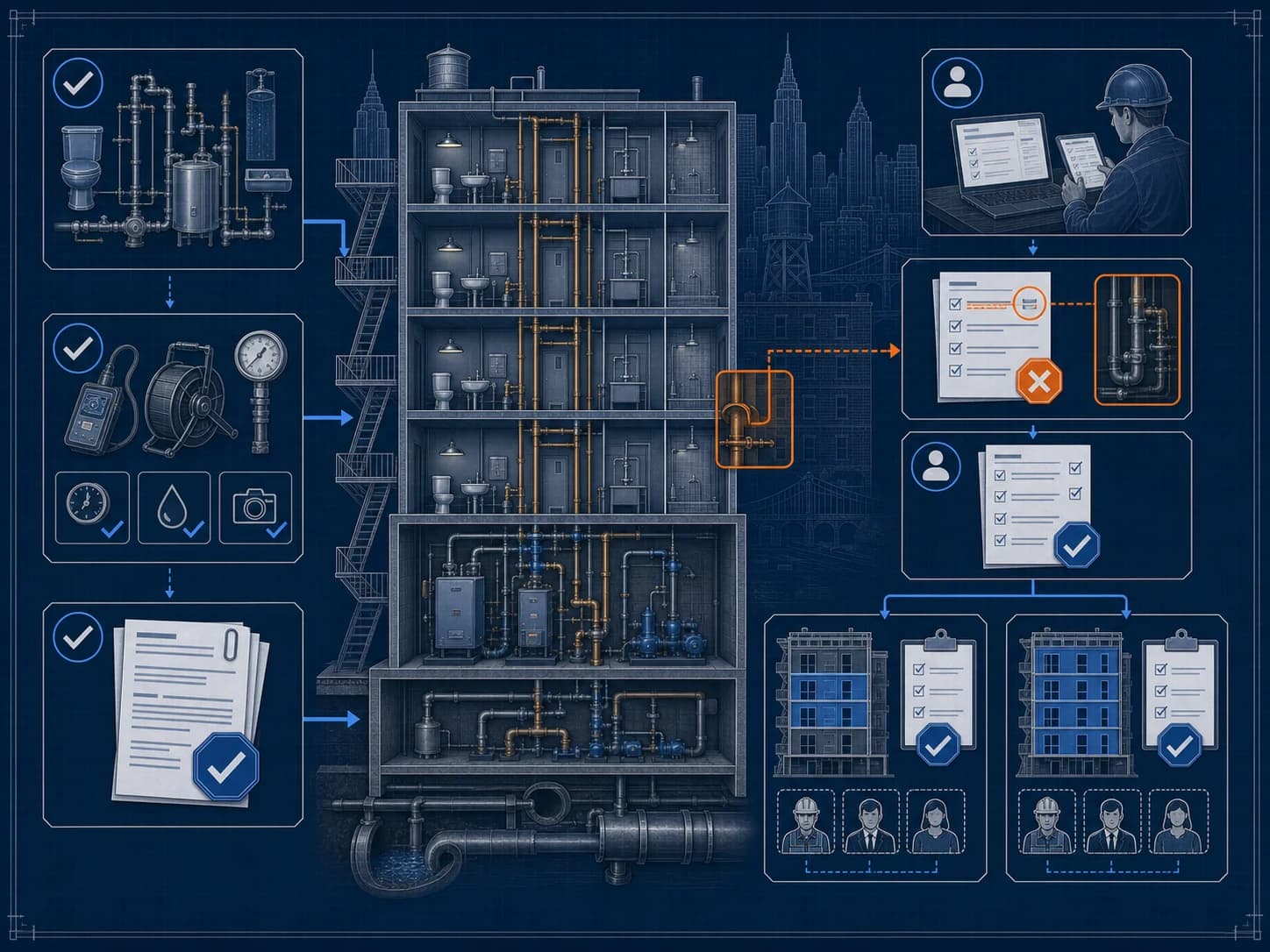
Plumbing work can look complete in the building and still hold up a Temporary Certificate of Occupancy or Final Certificate of Occupancy. That usually means the field work, plumbing permit, inspection record, job-level sign-off request, and occupancy request are not telling the same story yet.
The fix is not another vague update that says "waiting on DOB." The project team needs to identify the exact job, permit, inspection, floor, request, objection, and responsible party. This guide gives owners, general contractors, architects, developers, and construction managers a practical way to build that record.
Why can plumbing sign-off stop a TCO or Final CO?
DOB lists a temporary or final plumbing inspection sign-off among the requirements for a Temporary Certificate of Occupancy. For a Final Certificate of Occupancy, DOB lists final plumbing inspection sign-off along with other job-level requirements.
That does not mean the plumber controls the whole occupancy request. It means the plumbing record has to reach the sign-off state the occupancy unit expects for the applicable floor or building scope. Construction, electrical, elevator, Schedule of Occupancy, violations, open applications, cost, and other required items can remain separate lanes.
The plumbing hold should therefore be treated as a record-matching problem. Start with the occupancy request, trace it back to the main job and associated plumbing work, then compare every required status with the actual field condition.
Which plumbing record is actually holding the request?
There are several records that project teams casually call "the plumbing sign-off." They do not all prove the same thing.
| Record or milestone | What it tells the team | What it does not prove |
|---|---|---|
| Plumbing inspection result | Whether the recorded inspection reached its reported outcome | That every objection, permit, associated job, or CO sign-off item is closed |
| Plumbing permit or work-type status | Whether the applicable plumbing permit moved into signed-off status | That the job-level TCO or Final CO request has no plumbing objection |
| TCO or Final CO plumbing sign-off request | Whether the occupancy-related plumbing review was requested for the job and floors | That DOB granted the recommendation or that every other discipline is ready |
| Floor-level plumbing CO sign-off | The plumbing recommendation shown for the applicable floor on the CO request | That the whole building qualifies for Final CO |
| Letter of Completion | That an eligible alteration job reached its applicable completion record | That a new, amended, temporary, or final CO was issued |
DOB's DOB NOW Build FAQ distinguishes a signed-off permit from an issued Letter of Completion. The same FAQ says inspection sign-offs for construction, plumbing, electrical, and elevators appear in separate columns on the Certificate of Occupancy request.
Ask for the actual DOB NOW status or PDF, not a paraphrase. A screenshot should show the record number, request type, floor or scope, current status, and objection when one exists. That evidence lets the team work on the open item instead of repeating a completed step.
Build one closeout sheet before requesting another inspection
Create a one-page tracker that connects the main job to every plumbing record. It should be understandable to someone who did not attend the last coordination call.
- Identify the occupancy request. Record whether the request is for a TCO, TCO renewal, interim or partial occupancy where applicable, or Final CO. List the floors and uses included.
- Record the main job. Include the job number, filing type, applicant of record, owner, general contractor, Schedule of Occupancy status, and current CO-request status.
- List every associated plumbing job and permit. Do not assume the newest permit is the only one connected to the building or requested floors.
- Map required inspections and tests. Note the result, date, record number, open objections, and whether the result appears on the correct permit.
- Check work-type sign-off. Confirm that the applicable plumbing permit shows the expected signed-off status in DOB NOW, not only a pass result in an email or inspection report.
- Check the occupancy-related plumbing sign-off. Open the CO request and review the plumbing column for each requested floor.
- Name the next owner. Assign the open action to the applicant of record, LMP, owner, GC, another trade, or DOB unit.
- Define proof of completion. State which updated DOB record, approved request, inspection result, or accepted document will close the line.
DOB's plumbing permit guidance says LMPs need the required inspections and tests completed plus final plumbing sign-off. The owner-side plumbing project checklist likewise tells owners to make sure required inspections and sign-off are completed to close the permit.
What should be ready before a plumbing CO sign-off request?
The exact package depends on the job, permit structure, requested floors, approved plans, and field conditions. There is no responsible universal checklist for every TCO or Final CO project.
At minimum, reconcile these categories before treating the request as ready:
- the main job and every associated plumbing job are correctly linked;
- the plumbing scope in the field matches the approved record or approved amendments;
- required roughing, testing, finish, and final inspections for the scope are complete;
- open plumbing objections have an identified correction and response path;
- the requested floors match the occupancy request and Schedule of Occupancy;
- related permits do not carry an unresolved inspection that affects the request; and
- supporting documents are in the system and record where DOB expects them.
DOB's current TCO and CO sign-off manual says a Final CO plumbing sign-off request cannot proceed while plumbing inspections remain open on the primary job, linked permits, associated jobs, or their linked permits. Use that as a coordination check, then verify the live record because the project structure and current DOB interface control the actual request.
If field work changed after approval, do not hide the mismatch inside a sign-off request. Have the applicant of record and LMP determine whether the plumbing record, main job, or Schedule of Occupancy needs a correction or amendment first.
Who owns each handoff?
A stalled sign-off often persists because the whole team says "the plumber has it" even when the next action belongs to someone else.
| Party | Closeout responsibility |
|---|---|
| Owner or developer | Keeps the team engaged, provides access and authorizations, and demands a record-based status |
| Applicant of record, PE or RA | Coordinates the main job, plans, amendments, occupancy request, and job-level plumbing sign-off request |
| Licensed Master Plumber | Completes the permitted plumbing scope, tests, inspections, corrections, and plumbing closeout support |
| General contractor or construction manager | Coordinates trade readiness, access, floor sequencing, and dependencies across disciplines |
| DOB | Performs or reviews the applicable inspection and sign-off steps and decides the occupancy request |
DOB's current DOB NOW Build FAQ says the plumber cannot request final plumbing sign-off on the job record and assigns that request to the applicant of record. It also says the final inspection for the plumbing work type is performed by DOB.
DOB's linked workflow manual describes owner or delegate access for some TCO and CO sign-off requests. Because those public instructions are not perfectly aligned, use a conservative operating rule: have the applicant of record coordinate the request and confirm current permissions on the live job record or with the applicable DOB unit before relying on delegation.
How does a TCO differ from a Final CO?
A TCO is not a nearly finished Final CO. It is a separate occupancy decision with a limited scope and unresolved final items.
| Question | TCO | Final CO |
|---|---|---|
| What is DOB deciding? | Whether the requested space may be occupied while final issues remain | Whether the completed work and building record satisfy the final occupancy requirements |
| Which plumbing sign-off matters? | Temporary or final plumbing sign-off for the applicable floors or scope | Final plumbing inspection sign-off for the final occupancy path |
| Can other items remain open? | DOB may allow items that do not affect safe occupancy of the approved floors | DOB says open applications and violations must be closed or an applicable waiver approved |
| Does it expire? | The issued TCO has an expiration and may require renewal | A Final CO does not expire |
The project team should read the issued TCO and current CO request instead of working from a generic renewal assumption. A change in floors, plans, scope, or open items can change what DOB needs for the next request.
For Final CO, the plumbing line is only one part of the broader closeout. The DOB Certificate of Occupancy page also lists construction, elevator, electrical, survey, pavement, Schedule of Occupancy, application, violation, and cost requirements where applicable.
What are the most common plumbing sign-off stall patterns?
The record usually stalls in one of these patterns:
A passed inspection is not reflected in permit status. The team has an inspection result, but the linked permit or work type does not show signed off. Compare the inspection to the correct permit and ask the applicable DOB plumbing unit what remains.
The main job and plumbing job are not reconciled. The occupancy request points to one job while an associated plumbing permit, old filing, or related inspection remains open elsewhere.
The requested floors do not match the plumbing recommendation. A TCO may cover only certain floors. A plumbing sign-off for one scope should not be treated as approval for every floor or the entire building.
The field condition changed without an approved record update. Moved fixtures, changed equipment, revised risers, or other scope changes can make a clean inspection request difficult until the filing team addresses the mismatch.
A related enforcement record remains open. A violation, work-without-permit condition, or unclosed prior application may need its own correction and waiver review. Use the after-the-fact plumbing permit guide when the field condition is not covered by the approved permit.
What if the work passed but the project is still not signed off?
Treat "Pass/Final" as evidence, not the final answer. Confirm whether the result belongs to the right permit, whether the permit status changed, whether open objections remain, and whether the plumbing CO sign-off appears on the occupancy request.
DOB's Build FAQ says all permits on an eligible job filing need signed-off status before a Letter of Completion request. It also explains that the plumbing, electrical, elevator, and construction sign-offs for occupancy are visible separately on the CO request. A project can therefore have a successful inspection result and still need another record or request to move.
If the pass result is not reflected, send a focused inquiry. Include the main job, plumbing job, permit, inspection record, result date, requested floors, CO request, and screenshot of the mismatch. Ask what exact item prevents sign-off and which unit can receive it.
Avoid repeatedly scheduling inspections without that diagnosis. Another field visit will not fix a missing association, unresolved objection, wrong request type, or unsubmitted applicant action.
What belongs in the owner closeout file?
Keep one durable file that shows what was approved, built, inspected, signed off, and accepted for occupancy.
- approved plans and amendments relevant to the plumbing scope;
- main job, associated plumbing job, and permit numbers;
- inspection and test requests, results, and objection responses;
- photos of concealed and completed work where contractually available;
- plumbing work-type sign-off evidence;
- the floor-level plumbing sign-off shown on the CO request;
- Schedule of Occupancy and CO-request records;
- the issued TCO, Final CO, or Letter of Completion, as applicable; and
- a final responsibility log showing how open items were resolved.
This file helps the owner answer the next lender, buyer, tenant, board, insurer, or project team without reconstructing the job from inbox messages. The NYC transaction guide explains why accepted closeout evidence matters when a building changes hands.
When the plumbing scope is an apartment alteration, the co-op and condo board closeout-file guide adds the building approval, field-change, concealed-work, and managing-agent records that sit beside the DOB sign-off path.
When should Austin Plumbing review the hold?
Bring in Austin when the open item involves plumbing scope, an LMP permit, missing or failed plumbing inspections, testing, corrective work, an unresolved plumbing objection, unpermitted plumbing, or a plumbing record that does not match the field condition.
Austin can review the plumbing permit and field scope, identify LMP-controlled work, prepare for required inspections, correct plumbing conditions, and coordinate the plumbing evidence with the applicant of record. Austin does not replace the architect or engineer on the main job, decide the CO request, close unrelated trades, or promise a DOB approval date.
If a plumbing violation, open permit, or field mismatch is holding the project, send the job numbers, inspection results, objections, photos, and current CO-request status through Austin's project and violation review form. The first useful deliverable is a clear map of what Austin controls, what the applicant controls, and what DOB still needs to decide.
Common Questions
Is a passed plumbing inspection the same as plumbing sign-off for a TCO or Final CO?
Not necessarily. A passed inspection is evidence within the plumbing record. The project team should also confirm the permit or work-type status and the plumbing sign-off shown on the Certificate of Occupancy request for the applicable floors.
Can the Licensed Master Plumber request final plumbing sign-off for the CO?
DOB's current DOB NOW Build FAQ says no and assigns the final plumbing sign-off request on the job record to the applicant of record, a PE or RA. The LMP still owns the plumbing work, required tests, inspections, corrections, and supporting records.
Can DOB issue a TCO while other items remain open?
Sometimes. DOB says a TCO may be available when a property is safe to occupy but issues remain before final approval. The applicable floors still need the required temporary or final inspection sign-offs, and DOB decides whether the occupancy request is acceptable.
Does a Final CO require every open application and violation to be closed?
DOB's current guidance says a Final CO requires open applications and violations to be closed, unless the project receives an approved open-application or violation waiver through the applicable DOB review path. Do not assume a waiver will be granted.
Is a Letter of Completion the same as a Certificate of Occupancy?
No. DOB may issue a Letter of Completion for alteration work that does not require a new or amended CO. A TCO or Final CO addresses legal occupancy. Confirm which closeout document the main job and plumbing work actually require.