
Key takeaways
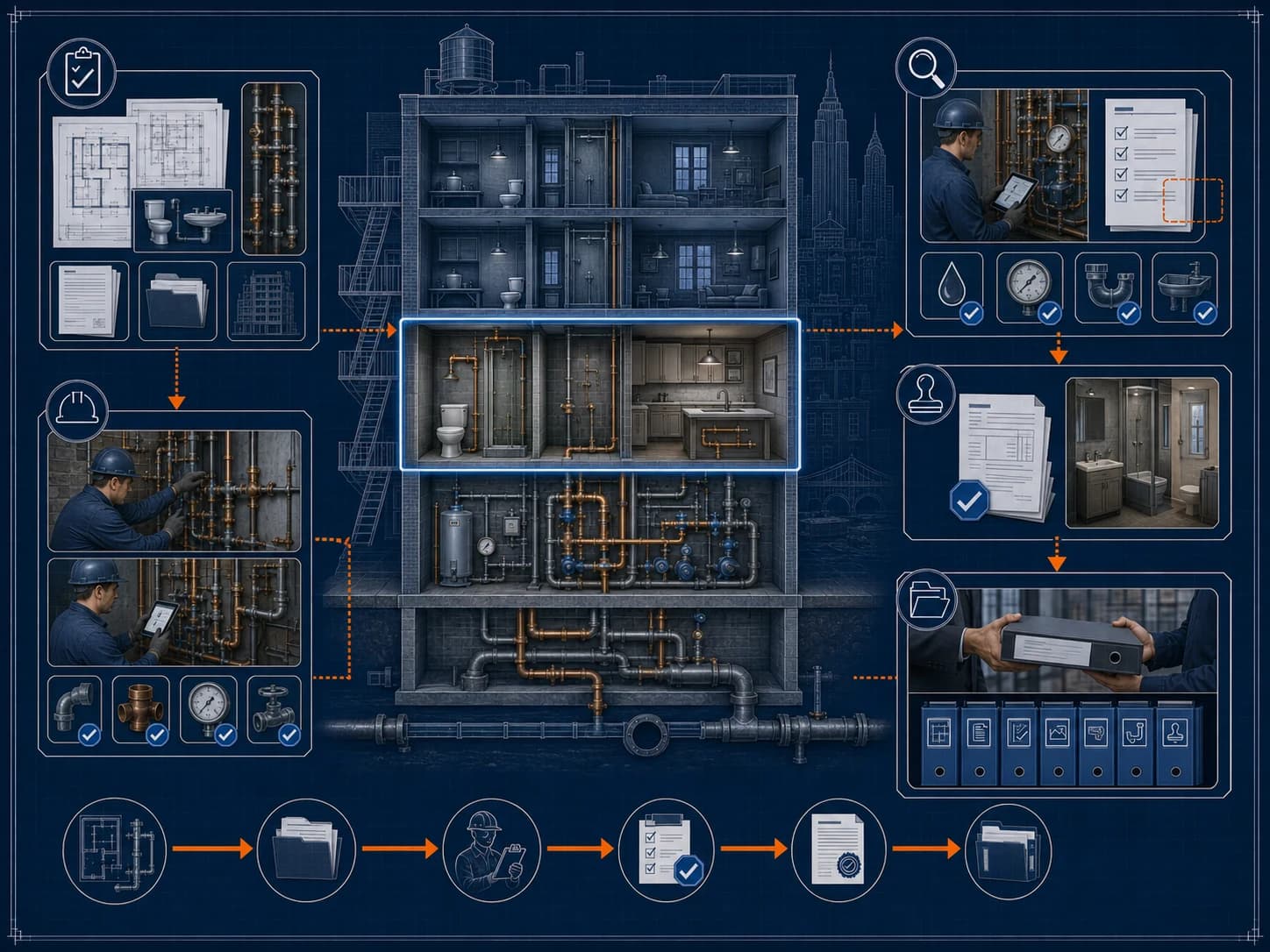
- A board closeout file should connect the approved scope, active permits, field work, inspections, resolved objections, sign-offs, and the final building record.
- A contractor invoice, finished bathroom, or passed inspection is not a complete closeout package by itself.
- Keep the building's private alteration agreement separate from DOB requirements. Both may matter, but one does not prove compliance with the other.
- Make one person responsible for reconciling the final document index against the live DOB records before the board releases the project from its closeout hold.
An NYC co-op or condo plumbing alteration should not disappear into an email thread after the walls close. The board needs a record that shows what was approved, who performed the licensed work, what DOB inspected, which objections were resolved, and what final sign-off or completion record applies.
DOB says plumbing alterations can involve an owner, Registered Design Professional, Licensed Master Plumber, permits, inspections, tests, and final sign-off. The exact path depends on the work. A building's alteration agreement can add private requirements, but it cannot replace the applicable DOB record (NYC DOB, Plumbing Permits and Applications, retrieved 2026-09-03).
Use this guide to build one board-ready index from approval through closeout. If the public record, approved scope, and apartment condition do not agree, start with Austin's project and violation review intake before calling the file complete.
What should a board approve before plumbing work starts?
Approve a defined scope and responsibility map, not just a contractor proposal. The pre-work package should identify the apartment, fixtures and piping affected, filed scope, responsible professionals, required permits, access rules, protection plan, inspection path, and the evidence required at closeout.
DOB's Project Checklists for Owner: Plumbing says the owner is responsible for hiring qualified professionals, providing filing consent, retaining a licensed contractor, and ensuring required inspections and sign-off are completed (retrieved 2026-09-03). A board or managing agent should use that public framework alongside its building-specific alteration agreement.
Before authorizing work, collect:
- A scope sheet. List every fixture, appliance, riser connection, branch line, drain, vent, water line, gas component, sleeve, chase, and wall or floor opening within the proposed work.
- The filing decision. Identify whether the work is permit-exempt, an LAA, or part of a larger alteration filing. Record who made that determination.
- The professional team. List the apartment owner, board contact, managing agent, applicant of record, Licensed Master Plumber, general contractor, and any Special Inspection Agency.
- The approved documents. Save the accepted drawings, work summary, schedules, specifications, permits, insurance records, and building approvals.
- The closeout promise. Name the exact records the team must deliver before the board treats the alteration as complete.
Build the closeout index before the walls close
Start a document index on day one and update it as the work changes. The index should show the file name, record number, responsible party, current status, last update, and final evidence for each item. It should be possible to audit the project without opening dozens of unlabeled attachments.
Use these sections:
| File section | Minimum useful contents |
|---|---|
| Board approval | Alteration agreement, board or managing-agent approval, deposits or insurance records required by the building, access and protection rules |
| DOB filing | Job and permit numbers, approved scope, drawings, amendments, filing status, applicant and contractor records |
| Licensed work | LMP contract, license information, daily or milestone records, concealed-work photos, test and inspection coordination |
| Changes | Written change approval, revised scope, applicant decision, Post Approval Amendment or as-built path when applicable |
| Inspections | Requests, results, objections, certifications, reinspection evidence, Special Inspection reports |
| Completion | Permit sign-off, job completion status, applicable Letter of Completion or occupancy record, final drawing set |
| Turnover | Shutoff and valve map, equipment information, warranties, maintenance notes, emergency contacts, final board index |
Do not treat private board approval as a DOB approval. Do not treat DOB approval as proof that the apartment owner satisfied every building rule. The closeout index should keep those lanes separate and show where they meet.
What should the board verify during the work?
The board should verify that field conditions continue to match the approved package. Plumbing routes, fixture counts, equipment, penetrations, shutoffs, and connections can change after demolition exposes the building. A verbal change is not a reliable final record.
DOB's Project Sign-Off and Completion guidance says substantive changes require a Post Approval Amendment and non-substantive changes may require revised as-built drawings before sign-off (retrieved 2026-09-03). The applicant of record should decide the filing response, while the LMP should document the licensed plumbing condition.
Set three project checkpoints:
Before concealed work is covered
Confirm the approved routing against the visible installation. Preserve dated photos tied to rooms, walls, floors, risers, or drawing references. Confirm required tests and inspections occur at the correct stage. Photos help reconstruct the work, but they do not replace required inspection or test records.
For a GC-led, area-by-area hold point, use the NYC plumbing rough-in checklist before walls close to connect drawings, trade coordination, field changes, tests, inspections, and the closure release.
When the scope changes
Require a written description of the field condition, proposed change, cost or schedule effect, and responsible professional's filing decision. If the change extends beyond the approved plumbing scope, use Austin's after-the-fact plumbing permit guide to understand why correction may involve more than a revised invoice.
Before final finishes
Review open objections, incomplete inspections, access needs, test results, and remaining DOB or building requirements. Closing walls before the record is ready can make later verification slower, more invasive, or impossible without reopening finished work.
Which inspection and sign-off records belong in the file?
Keep the actual result, not a screenshot that says an inspection was requested. DOB's inspection system distinguishes appointments, results, objections, certifications, reinspections, and sign-off activity. The board file should preserve the final status and enough context to connect it to the correct job and permit.
The DOB NOW: Inspections FAQs say anyone can search inspection information, while owners and associated professionals can request or manage actions. They also explain that approved certification of the last certifiable objection generates an updated passing inspection report that can support a Letter of Completion or sign-off request (retrieved 2026-09-03).
For each required inspection or test, record:
- the job, permit, work type, and inspection type;
- the request and inspection dates;
- the result and every objection;
- correction evidence and certification or reinspection outcome;
- the final report or record showing the accepted status; and
- the professional who confirmed no related inspection item remains open.
A passed plumbing inspection does not automatically prove that every filing, permit, Special Inspection, objection, or private building requirement is closed. The board should reconcile the whole index, not stop at the first green status.
Does the project need a Letter of Completion or another final record?
The final record depends on the job type and approved scope. A minor alteration that does not require a new or amended Certificate of Occupancy may be eligible for a Letter of Completion. Other alteration work may connect to a broader occupancy or completion path.
DOB's Letter of No Objection or Completion guidance says project work does not end when the contractor finishes physically. Required inspections and sign-offs must be completed before the applicable Letter of Completion or Certificate of Occupancy can close the project (retrieved 2026-09-03).
Ask the applicant of record to identify the expected closeout document at the start and confirm it again before turnover. The board file should show:
- Each related job and permit reached its required final status.
- Required inspections and objections are complete.
- Special or progress inspections are complete when applicable.
- Approved documents match the final condition, including required amendments or as-builts.
- The applicable completion, sign-off, or occupancy record was requested and accepted.
If plumbing sign-off is tied to a larger building occupancy request, Austin's TCO and Final CO plumbing sign-off guide explains why the floor-level plumbing recommendation, related permits, and main job remain separate records.
What belongs in the final board archive?
The board archive should let a future manager, superintendent, engineer, plumber, buyer, or apartment owner understand what changed without reconstructing the project from memory. It should include both a readable index and the underlying accepted records.
Use a final handoff meeting to confirm:
- the final scope and drawing set match the installed work;
- valves, shutoffs, cleanouts, equipment, and access points are identified;
- required tests, inspections, objections, and sign-offs are documented;
- open items are listed with an owner and due date rather than hidden in “substantially complete” language;
- warranties and maintenance requirements are assigned;
- the managing agent received files in the building's durable storage system; and
- the apartment owner and board understand which future maintenance remains private and which affects common systems.
The building should set its own retention policy with management, counsel, and its insurer. DOB does not publish one universal retention period for every co-op or condo alteration file. Avoid promising that a particular archive package settles contract, insurance, warranty, or liability questions.
Common closeout mistakes
Closing on appearance. Finished tile and working fixtures do not prove the filed scope, inspections, objections, and sign-offs are complete.
Accepting screenshots without identifiers. Every status image should connect to a job, permit, inspection, request, property, and date.
Losing the original approved scope. Without the starting set, the board cannot tell whether the final drawings or installed conditions changed.
Letting a contractor change break the record. If the original plumber cannot finish, use the new-LMP takeover guide before assuming another firm can inherit the permit or prior work.
Treating the archive as legal clearance. Board counsel should interpret alteration agreements, releases, indemnity, insurance, payment, lien, and ownership questions. Austin can address the plumbing record and field condition, not decide private legal rights.
Failing to check the public record. The DOB NOW Public Portal FAQs explain how public users can search DOB NOW records (retrieved 2026-09-03). Compare the handoff package with the live record before the board closes its checklist.
When should Austin Plumbing review the alteration?
Bring Austin in when the alteration includes an open plumbing permit, failed or missing inspection, unresolved objection, concealed-work question, field condition that differs from the filed scope, prior unpermitted work, contractor change, common-system impact, or a record that may affect a sale or refinance.
Austin Plumbing & Heating can review the supplied board and DOB records, inspect accessible plumbing conditions, identify the licensed plumbing gaps, and coordinate the applicable permit, correction, inspection, and sign-off work with the project's responsible professionals. For broader filing and inspection support, the compliance services hub explains the available service paths.
If the board's file and the live plumbing record do not agree, request a project and violation review. Include the alteration agreement, approved plans, job and permit numbers, inspection results, objections, photographs, contractor information, and the closeout document the project is supposed to reach.
Common Questions
Does every NYC co-op or condo plumbing alteration need a DOB permit?
No. DOB identifies limited categories of minor alteration and ordinary plumbing work that may not require a permit, while other plumbing alterations require a Licensed Master Plumber and may require a Registered Design Professional. The board should require the project team to document the applicable path before work starts.
Is a contractor's final invoice enough to close the board file?
No. Payment and physical completion do not prove that required DOB inspections, tests, objections, permit sign-off, or the applicable Letter of Completion or occupancy record are complete. The board should match the contractor package to the live DOB records and the alteration agreement.
What if the installed plumbing differs from the approved drawings?
The project team should stop treating the approved set as the final record. DOB says substantive changes require a Post Approval Amendment, while non-substantive changes may require as-built drawings before sign-off. The applicant of record and Licensed Master Plumber should classify and document the actual condition.
Does a passed plumbing inspection mean the entire alteration is closed?
Not necessarily. A passed inspection may still leave other inspections, objections, special-inspection reports, permit sign-off, job completion, or building-specific closeout requirements open. Confirm the final status of every filing and permit that the alteration agreement made part of the project.
How long should a co-op or condo keep plumbing alteration records?
DOB's owner guidance does not set one universal board retention period for every alteration file. The board, managing agent, insurer, and counsel should set the building's policy. Keep the complete file long enough to support future repairs, ownership changes, claims, audits, and record questions.