
Key takeaways
- An operating boiler is not a complete closeout file. Utility acceptance, DOB sign-off, chimney and tank records, commissioning, and owner turnover must be checked as separate lanes.
- Build the file from the approved project scope. Another building's checklist cannot prove which permits, inspections, special inspections, or utility submissions apply to this job.
- Use one index with three honest states: complete, open, or not applicable with a reason. Blank cells and verbal assurances hide unfinished work.
- Keep evidence, not only summaries. The owner should be able to open the underlying inspection, sign-off, acceptance, test, warranty, or closure record.
- Closeout is also an operating handoff. The building team needs manuals, setpoints, contacts, training, maintenance tasks, and a clear list of obligations that continue after turnover.
An NYC oil-to-gas conversion is not closed simply because the new plant starts and the building has heat. A complete owner file should show what was approved, what was installed, which authorities or utility accepted their part, what remains open, and who owns each next action.
This guide begins at turnover. It does not repeat the fuel-choice and backward-planning work in Austin's No. 4 oil conversion timeline. It gives owners, managers, boards, and project teams a practical way to verify the record after construction.
Local Law 32 still makes the deadline context important: New York City law prohibits most boilers from burning No. 4 fuel oil on or after July 1, 2027 (New York City Council, Local Law 32 of 2023, retrieved 2026-10-20). But this checklist does not assume that every project has the same equipment, tank, chimney, utility, or filing path.
What counts as a closed oil-to-gas conversion file?
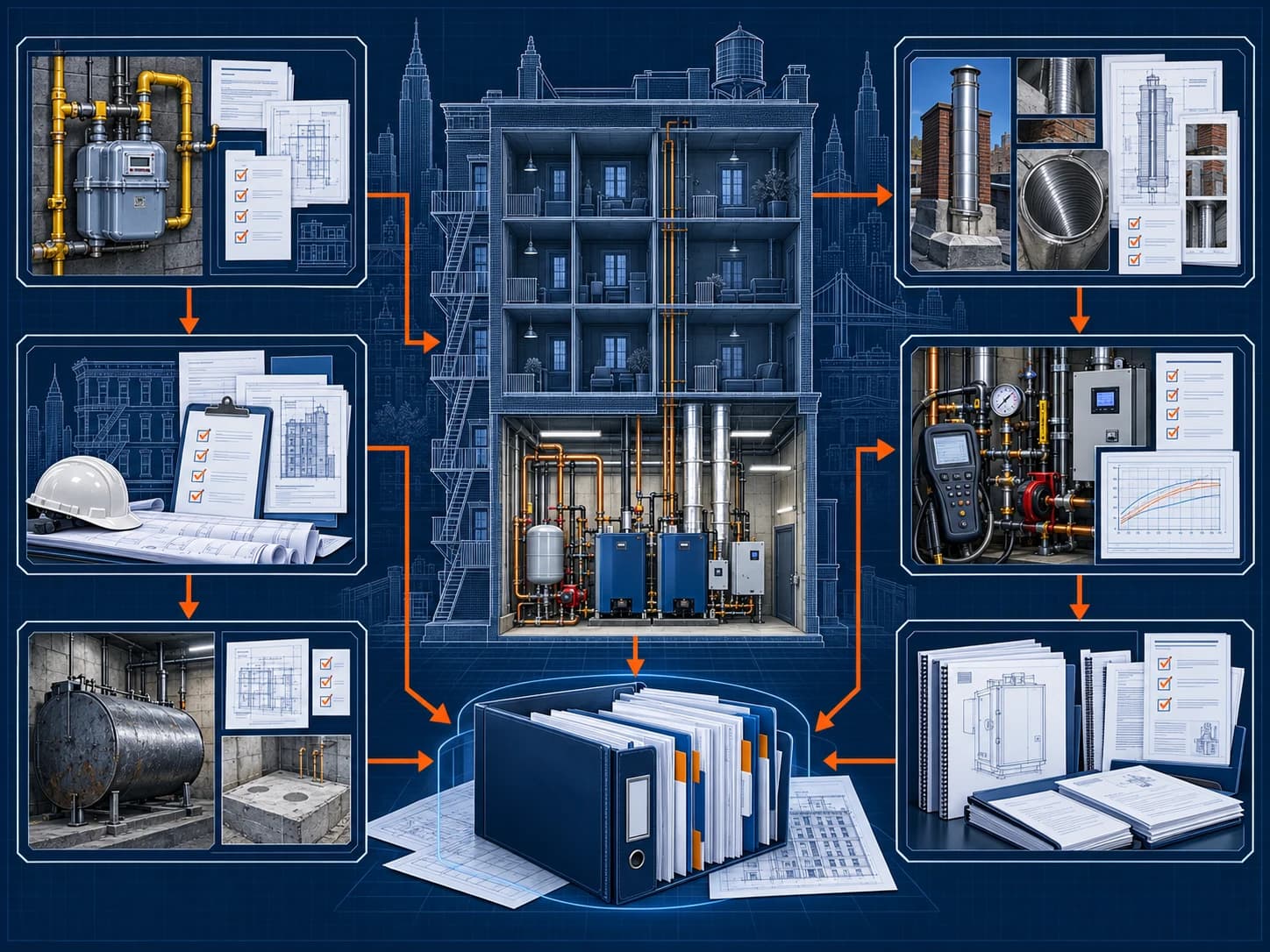
A closed file connects the final field condition to the approved scope and to every required acceptance record. The useful standard is not “we have a binder.” It is “we can show which record closes each project lane, and we can identify every exception that remains.”
Start with a master index:
| Closeout lane | Evidence to locate | Owner verification question |
|---|---|---|
| Final scope | Approved drawings, equipment schedule, approved amendments, as-built information when required | Does the record match what is installed? |
| Utility | Case or project reference, service conditions, accepted contractor submissions, final inspection or acceptance, meter and turn-on record | Has the serving utility completed its stated handoff? |
| DOB | Job and permit numbers, inspection results, First Test when applicable, special inspections, sign-offs | Is every related record closed or assigned? |
| Chimney and venting | Approved scope, inspection or special-inspection record when required, liner and contractor documentation | Does the record match the final venting system? |
| Oil tank and piping | Final tank disposition, inspection or special-inspection evidence, closure or removal records | Is the former oil system legally and physically resolved? |
| Startup and commissioning | Startup report, combustion and safety checks, controls sequence, balancing and commissioning records that apply | Can the operating team prove and repeat the accepted setup? |
| Owner turnover | Manuals, warranties, training, contacts, maintenance plan, open-items list | Can management operate and maintain the plant without the project inbox? |
Use three status labels only: complete, open, or not applicable—with the reason recorded. “Contractor says done” is not a fourth status.
Step 1: Freeze the final approved scope
Before checking individual documents, establish what the project was actually approved to build. Collect the final approved drawings, equipment and fuel schedules, boiler and burner information, gas riser or load information, chimney and tank scope, and every approved amendment that changed the work.
This matters because a closeout package can look complete while describing an earlier version of the project. Compare model numbers, capacities, fuel, meter arrangement, gas load, chimney or liner, tank disposition, controls, and major field changes against the installed condition. Ask the applicant of record and licensed contractors to identify any difference that required an amendment, additional inspection, or revised filing.
NYC DOB's owner boiler checklist tells owners to ensure required inspections and sign-offs close the project permit, and to complete commissioning before sign-off when commissioning applies (retrieved 2026-10-20). That makes the approved scope—not the proposal or final invoice—the correct spine for the closeout index.
Step 2: Verify the serving utility handoff
Treat the utility file as its own lane. Confirm whether the building is served by Con Edison or National Grid, then index the documents and milestones used on that actual case. Do not relabel a contractor's pressure test, a DOB gas authorization, and utility acceptance as if they were the same record.
For Con Edison work, preserve the service-layout or customer service installation agreement when one was issued, the final contractor checklist and pressure-test submission that applied, the utility's final inspection or acceptance, and the meter installation and turn-on record. Con Edison's current Building and Remodeling FAQ describes the service layout, contractor readiness submissions, final inspection, and final connection or meter process as separate steps (retrieved 2026-10-20). Its contractor resources also maintain distinct inspection checklists and gas forms.
For National Grid work, preserve the gas project request and load information, the service-installation conditions, evidence of site readiness when service work was required, and the meter or utilization handoff. National Grid's current NYC commitment form separates the request for service, job-site readiness, service installation, and later meter use (retrieved 2026-10-20).
If the project reused an existing service, document that decision and the accepted final load. A meter on the wall does not prove that the utility accepted every piece of new building-side work. Austin's licensed gas piping practice can help reconcile the building-side gas file with the utility and DOB milestones when records are incomplete.
Step 3: Reconcile every DOB job, permit, inspection, and sign-off
Build a one-line record for every related DOB job and permit. Include the job number, work type, permit number and status, applicant, contractor or licensee, required inspections, latest inspection result, objections, sign-off status, and the person responsible for any open item.
Do not stop after finding one passed inspection. Boiler, burner, gas piping, chimney, fuel storage, electrical, and related building-system work can have different filings or inspection requirements. The exact set comes from the approved scope.
Check First Test separately. DOB says new boiler installations, certain major component replacements, and fuel-burner replacements require a First Test before use. A passing First Test provides approval and sign-off for the boiler or fuel-burner job tied to that inspection; a failed result requires correction and reinspection before DOB can approve and sign off the job (NYC DOB, First Test Requirements, retrieved 2026-10-20).
If the conversion failed that checkpoint, use Austin's failed boiler First Test guide to separate the objection list, correction scope, reinspection, and final record. For ongoing annual obligations after turnover, keep the boiler inspection and filing lane separate from the project-closeout lane.
Step 4: Close the chimney and liner record
The chimney file should show what the final design required and what was accepted—not merely that a liner invoice exists. Preserve the approved chimney, breeching, flue, and combustion-air scope; product and installer information that the project requires; field or as-built information; and the inspection or special-inspection record when that requirement applies.
DOB's current boiler work and inspection requirements list chimneys among the special-inspection categories that can apply to boiler projects and require a final inspection for permitted work (retrieved 2026-10-20). The registered design professional identifies required special inspections for the filed project.
Ask one practical question: can the owner trace the final venting system from the approved document to the installed system and then to the accepted inspection record? If the answer depends on memory or unlabeled photos, the handoff is incomplete.
Step 5: Close the former oil tank and fuel-piping file
Record exactly what happened to each oil tank: removed, sealed in place, retained for another lawful use, or handled under another project-specific disposition. Include tank identity and location, capacity when known, the approved scope, licensed contractor information, inspection or special-inspection results, and the closure, removal, disposal, or agency documents that apply.
DOB's boiler inspection requirements identify fuel-storage and fuel-piping systems as a special-inspection category that may apply, and note separate FDNY requirements for fuel-storage work. Requirements vary with the tank, location, capacity, final use, approved filings, and other agency rules. Do not convert that variability into a universal “clean and fill” instruction.
If the historical record is unclear, FDNY's Fuel Tank Special Reports process includes records for existing, removed, or sealed fuel-oil and heating tanks (retrieved 2026-10-20). A records request is not a substitute for required project filings or closure work, but it can help an owner identify what FDNY currently has on file.
Close the visible leftovers too. Unused fill, vent, return, transfer, or burner piping should not remain as an unexplained future due-diligence problem. Ask the project team to show how every component was addressed under the approved scope.
Step 6: Build the startup, controls, and commissioning file
The owner needs more than “first fire.” Collect the manufacturer's startup record, combustion and safety-test results, final controls sequence, accepted operating setpoints, pump and system settings, balancing information, alarms and interlocks, training record, manuals, warranties, and maintenance instructions that apply.
For projects where commissioning is required, preserve the commissioning agent, preliminary and final records, outstanding findings, and DOB filing milestone. DOB's owner checklist states that projects with permitted heating capacity above 600 kBTU/h require a qualified commissioning agent and that required commissioning must be completed before sign-off (retrieved 2026-10-20).
Turn these documents into an operating handoff. Identify who can change controls, who receives alarm calls, who owns warranty notices, which contractor maintains each component, and which readings the superintendent or manager should log. A larger occupied-building conversion may fit Austin's heating-plant project lane when phasing, controls, multiple boilers, or continuing capital work extend beyond a single equipment turnover.
Step 7: Deliver one owner binder with an exceptions log
Create one digital index and one durable owner copy. File records by lane, not by sender. Use consistent names that begin with the building, project, agency or utility, record type, and date. Keep the underlying PDFs, photos, test sheets, acceptance records, manuals, and warranties—not only a spreadsheet saying they exist.
The final index should show:
- the approved final scope and equipment schedule;
- the serving utility and completed handoff milestones;
- every DOB job, permit, inspection, objection, and sign-off;
- the First Test record when applicable;
- chimney and liner documents;
- oil-tank and fuel-piping disposition;
- startup, controls, balancing, and commissioning records;
- manuals, warranties, training, contacts, and maintenance tasks;
- annual boiler, LL97, energy, or other obligations that continue; and
- an exceptions log naming every open item, responsible party, next action, and follow-up date.
Have the applicant of record, Licensed Master Plumber, Licensed Oil Burner Installer, utility representative, special inspection agency, commissioning agent, and other project participants confirm only the lanes they actually control. One contractor should not certify another agency's or utility's completion.
Common closeout gaps to catch before final payment
Heat is on, but a job is still open. Compare the operating condition to the public DOB record and the project team's sign-off evidence.
One passed inspection is treated as universal approval. Match each inspection to its job, work type, and required scope.
The utility file ends at the application. Locate final readiness, inspection, meter, acceptance, or turn-on evidence that applies to the actual case.
A tank invoice replaces the closure record. Preserve the project and agency evidence required for the tank's final disposition.
The liner exists, but the approved and inspected record is missing. Connect the product and installer documents to the filed chimney scope and required inspection.
The binder has manuals but no exceptions log. A complete-looking archive can still hide unresolved objections, missing signatures, warranty startup requirements, or future filings.
When to review the closeout file with Austin
Review the file before the project team disperses, before retainage or final payment is released, and before the next refinancing, sale, insurance request, or heating-season emergency exposes the gap. The best time to request a missing test sheet or inspection record is while the responsible party is still active on the job.
Austin Plumbing & Heating can review the boiler room, gas scope, DOB and utility milestones, tank and chimney handoffs, and owner turnover package with NYC Licensed Master Plumber oversight. Bring the approved scope, job and permit numbers, utility case information, inspection results, tank records, startup documents, and the current exceptions list to an oil-to-gas conversion project review.
Common Questions
Is an NYC oil-to-gas conversion closed when the new boiler is producing heat?
No. Heat confirms an operating condition, not complete project closeout. The owner should separately verify the utility handoff, each DOB job and permit, required inspections and sign-offs, applicable First Test result, chimney and tank records, commissioning items, manuals, warranties, and any remaining exceptions.
Does every oil-to-gas conversion require the same closeout documents?
No. The required package depends on the approved scope, building, serving utility, boiler and burner work, gas service, chimney, tank disposition, special inspections, and commissioning threshold. Build the checklist from the project's approved documents and agency or utility requirements rather than copying another building's binder.
Does a passed boiler First Test close the entire conversion project?
No. DOB says a passed First Test provides approval and sign-off for the boiler or fuel-burner job tied to that inspection. Other gas, chimney, fuel-storage, electrical, utility, special-inspection, or commissioning items may remain open. Reconcile every related record before calling the project closed.
What utility records should an owner keep after gas service starts?
Keep the serving utility's project or case reference, accepted service conditions, required contractor submissions, final inspection or acceptance evidence, meter and turn-on record, and any owner agreement that applies. The exact names differ between Con Edison and National Grid, so index the actual project documents rather than using a generic label.
What should the owner keep for an abandoned or removed oil tank?
Keep the approved tank scope, contractor and license information, required inspection or special-inspection results, closure or removal documentation, FDNY or other agency records that apply, and proof that related fill, vent, piping, and permit items were resolved. Requirements vary by tank and project; an invoice alone is not a regulatory closeout record.