
Key takeaways
- Map the pattern during the same call for heat: one radiator, one vertical stack, one steam-main side, or the whole building.
- A room map narrows the professional investigation. It does not prove that a vent, valve, trap, control, boiler, or pipe is the cause.
- Identify whether the building is one-pipe or two-pipe before interpreting radiator components; the same cold-room complaint can follow a different path.
- Record time, outdoor conditions, control call, boiler-room observations, room temperatures, radiator behavior, noise, and visible moisture together.
- Stop mapping and use the safety response for a carbon monoxide alarm, gas odor, uncontrolled steam release, smoke, or unsafe equipment.
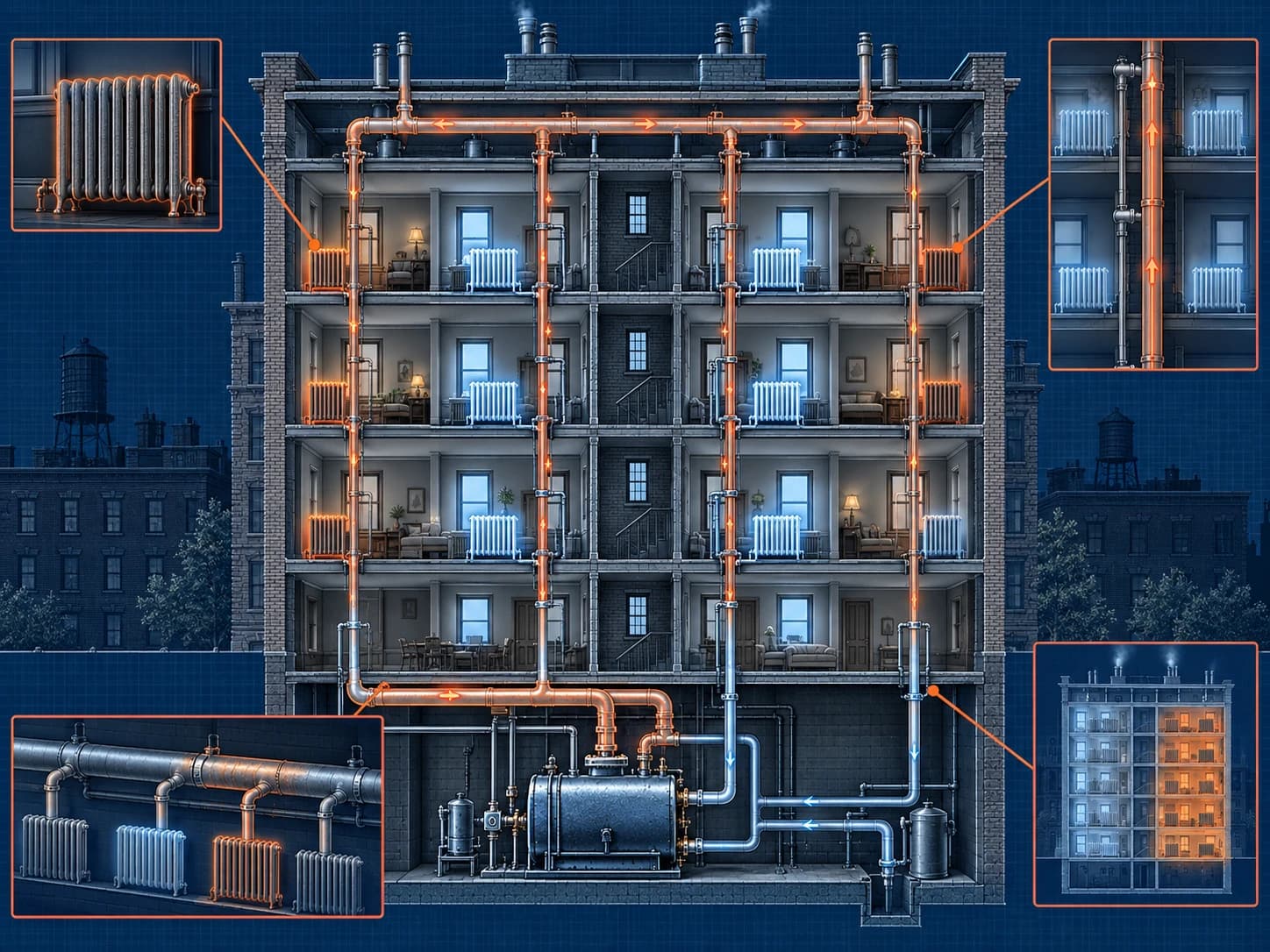
“The heat is uneven” is a complaint, not yet a diagnostic pattern. A useful building map shows where the problem starts, which rooms share it, when it appears in the boiler cycle, and what the boiler and distribution system were doing at the same time.
The purpose is not to turn an owner or super into a steam technician. It is to replace scattered tenant reports with one building-wide picture that Austin can trace from boiler to main, riser, radiator, vent or trap, and control.
Start with one comparable heating cycle
Do not combine a top-floor complaint from Monday morning with a first-floor reading from Wednesday afternoon. Choose one active call for heat and give every observation the same context:
- date, time, and outdoor condition;
- which thermostat, timer, or building control called for heat, if known;
- when the boiler started and stopped, as safely observable;
- room, floor, and apartment position;
- room temperature measured with the same device and method where practical;
- whether the radiator stayed cold, warmed late, warmed partly, overheated, hissed, banged, leaked, or changed after the cycle;
- boiler water-line, visible leak, or unusual cycling observation from the normal safe viewing position;
- open windows, blocked radiators, closed rooms, access limits, or recent renovation that could distort the comparison.
The Brooklyn steam heat owner's manual explains how to identify the system and keep the longer operating record. This guide uses one slice of that record to map a specific uneven-heat event.
Read the map from smallest pattern to largest
Begin with the narrowest pattern the evidence supports. Do not name a failed part merely because it appears in the “professional questions” column.
| Pattern on the map | What to compare next | Professional questions the pattern raises |
|---|---|---|
| One radiator is cold; nearby radiators heat | Other radiators on the same floor, riser, and main | Radiator connection, vent or trap path, valve condition, pitch, branch, or local obstruction |
| Several radiators in one room or apartment lag | Adjacent apartments above, below, and across the hall | Shared branch or riser, apartment-side changes, radiator coverage, access, or envelope effects |
| The same vertical stack lags on several floors | Rooms served by neighboring risers during the same cycle | Riser venting, riser connection, main feed, or a distribution restriction |
| One side of the building lags | All risers believed to share that steam main | Main venting, main pitch, trapped condensate, distribution sequence, or piping change |
| Far rooms heat only after near rooms overheat | Arrival time at near and far radiators | Main and riser air removal, radiator venting balance, control response, and building heat-loss differences |
| Most or all rooms are slow or cold | Boiler response, controls, water line, fuel service, and the full distribution | Boiler output or condition, control call, system pressure, wet steam, fuel or gas issue, or building-wide venting |
| The pattern changes from cycle to cycle | Cycle length, outdoor condition, water addition, and control behavior | Intermittent control, water-line, condensate-return, venting, or access condition |
NYC Retrofit Accelerator guidance describes one-pipe steam as a complete system: steam and condensate share the same radiator connection, trapped air must leave before steam can arrive, and high-performance work coordinates radiator, distribution, control, and boiler changes rather than treating one part in isolation (One-Pipe Steam Optimization, retrieved 2026-09-13).
Mark time as well as location
Two rooms can reach the same temperature and still reveal different problems. Record when each radiator changes relative to the call for heat.
| Cycle behavior | Useful map notation | Why the timing matters |
|---|---|---|
| Never warms | Cold for the full observed cycle | Separates a non-heating branch from a merely delayed one |
| Warms much later than comparable rooms | Arrival time and first warm section | Helps trace how steam reaches a main, riser, and radiator |
| Warms partly | Which sections warm and when | Gives the professional a better starting point than “lukewarm” |
| Warms, then cools while the call continues | Time of both changes | May point toward cycle, control, condensate, or intermittent distribution questions |
| Overheats before distant rooms warm | Near-room temperature and distant-room arrival time | Shows a building-balance pattern rather than one isolated cold room |
| Hisses, spits, bangs, or leaks during one phase | Location and exact point in the cycle | Connects the sound or moisture to steam arrival, condensate return, or shutdown |
The NYC smart-steam visual identifies master venting, boiler tuning, controls and sensors, and system-specific radiator measures as coordinated parts of whole-building performance. It also separates two-pipe trap and orifice questions from one-pipe venting work (Smart Steam Heating Upgrades, retrieved 2026-09-13). That is why a room map must preserve the system type and cycle timing.
Separate one-pipe and two-pipe clues
In a one-pipe system, the same connection carries steam toward the radiator and condensate back. Air leaves through radiator and main or riser venting. A cold radiator, cold stack, and cold main-side group therefore do not mean the same thing, even when every tenant says “the vent is bad.”
In a two-pipe system, supply and return are separate at the radiator, and many systems use traps or other return-side components. Do not copy a one-pipe vent diagnosis onto a two-pipe radiator or assume every two-pipe building has the same hardware.
If the system type is unconfirmed, write “unknown” on the map. Austin's steam heating repair and service page explains the service scope for one-pipe and two-pipe systems; the field diagnosis should confirm the installed system before anyone chooses parts or settings.
Build a technician-ready handoff sheet
Put the building sketch and observations on one page, then attach supporting records. The handoff should include:
- Building address, contact, access plan, dwelling-unit count, and any commercial space.
- One-pipe, two-pipe, or unconfirmed system type.
- A floor-by-floor sketch with each radiator or complaint location marked consistently.
- The shared-cycle observation table with warm, delayed, cold, overheated, noisy, and leaking locations.
- Boiler make/model information, control-call source, water-line observation, and any water added if reliably known.
- Recent work that could affect piping, radiators, controls, fuel service, windows, insulation, or apartment access.
- Prior service reports, open recommendations, tenant messages, and before/after photos.
- The exact question for the visit: one radiator, one riser, one main, building-wide distribution, or a changing cycle pattern.
Keep unknowns visible. “Rear top-floor radiator delayed; serving riser not confirmed” is more useful than a confident but unverified part diagnosis.
Know where observation stops
Owners and supers can record accessible conditions without opening equipment or changing the system. Stop and route the work to a qualified steam professional when the next step would require:
- changing boiler, burner, pressure, safety, or building-control settings;
- selecting, drilling, replacing, or re-sizing radiator or main vents;
- testing or replacing steam traps or return-side components;
- draining, feeding, opening, skimming, or firing the boiler;
- touching hot piping or a leaking radiator, valve, vent, trap, or return;
- deciding whether a gas, boiler, permit, inspection, or code requirement applies.
This boundary matters because a local symptom may be the visible end of a building-wide condition. Austin's Boiler Physical is the preseason service path; an active uneven-heat problem belongs with steam diagnosis and repair.
Keep heat obligations and radiator records separate
The map supports service response, but it does not replace the owner's heat obligation or an agency record. HPD says NYC heat season runs October 1 through May 31 and publishes the applicable daytime and nighttime indoor-temperature rules. When a tenant complaint is active, use the HPD heat and hot-water complaint workflow to connect the room readings, communication, repair evidence, and HPD record (NYC HPD, Heat and Hot Water Information, retrieved 2026-09-13).
Some multiple dwellings also have a separate Local Law 151 steam-radiator notice, inspection, repair, and recordkeeping process. HPD's current guidance covers buildings with three or more residential units and specifies which apartments and common areas require inspection, who may inspect, and which owner records must be kept. A diagnostic room map can support the service file, but it is not the required annual notice, inspector qualification, inspection record, repair notice, or owner evidence (NYC HPD, Inspection of Steam Radiators, retrieved 2026-09-13).
Safety overrides the map
Leave the building and call 911 if anyone may be experiencing carbon monoxide poisoning. Con Edison says carbon monoxide cannot be seen, smelled, or tasted and advises immediate exit and a 911 call when poisoning is suspected. A carbon monoxide alarm, gas odor, smoke, uncontrolled steam release, or visibly unsafe boiler condition is not a balancing experiment (Con Edison, Carbon Monoxide Safety, retrieved 2026-09-13).
Do not silence an alarm, keep running the boiler to finish the map, or treat a safety shutdown as an uneven-heat symptom.
When to call Austin
Call Austin Plumbing & Heating when the map shows one recurring cold radiator, a delayed riser, one main-side group that lags, near rooms overheating before far rooms warm, changing water or cycle behavior, persistent noise, or a whole building that cannot distribute heat evenly.
Austin works across one-pipe and two-pipe steam systems and traces the complaint across the boiler, controls, near-boiler piping, mains, risers, returns, radiators, vents, and traps that actually serve the pattern. Start with steam heating repair and service and bring the room map, shared-cycle notes, photos, and recent service record.
Common Questions
What does one cold radiator usually tell an NYC building owner?
It narrows the first professional check to that radiator and its connection, venting or trap path, valve condition, pitch, and nearby branch. It does not prove which part failed. Record whether other radiators on the same riser and main heat normally before replacing or adjusting anything.
What if every radiator on one vertical line is cold or delayed?
A vertical stack pattern moves the investigation beyond one radiator. A steam professional may need to trace the riser, its venting, accessible connections, and the main that feeds it. The room map should show whether the entire stack behaves alike during the same boiler cycle.
Can an owner diagnose uneven steam heat from room temperatures alone?
No. Room readings are useful when the time, outdoor conditions, control call, radiator behavior, and building location are recorded together. Sun, open windows, blocked radiators, access conditions, and envelope differences can affect a room reading without identifying the steam-system cause.
Should a super change boiler pressure or swap vents to test the map?
Not from the map alone. The map is an observation and handoff tool, not a universal setting or parts guide. Control changes, vent selection, trap work, and boiler or burner work should follow system identification and qualified diagnosis.
When is uneven heat an emergency instead of a balancing problem?
A carbon monoxide alarm, gas odor, uncontrolled steam or water release, smoke, or visibly unsafe equipment overrides the diagnostic map. Get people to safety and follow emergency instructions; do not continue testing the heating pattern.