
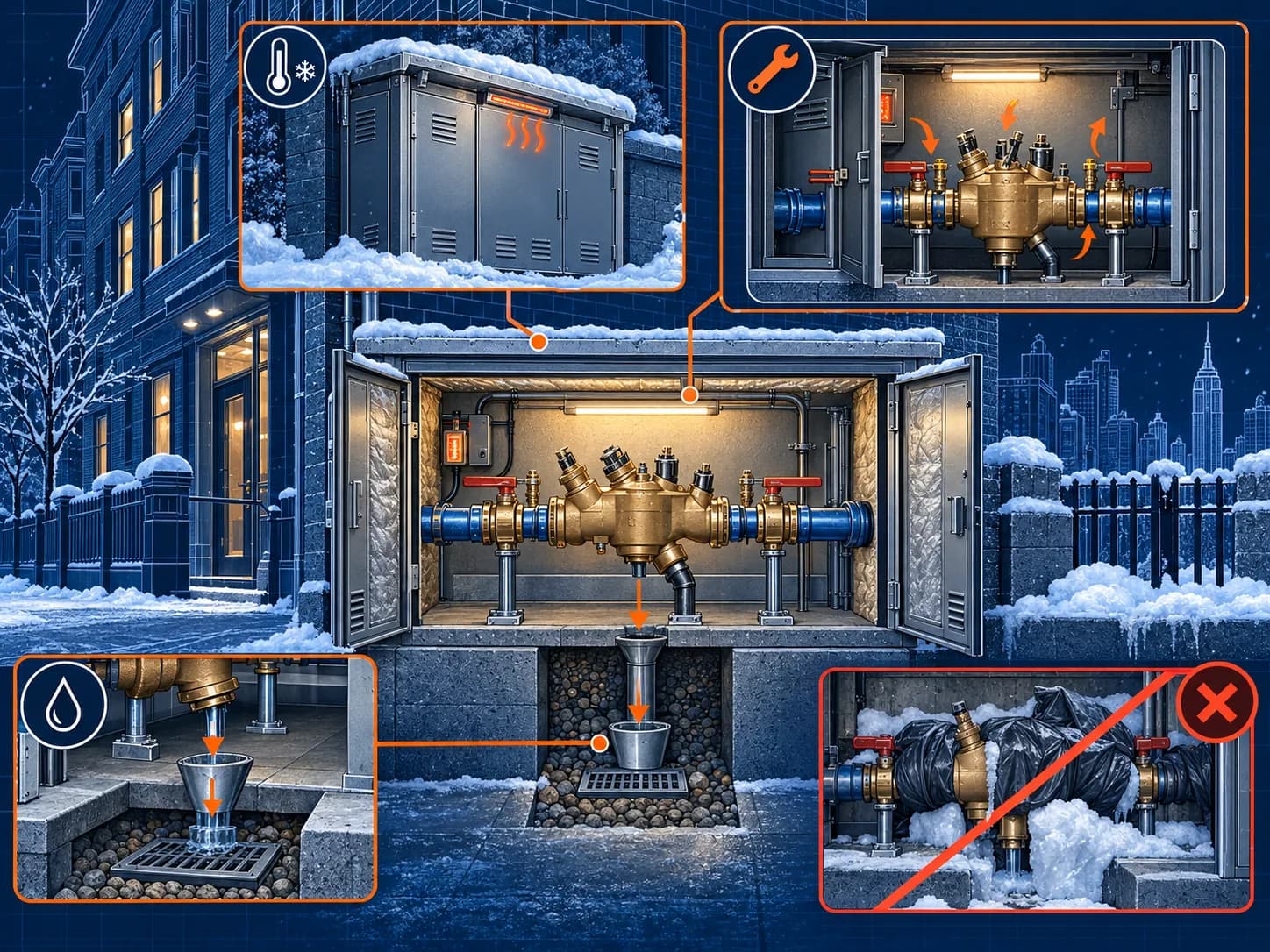
A backflow preventer in an outdoor enclosure, loading area, unheated room, or drafty service space needs a winter plan that protects the assembly without blocking its test points, shutoffs, relief discharge, or drainage. The owner should verify the approved installation, confirm the freeze-protection system works, clear access, and document the condition before sustained cold arrives.
This is not a do-it-yourself draining or valve-operation checklist. A containment assembly protects the public water supply, and the wrong shutdown, bypass, wrapping, or heat source can create a larger safety and compliance problem. Use the checklist to prepare the site and the owner record for a Licensed Master Plumber and certified tester.
Key takeaways
- Confirm whether the device is in a location subject to freezing and how the approved installation protects it.
- Preserve clear access, relief-port discharge, and drainage; do not bury the assembly in improvised insulation.
- Record the enclosure, heat source, device identity, prior test, and open defects before cold weather.
- Freeze preparation does not replace the annual test, repair, retest, or agency record.
Why is backflow freeze protection different from ordinary pipe insulation?
A backflow assembly is serviceable safety equipment, not a straight length of pipe. The 2022 NYC Plumbing Code, Section 608.14 requires access according to the approved manufacturer's instructions. It also says outdoor enclosures must comply with the applicable enclosure standard and that backflow preventers in freezing areas need removal provisions or protection by heat, insulation, or both.
Reduced-pressure assemblies add another constraint: the relief port and air-gap discharge need a safe path. The same code section requires relief-port piping to terminate at an approved indirect waste receptor or outdoors where it will not cause damage or a nuisance. A winter measure that keeps the brass body warm but blocks discharge, drainage, test cocks, or service panels is not a complete protection plan.
NYC DEP's Cross-Connection Control Program Handbook describes applicable outdoor RPZ enclosures as above grade, protected from freezing, free of debris, accessible for valves and testing, and equipped for gravity drainage. Those requirements explain why owners should inspect the whole installation rather than wrapping the visible valve body.
Step 1: Identify the device, agency record, and approved location
Start with the device record. Photograph the assembly tag from a safe position and gather the prior test report, plan approval, enclosure information, and any DEP or DOB correspondence. Record the make, model, size, serial number, exact location, water service, and whether the assembly is a containment device at the service entrance or a secondary device protecting building equipment.
That distinction matters because containment and secondary devices can follow different records. NYC DEP's current backflow page covers containment approval and annual testing. Internal devices serving equipment such as boilers or cooling systems may use a DOB record instead. Do not decide the agency lane from the nickname “RPZ” alone.
Use Austin's annual backflow testing owner checklist when the device file or due date is unclear. The winter walk should add current enclosure and exposure evidence to that existing compliance record, not create a separate mystery file.
Step 2: Verify the designed freeze-protection system
Inspect what the approved installation already uses: a conditioned room, an insulated enclosure, a listed heated enclosure, heat trace, or another designed method. Ask the Licensed Master Plumber to confirm that the protection matches the actual device, enclosure, power supply, drainage, and manufacturer requirements.
For an enclosure, document these conditions without dismantling equipment:
| Winter check | What the owner should record |
|---|---|
| Exterior condition | Damaged panels, open seams, missing hardware, impact damage, snow or debris at openings |
| Interior condition | Wet insulation, corrosion, standing water, loose panels, stored materials, or visible damage |
| Heat or trace system | Indicator condition, power-source label, recent service record, and who verifies operation |
| Building exposure | Open doors, broken windows, wall penetrations, drafts, or a room no longer receiving expected heat |
| Device condition | Leaks, staining, deformation, damaged gauges or test points, and the visible device identification |
NYC DEP's winter guidance tells owners to correct drafts, close exterior openings, insulate exposed areas, and use a Licensed Master Plumber when pipes cannot be safely restored. NYC DOB's weatherizing guidance likewise treats unheated pipes and meters as a winter risk. Apply those building-envelope lessons without improvising changes to the backflow assembly itself.
Step 3: Keep access and testing points clear
The person inspecting or testing the device needs to reach the shutoffs, check valves, relief valve, and test cocks. Clear stored cartons, refuse, snow, construction materials, and locked-access conflicts before the visit. Do not remove fixed guards, panels, insulation, or electrical covers unless the qualified professional responsible for the system directs the work.
Access also includes a safe route to the enclosure. Record blocked doors, poor lighting, ice, overhead hazards, tenant restrictions, and any area that requires building staff. A clear photograph of the approach and the openable service panels can prevent a winter test or repair visit from failing at the door.
For portfolio buildings, put this access check beside the other seasonal tasks in Austin's property-manager plumbing compliance calendar. The owner record should name who controls the room, who monitors the enclosure, and who can authorize emergency access.
Step 4: Protect the relief and drainage path
An RPZ can discharge through its relief valve during operation or a fault. The approved air gap, receptor, enclosure drain, and downstream path need to remain visible and unobstructed. Remove loose debris around the area only when it can be done safely; do not stuff insulation, rags, foam, or plastic into openings to stop cold air.
Ask the professional review to confirm:
- The relief port and air gap are visible and not capped, wrapped, or redirected informally.
- The receptor and drain path are not blocked by debris, ice, storage, or construction.
- Discharge would not run across an unsafe walking surface or toward electrical equipment.
- Enclosure drains and openings match the approved installation rather than a field improvisation.
- Any alarm, heat, or power indicator is part of the documented system and has an assigned response.
Do not treat a dry floor as proof that the drain path works. The checklist records visible conditions; the Licensed Master Plumber determines what inspection or correction is needed.
Step 5: Separate owner observations from licensed work
The owner can document access, enclosure damage, drafts, water, alarms, recent power interruptions, and the last known test. The owner should not bypass the assembly, operate unfamiliar shutoffs, remove the device, apply an open flame, or improvise heat directly on the valve body.
Use this handoff table:
| Observation | Safe next question |
|---|---|
| Enclosure is cold or heat indicator is off | Who verifies the listed protection system and its power source? |
| Water, ice, or staining is visible | Is the source a relief discharge, leaking fitting, damaged assembly, or another condition? |
| Device or enclosure appears damaged | Does the assembly need isolation, repair, replacement, or a plan/record update? |
| Test points or access panels are blocked | What can be cleared without altering the approved installation? |
| Prior annual report is missing or overdue | Which device record and agency submission need to be restored? |
This keeps the owner's winter walk useful without turning it into repair instructions.
What should happen after suspected freeze damage?
Treat active water release, damaged electrical equipment, falling ice, or an unsafe enclosure as a service condition first. Keep people away, document from a safe location, and call the building's Licensed Master Plumber or emergency plumbing contact. Do not bypass the device or assume that thawing restores compliance.
After the immediate condition is controlled, the assembly may need inspection, repair, and certified testing. If it does not pass, use Austin's separate failed backflow test repair, retest, and filing guide. That guide owns the post-failure correction record; this checklist owns prevention and pre-freeze readiness.
Build one winter backflow record
Keep the following items together:
- Device identification and exact location.
- Approved plan, installation, and enclosure information available to the owner.
- Prior annual test report and next due date.
- Pre-winter photos of the enclosure, access route, relief area, and drainage path.
- Heat, trace, alarm, or enclosure service records that actually apply.
- Open defects, responsible party, target date, and verification evidence.
- Freeze event, repair, retest, and agency-submission records if a failure occurs.
For buildings with recurring seasonal coverage, Austin's maintenance-contract planning service can help define which equipment, records, access points, and escalation responsibilities belong in the service scope.
When should an owner call Austin?
Call Austin when the device sits in an outdoor or unheated area, the enclosure or drainage is damaged, access is blocked, the heat-protection record is unclear, a leak or freeze event occurred, or the annual test file is incomplete. Bring the device photos, prior report, plan or enclosure information, and any DEP or DOB notice.
Austin can review the backflow record, inspect the plumbing installation, coordinate certified testing, define repair or replacement work, and organize the applicable compliance trail. Start with Austin's backflow prevention testing and compliance service before freezing weather turns an access or enclosure defect into a water-service problem.
Common Questions
Can an NYC backflow preventer be left in an unheated area?
Do not assume it can. NYC Plumbing Code Section 608.14.2 says backflow preventers should not be in freezing areas unless they are removable by unions or protected by heat, insulation, or both. The approved installation and manufacturer instructions control the actual protection plan.
Can I wrap an RPZ valve in blankets or plastic for winter?
Improvised wrapping can hide leaks, obstruct test points and shutoffs, or interfere with the relief-port and drainage path. Have a Licensed Master Plumber compare the existing enclosure, heat, insulation, access, and drainage with the approved installation and manufacturer instructions.
What should a winter backflow enclosure preserve?
It should preserve suitable freeze protection, access for testing and repair, the required clearances, and safe relief discharge and drainage. NYC DEP's handbook describes insulated or heated protective enclosures with removable access panels and gravity drainage for applicable outdoor RPZ installations.
What should I do if the device is leaking after a freeze?
Keep people away from the discharge and any nearby electrical exposure, document the condition from a safe location, and call a Licensed Master Plumber. Do not bypass the assembly or operate unfamiliar valves. The device may need inspection, repair, and certified retesting.
Does freeze preparation replace the annual backflow test?
No. Freeze protection addresses location and winter operating risk. NYC DEP separately requires covered containment assemblies to be tested every 12 months by a certified tester, with the annual report signed by a Licensed Master Plumber and submitted through the current DEP process.