Key takeaways
- Do not decide from the building label alone. DEP looks at the property’s occupancy, water services, equipment, and actual or potential cross-connections.
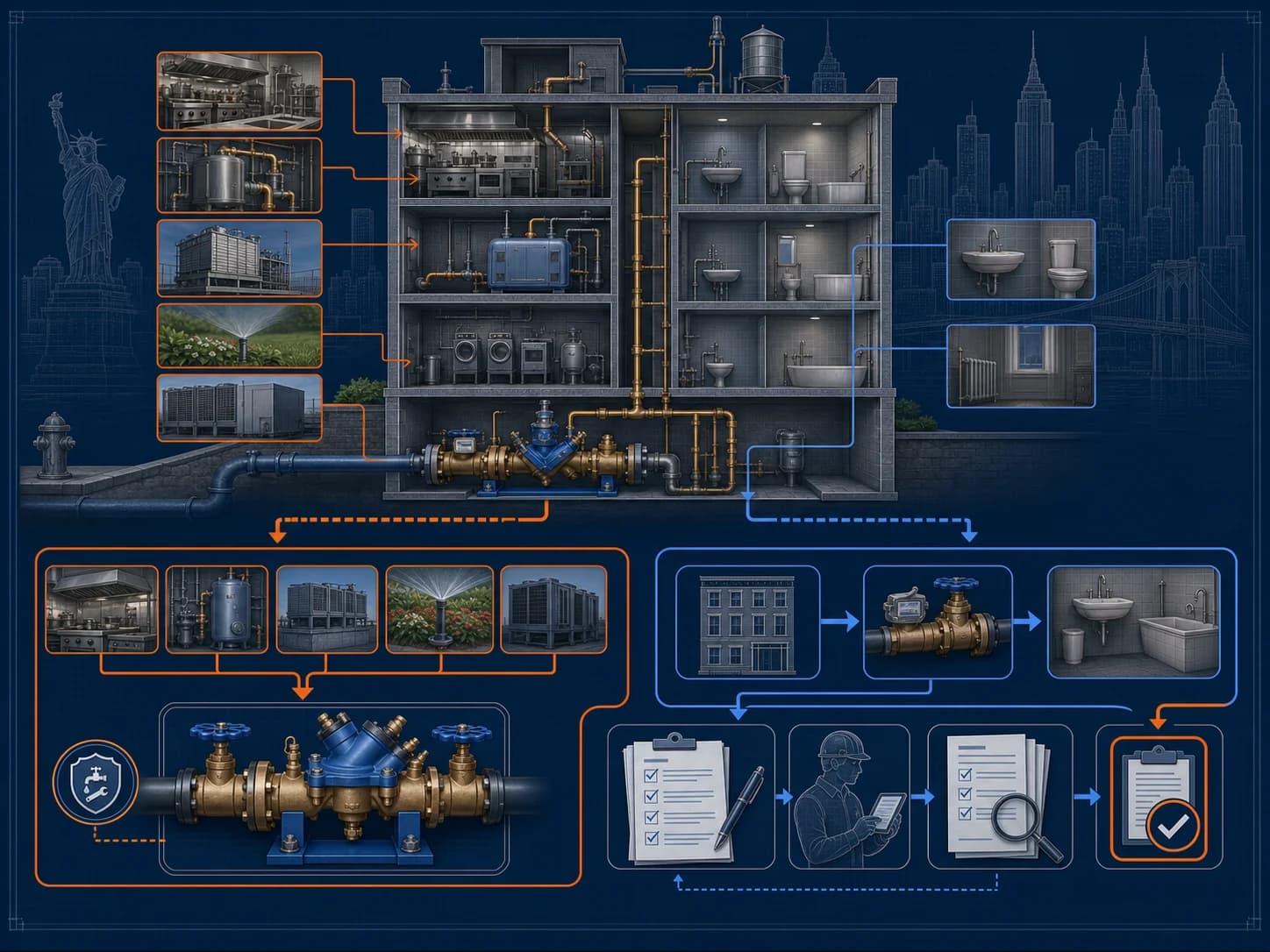
- DEP lists many common triggers, including multiple water services, commercial kitchens, medical uses, laundries, roof tanks, irrigation, large or chemically treated boilers, cooling equipment, and water reuse.
- The current exemption form is narrow: it is for a residential building with one domestic service line only and none of the listed risk conditions.
- A Professional Engineer or Registered Architect prepares the requirement or exemption submission. Only written DEP approval resolves the screening question.
The short answer for NYC owners
A property may need a containment backflow prevention assembly when its plumbing could allow contaminated or chemically treated water to flow back toward the City water supply. NYC DEP’s current backflow page publishes a long list of property types and water-system conditions that are commonly subject to the requirement.
That list is a screening tool, not a substitute for a building-specific decision. DEP’s current FAQ tells owners to hire a Professional Engineer (PE) or Registered Architect (RA) to determine whether the property requires a device. DEP then reviews the plan or exemption request.
What is DEP screening for?
Backflow can occur when pressure changes reverse the expected direction of water. A containment assembly sits near the property’s incoming water service to protect the public supply from risks created anywhere in the building’s plumbing system.
The practical owner question is therefore broader than “Do I have an RPZ?” Start with these questions:
- How many domestic and fire water service lines enter the property?
- What occupancies and tenant uses are present now or proposed?
- Which fixtures, equipment, storage systems, chemicals, or alternate water sources connect to the plumbing?
- Does DEP already have an approval, device record, annual test record, order, or exemption for the property?
- Has the building changed since that record was created?
The DEP risk-assessment charts separate residential, mixed-use, and non-residential conditions and route different hazard levels toward an exemption request, a double-check assembly, or a reduced-pressure assembly. The PE or RA uses the full building condition—not a single tenant label—to develop the submission.
Which properties and conditions commonly trigger backflow protection?
DEP’s published list includes both business types and physical water-system conditions. Owners should screen the property in groups rather than trying to memorize every category.
Food, health, personal-care, and public uses
Examples include commercial or public kitchens, food preparation or processing facilities, supermarkets, hospitals, clinics, laboratories, veterinary hospitals, medical and dental offices, nursing homes, schools, colleges, funeral parlors, barber shops, and beauty salons.
The risk is tied to the water use and possible contamination source. A restaurant tenant, medical suite, lab process, or public kitchen can change the building’s cross-connection profile even when the shell of the property has not changed. Austin’s restaurant plumbing opening checklist shows why this screening belongs before a commercial buildout is finalized.
Industrial, service, and chemical uses
DEP also lists laundries and dry cleaners, auto repair shops, commercial car washes, metal processing facilities, printing and photo-processing facilities, breweries, greenhouses, exterminators, warehouses with toxic chemical storage, marinas, and several other industrial or processing uses.
Do not reduce this to a zoning or certificate-of-occupancy label. The assessment should identify the actual equipment and substances connected—or capable of becoming connected—to the water system.
Building systems that can create a trigger
The building itself may create the requirement even without an obviously hazardous tenant. DEP identifies conditions such as:
- Multiple water service lines.
- Roof tanks or elevated water storage.
- In-ground irrigation sprinklers or swimming pools.
- Large boilers or chemically treated boilers.
- Water-cooled equipment, chillers, cooling towers, or water softeners.
- Groundwater wells, water reuse, or recycled-water systems.
- Certain fire-protection arrangements and connections.
DEP says that when a required property has multiple water service lines, a device is required on each line. The device type and layout still depend on the assessed hazard and approved plan.
What is the narrow residential exemption path?
DEP’s current exemption form is titled for a residential building with one domestic line only. It requires a PE or RA to document the building, its single dedicated domestic service, the general use of the water system, and a detailed inspection or assessment.
The sample letter requires confirmation that the property does not contain a long list of conditions. Among them are commercial use, multiple domestic services, irrigation, a swimming pool, a roof or water-storage tank, water reuse, water-cooled equipment, coin- or card-operated laundry, a large or chemically treated boiler, tankless-coil or heat-exchanger water heating, certain fire-protection connections, and other listed equipment.
This creates a useful three-part screen:
| Question | What it means for the owner |
|---|---|
| Is it residential only? | Mixed-use or commercial occupancy does not fit the form’s basic premise. |
| Is there exactly one domestic service line? | Multiple domestic services are a listed disqualifying condition for this form. |
| Are all listed risk conditions absent? | One listed fixture, system, use, or equipment condition can change the assessment. |
Even when all three answers appear favorable, the owner does not self-declare an exemption. The PE or RA prepares the required documentation, the owner signs where required, and DEP reviews the request.
What does “exempt” not mean?
An exemption is not a price waiver, permission to ignore an existing device, or a permanent promise that the building can never need backflow protection.
DEP’s Cross-Connection Control Program Handbook says an exemption is based on the property’s assessed health hazard. It also says architectural style, design preferences, and budget constraints are not a basis for exemption.
The same handbook warns that alterations, additions, new fixtures or equipment, or changes in tenancy or ownership that affect the water system can void the exemption basis. The current exemption form similarly requires the owner and applicant to acknowledge that a changed condition may make an assembly mandatory.
Re-screen after events such as:
- A residential storefront becomes a restaurant, salon, medical office, or laundry.
- A boiler is replaced, enlarged, or begins using treatment chemicals.
- A roof tank, irrigation system, chiller, cooling tower, water softener, or reuse system is added.
- A water service is added, separated, combined, or replaced.
- A renovation changes fire-protection or domestic-water connections.
- The property’s existing DEP record cannot be matched to the current field condition.
Who owns each part of the process?
The roles are related but not interchangeable.
| Role | Typical responsibility in the DEP path |
|---|---|
| Property owner or manager | Supplies records and access, discloses current and proposed uses, retains the professionals, and keeps the written approval or exemption. |
| PE or RA | Surveys the property, assesses the cross-connection risk, prepares the device plan or exemption request, and responds to DEP review. |
| DEP | Reviews the submission and issues the applicable approval, exemption, denial, or request for more information. |
| Licensed Master Plumber | Installs the approved assembly and handles licensed plumbing work; signs the applicable testing record. |
| Certified tester | Performs the initial or annual performance test and completes the testing portion of the form. |
Austin Plumbing can inspect the existing plumbing condition, identify likely device and service-line records, coordinate the Licensed Master Plumber scope, install an approved assembly, and handle the testing, repair, and documentation lane. The PE or RA remains responsible for the professional assessment and submission that decides the plan or exemption path.
What should the owner assemble before a PE or RA review?
Bring enough evidence to compare the paper record with the real property:
- Current and proposed occupancy for every commercial or institutional space.
- Domestic and fire water-service count, sizes, and known routing.
- Water riser, site plan, prior approved backflow plans, and exemption letters.
- Existing assembly locations, tags, serial numbers, and test reports.
- Boiler input and water-treatment information.
- Roof tanks, pools, irrigation, cooling equipment, water softeners, wells, and reuse systems.
- Commercial kitchen, medical, laundry, salon, processing, or chemical-storage equipment.
- DEP orders, due notices, correspondence, or water-service application requirements.
- Planned renovations, tenant changes, or service-line work.
If a device is already installed, do not treat an exemption article as a reason to stop annual compliance. Use Austin’s NYC backflow testing owner checklist to confirm the device record and test cycle. If the assembly did not pass, follow the separate repair, retest, and DEP filing guide.
The owner decision sequence
- Inventory the property. Document occupancy, water services, equipment, fixtures, chemicals, storage, and existing DEP records.
- Flag obvious DEP categories. Use the current property list and risk charts as a screen, not a final determination.
- Retain a PE or RA. Ask for a building-specific cross-connection assessment and the correct plan or exemption path.
- Wait for the written DEP decision. Do not treat a draft letter, prior owner statement, or contractor opinion as approval.
- Execute the approved path. If a device is required, coordinate the approved design, LMP installation, certified initial test, and DEP record.
- Reassess after material changes. Tenant, equipment, fixture, service-line, and building-use changes can alter the original conclusion.
For an existing device, a DEP order, planned water-service work, or an unclear building record, use Austin’s backflow prevention compliance service to organize the licensed plumbing and testing side of the decision before the project schedule is fixed.
Common Questions
Does every NYC commercial or multifamily property need a backflow prevention device?
Not automatically. DEP identifies many property types and water-system conditions that require backflow protection, but a PE or RA must assess the actual occupancy, water services, equipment, and cross-connection risks. DEP makes the approval or exemption decision.
Can a mixed-use building use the one-domestic-line residential exemption form?
The current DEP form is for a residential building with one domestic service line only and requires the applicant to confirm there is no commercial use or any listed risk condition. A mixed-use building should be evaluated by a PE or RA instead of assuming that form applies.
Who applies for a NYC backflow prevention exemption?
DEP's current FAQ and exemption form assign the exemption application to a Professional Engineer or Registered Architect acting for the property owner. The request must document the building and water system and receive written DEP approval.
Is a prior backflow exemption permanent?
No. DEP's handbook and current exemption form warn that changes to occupancy, tenancy, equipment, fixtures, water services, or other water-system conditions can void the basis for an exemption and may require a backflow prevention assembly.