Key takeaways
- Review plumbing before the lease, floor plan, and equipment schedule are locked.
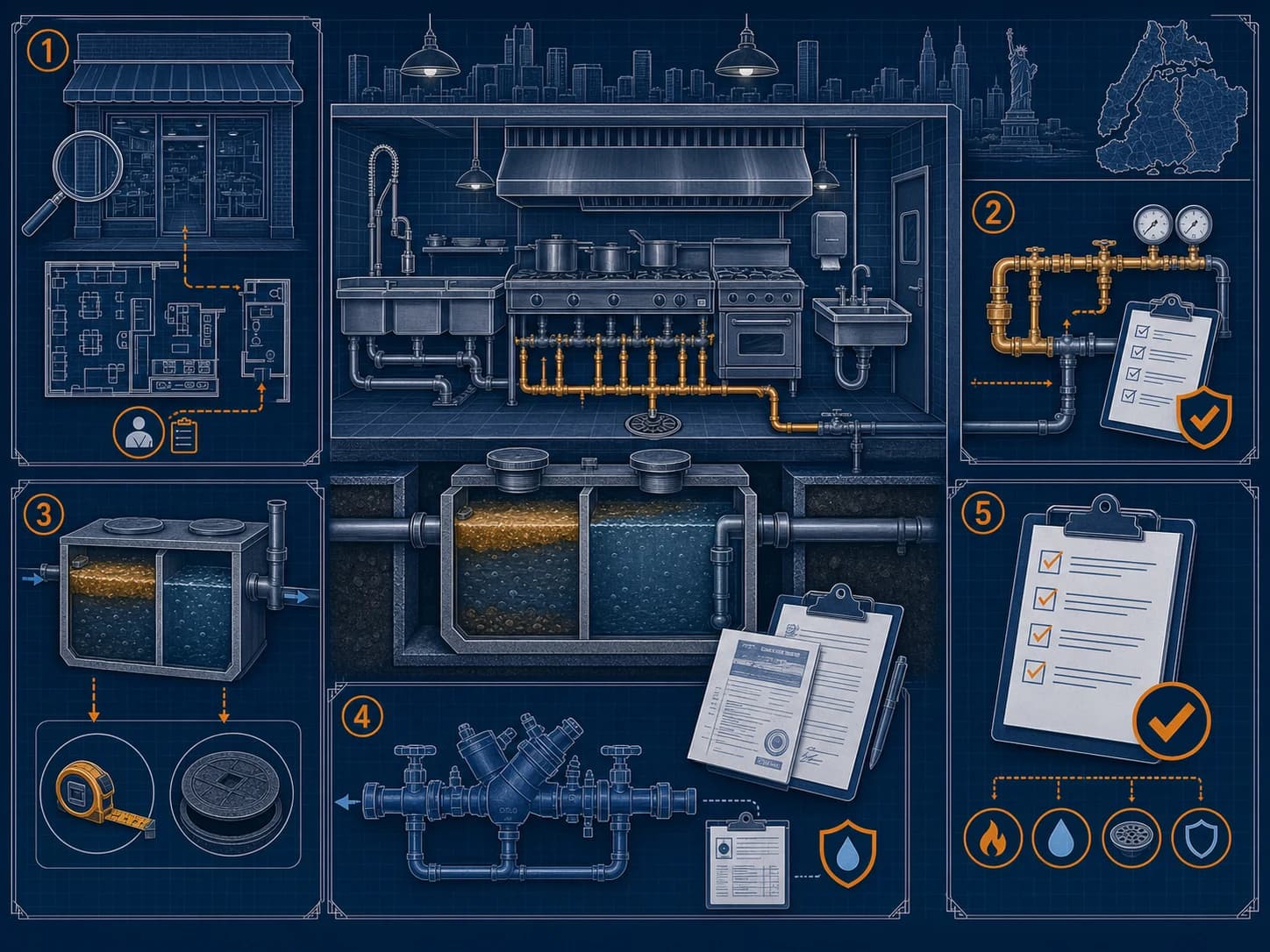
- Treat gas piping, grease handling, backflow protection, hot water, floor drainage, and permits as one opening-readiness checklist.
- Keep the records that prove the work was scoped, filed, installed, inspected, and maintainable.
Before opening an NYC restaurant, the plumbing question is not just "does the kitchen have sinks?" Owners and operators should confirm whether the proposed use can be supported by the existing gas, water, waste, grease, and backflow systems before construction pricing or opening dates become fixed.
That review belongs early because restaurant plumbing sits between design, DOB filings, DEP compliance, utility coordination, Health Department readiness, and landlord-tenant responsibility. Austin Plumbing handles the licensed plumbing side of commercial kitchen projects, but the owner still needs a checklist that separates lease decisions, construction scope, and opening records.
This guide is for restaurant operators, landlords, property managers, general contractors, and buildout teams planning a new food-service space or taking over a prior restaurant in New York City.
What should be checked before signing the lease?
The first plumbing review should happen before a food-service tenant commits to a space. A location can look restaurant-ready while still having a gas service that is too small, a grease interceptor that served a lighter prior use, missing backflow records, or drain routing that does not match the proposed kitchen plan.
Start with the proposed menu, equipment schedule, seating or service model, and hours of operation. A small coffee counter, full-service restaurant, commissary, bakery, fast-casual kitchen, and bar with cooking equipment can create different plumbing loads even when the storefront is the same size.
| Pre-lease item | What to confirm | Why it matters |
|---|---|---|
| Prior use | Was the space legally used as food service? | Prior restaurant use does not prove the current layout or records are still adequate. |
| Cooking equipment | What gas-fired or high-water-use equipment is planned? | Equipment can change gas load, hot-water demand, drainage, and permits. |
| Grease handling | Is there an existing interceptor, and is it accessible? | DEP expects grease-producing businesses to control fats, oils, and grease before discharge. |
| Water protection | Does the building have a backflow device record? | Cross-connection review can affect water service and filing work. |
| Drainage | Are floor drains, indirect waste, and cleanouts in useful locations? | Poor routing can create backups, access problems, and expensive slab work. |
| Records | Are prior permits, inspections, and maintenance records available? | Missing records can turn a simple opening into an agency-documentation problem. |
If the space is already open as a restaurant, do not treat that as proof that all plumbing records are clean. Review the field conditions and paperwork together.
Which plumbing items can hold up an opening?
The items most likely to affect an opening are the ones that cross from field work into permits or inspections: gas piping, grease interceptor work, backflow prevention, water heaters, drain/waste/vent alterations, and fixture layouts.
NYC DOB says plumbing permits and applications are issued to a Licensed Master Plumber or Licensed Master Fire Suppression Contractor, and that only those licensees or their supervised employees may work on piping systems. DOB's separate plumbing permits guidance also says alteration, rearrangement, relocation, or permanent removal of piping must be supervised by the proper licensee.
For a restaurant buildout, that means the plumbing scope should be identified before a general contractor prices the job. A drawing set can say "connect equipment," but the field reality may involve gas pipe sizing, pressure testing, waste-line changes, new cleanouts, interceptor replacement, or hot-water upgrades.
Common opening blockers include:
- Gas piping that does not match the final cooking-equipment load.
- A grease interceptor that is missing, undersized, inaccessible, or not documented.
- Backflow prevention questions discovered after water service or equipment is selected.
- Hot-water capacity that cannot support dishwashing, handwashing, and prep demands.
- Fixture layouts that conflict with code, health inspection expectations, or practical service access.
- Prior plumbing work that was altered without clear DOB permit records.
For the licensed field lane, Austin's commercial plumbing service and gas piping practice are the natural next steps when the checklist shows the space needs scoped work, permit coordination, or field correction.
How should gas, grease, and backflow be scoped?
Gas, grease, and backflow should be scoped as connected systems, not separate last-minute tasks. A commercial kitchen's cooking line drives gas demand, its sinks and floor drains drive grease and waste routing, and its water-service risks may trigger backflow review.
| System | Owner question | Licensed review should answer |
|---|---|---|
| Gas piping | Can the building serve the proposed cooking line? | Whether piping, meter/service capacity, shutoff locations, permits, pressure testing, and utility coordination match the equipment schedule. |
| Grease interceptor | Is the interceptor right for the actual kitchen? | Whether the unit type, sizing, location, access, flow control, venting, and maintenance path fit the proposed food service use. |
| Backflow prevention | Does the water service connect to a possible contamination source? | Whether DEP records, device type, installation approval, annual testing, and filing responsibility are clear before opening. |
| Hot water | Can the system support peak demand? | Whether water heaters, recirculation, storage, recovery, mixing, and fixture demand match the operating plan. |
| Waste and drainage | Can the kitchen be cleaned and serviced without recurring backups? | Whether floor drains, indirect waste, cleanouts, slope, grease waste lines, and access are practical for daily operation. |
NYC DEP's grease guidance tells businesses to install correctly sized units and maintain them properly. DEP also tells businesses to use licensed plumbers for installation, which is why grease planning should be part of the licensed plumbing scope instead of a last-minute equipment purchase.
That is why a restaurant should not wait until the first backup or agency visit to ask whether the grease system is right. Austin's grease trap compliance service covers the installation and sizing lane, and the owner-focused NYC grease trap requirements guide explains the landlord, tenant, maintenance, and record questions in more detail.
Backflow should be screened with the same early discipline. NYC Business says a property needs a backflow prevention device on every water service pipe connecting the drinking water supply to a possible contamination source, and that a licensed plumber or engineer can help decide whether a device is needed. For existing devices, use Austin's backflow prevention testing service or the NYC backflow testing checklist to organize the record.
What records should be ready before inspections?
Opening readiness is partly physical and partly documentary. The plumbing may work in the field, but the owner still needs proof that the right scope was filed, inspected, signed off, and maintainable after opening day.
NYC311's Food Establishment Permit page says a Food Service Establishment Permit is required to serve food or drinks at a restaurant or eatery. The NYC Business restaurant guide also groups restaurant setup around permits, inspections, operations, and compliance. Treat those restaurant-opening steps as separate from, but dependent on, a clean plumbing file.
Before the final push to open, collect:
- The approved kitchen layout and equipment schedule used for plumbing review.
- DOB plumbing permit records for gas, waste, water, or fixture work where the scope required filing.
- Gas pressure-test, inspection, sign-off, and utility-restoration records where gas work was involved.
- Grease interceptor sizing notes, installation records, access location, maintenance plan, and pump-out responsibilities.
- Backflow device approval, installation, annual test, or due-date records where a device exists or is required.
- Water heater and hot-water system documentation, especially where dishwashing or food-prep demand changed.
- Landlord-tenant responsibility notes for maintenance, pump-outs, access, records, and emergency response.
- Any DEP, DOB, OATH, or prior-owner notices tied to the space.
Do not wait until a failed inspection to discover that nobody knows who owns a grease pump-out record, backflow form, or gas sign-off document.
When is this a service issue versus a compliance issue?
Many restaurant plumbing problems start as service issues and become compliance issues when they repeat, affect records, or involve agency notices. A slow floor drain is a service call. A recurring grease-line backup in a kitchen with no maintenance record can become a DEP compliance problem. A gas appliance that will not fire may be a service issue; a locked meter or failed pressure test is a gas-restoration and documentation issue.
Use this decision rule:
| Situation | First lane |
|---|---|
| The kitchen is still in lease or design review. | Pre-opening plumbing walkthrough and scope review. |
| The buildout is underway and drawings are changing. | LMP review of permits, gas, waste, grease, and water changes. |
| The restaurant is open and drains keep backing up. | Service diagnosis, then grease compliance review if the condition repeats. |
| A DEP, DOB, OATH, or utility notice has arrived. | Agency-record review before assuming it is only a repair. |
| Prior work looks undocumented. | Permit and closeout review, with violation removal if records are already open. |
For active plumbing work, start with the system that is failing. For opening preparation, start with the checklist, because the systems interact.
Owner checklist before opening
Use this checklist before the opening date becomes the pressure point.
| Checklist item | Owner action |
|---|---|
| Lease and use | Confirm the proposed food-service use matches the building's real plumbing capacity and prior records. |
| Equipment schedule | Share the final cooking, dishwashing, prep, refrigeration, and bar equipment list with the plumbing reviewer. |
| Gas scope | Confirm gas load, routing, shutoffs, permits, pressure testing, and utility coordination where gas cooking is planned. Use the restaurant gas authorization handoff guide to track the separate FDNY, DOB, and utility records. |
| Grease system | Confirm interceptor size, location, access, connected fixtures, maintenance plan, and pump-out responsibility. |
| Backflow | Confirm whether the building has a device, needs one, or has an annual testing record tied to the restaurant use. |
| Hot water | Confirm capacity for hand sinks, prep sinks, dishwashing, peak service, and cleanup. |
| Drainage | Confirm floor drains, indirect waste, cleanouts, slope, and service access before floors and walls close. |
| Records | Keep permits, inspection notes, sign-offs, device documents, and maintenance obligations in one opening file. |
The best time to correct a restaurant plumbing problem is before the lease, before the slab is opened, or before equipment is ordered. The second-best time is before a failed inspection or Friday-night service emergency forces the issue.
Where Austin fits
Austin Plumbing & Heating helps NYC restaurant owners, food-service tenants, landlords, and buildout teams review the plumbing side before it turns into an opening delay. The useful first step is not a generic estimate. It is a site-specific review of the proposed kitchen, existing field conditions, records, and agency path.
For a new restaurant, equipment change, grease interceptor issue, gas cooking line, or unclear plumbing record, start with Austin's commercial kitchen plumbing team. The goal is simple: identify the plumbing scope early, file the work correctly where filing is required, and leave the owner with a record that still makes sense after opening day.
Common Questions
When should plumbing be reviewed before opening an NYC restaurant?
Review plumbing before the lease, layout, and equipment schedule are final. Gas load, grease interceptor location, backflow requirements, drain routing, water heater capacity, and DOB permit scope can all affect cost and opening readiness.
Does a restaurant grease interceptor need a Licensed Master Plumber?
Yes. NYC DEP guidance points businesses to licensed plumber installation for grease interceptors, and DOB plumbing permit work runs through a Licensed Master Plumber when the scope requires filing.
Is a backflow device always part of a restaurant opening?
Not always, but it should be screened early. NYC Business says properties need backflow prevention where a water service pipe connects drinking water to a possible contamination source, and a licensed plumber or engineer can help decide whether a device is needed.
What records should an owner keep before opening?
Keep the approved plumbing scope, permits, inspection records, gas pressure-test and sign-off documents where applicable, grease interceptor sizing and maintenance records, backflow device paperwork, and any landlord-tenant responsibility notes.