
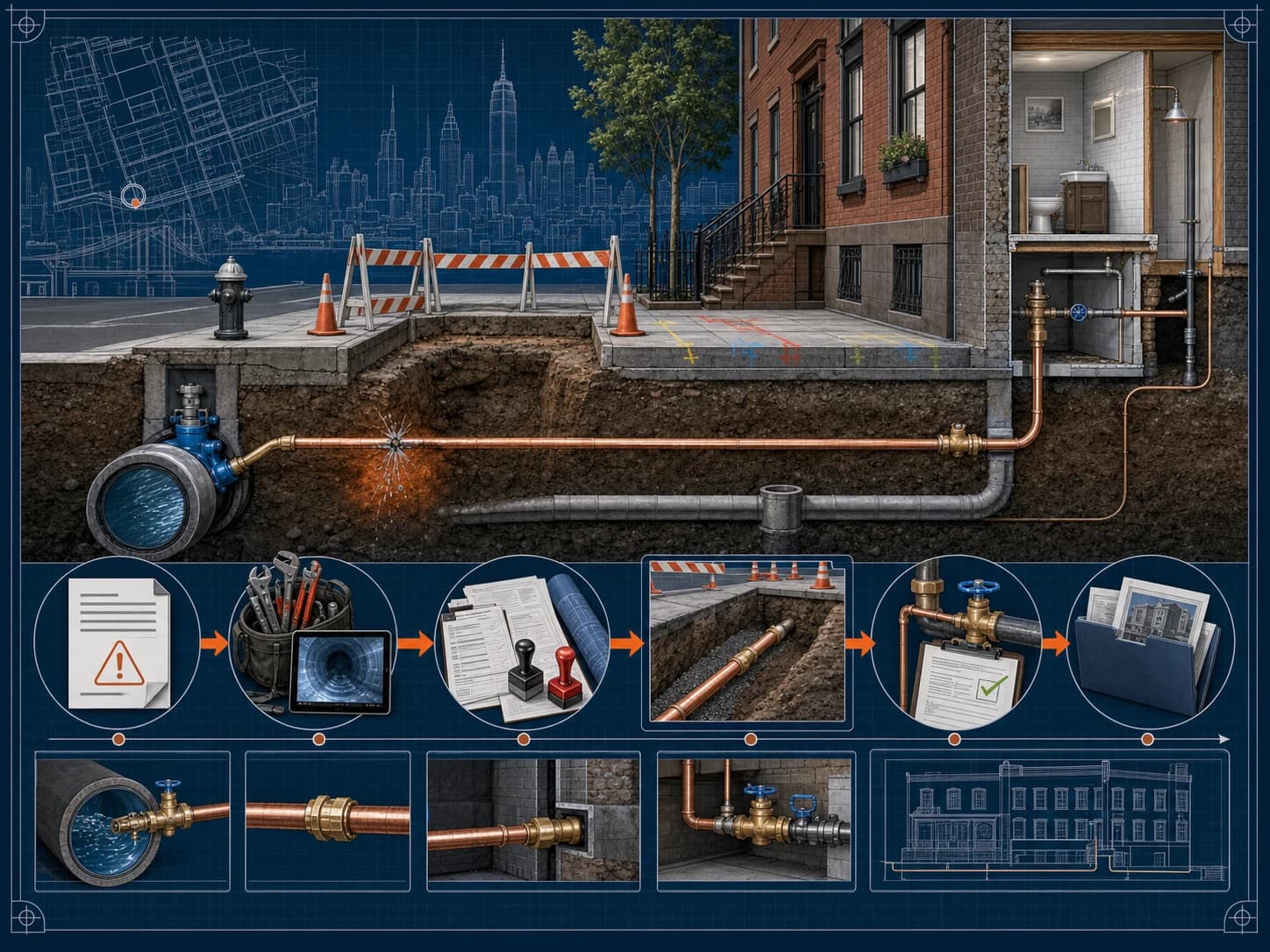
Key takeaways
- Treat the notice as an active water-service case, not a request for a routine estimate. Save every page, the inspection date, the inspector information, and the DEP Customer Service Request number.
- Call a Licensed Master Plumber immediately. DEP says the LMP must coordinate the necessary DEP and DOT permits before repair work begins.
- Keep the building safe while the line is assessed. Do not enter a flooded excavation, operate an unknown curb valve, or let unlicensed work disturb the street connection.
- Separate the field repair from case closeout. The owner file should show what leaked, which scope was approved, which permits applied, what DEP required, and how the completed work was documented.
The short answer for an NYC owner
A DEP Water Shut Off Warning — Notice to Repair means DEP believes the private water service line serving the property is leaking and creating a hazard. The useful first move is to call a Licensed Master Plumber, give the plumber the complete notice and CSR number, and organize immediate access to the building entry point and the street-side condition.
DEP's current notice page says property owners own and are responsible for the water service line connecting the building to the City water main. It also says the owner has three days to hire an LMP to fix the leak and that the LMP must obtain the necessary DEP and DOT permits before the work.
If water is actively surfacing, entering a basement, undermining pavement, or affecting neighboring property, keep people away from the area and call for emergency plumbing service. A hazardous condition can change how quickly DEP acts.
What exactly does the notice say?
The current DEP sample Notice to Repair records the property, notice date, inspector, and CSR number. It states that the building has a water service line leak, directs the owner to hire a Licensed Master Plumber, and warns that unresolved work can result in shutoff and a $1,000 shutoff fee.
Start by copying the notice before it gets handed between the owner, manager, insurer, plumber, and excavation team. Record:
- The exact property address shown.
- The notice date and any printed response or repair date.
- The inspector's name and contact information.
- The DEP CSR number.
- Where water was observed and whether it is still moving.
- Any marked curb, street, sidewalk, or building-entry location.
- Whether neighboring property, a cellar, the sidewalk, or the roadway is being affected.
- Prior water-service plans, tap cards, repairs, protection-plan records, or insurance correspondence.
If the address, condition, or service-line identification appears wrong, the DEP notice page provides a general-inquiries number for mistakes or extreme circumstances. That call should happen alongside licensed field coordination, not instead of it.
How should the owner treat the three-day clock?
Two current official surfaces describe the period differently. DEP's warning and sample form say three days. NYC311's 3-Day or 10-Day Water Notice page describes the three-day period as three business days and gives a Friday-to-Wednesday example.
The safe owner practice is simple:
- Use the deadline and directions printed on the actual notice.
- Call the Licensed Master Plumber on the day the notice is found.
- Have the LMP confirm the CSR, service-line condition, and case timing with DEP.
- Do not assume a weekend, insurance review, access problem, or pending estimate pauses the case.
- Keep a dated communication log showing who called DEP, what was confirmed, and what work was scheduled.
NYC311 also says that if the repair cannot be made within the stated period, only the licensed plumber may apply to DEP for an extension. An owner can assemble access, insurance, hardship, or scheduling evidence, but should not describe the deadline as extended until the licensed team has a case-specific response.
What should the first Licensed Master Plumber visit determine?
The first visit should connect the notice to the actual service line. Surface water alone does not tell the owner whether the failure is at the curb connection, beneath the sidewalk, at a joint, along the service pipe, or near the building entry. It also does not establish whether the correct scope is a localized repair or a relay.
Ask the LMP to document:
- The apparent path of the domestic water service from the City main to the building.
- The location DEP marked or described and the visible leak pattern.
- The service material, size, and accessible condition where they can be confirmed.
- Whether the building shutoff, meter area, entry piping, and nearby interior piping show a related condition.
- Whether leak-location work or controlled testing is needed before excavation.
- What emergency protection is needed around the sidewalk, street, cellar, or neighboring property.
- Whether the proposed scope is repair, relay, tap or connection work, or a staged investigation.
- Which DEP, DOT, access, utility-marking, inspection, and closeout steps belong to that scope.
Austin's leak-detection service can help distinguish an interior piping failure from a service-line condition, while the notice itself still needs a licensed outdoor-work and agency plan. Do not let a general interior leak repair be presented as resolution of the DEP case without matching the noticed service line.
When is the job a repair, and when is it a relay?
A repair corrects a defined failed section when the existing service and applicable rules allow it. A relay replaces the water service connection along the required route and may also change the tap, pipe size, or building-entry work. The correct choice depends on field evidence and the current DEP record, not on a universal price or age rule.
DEP's water-service permitting page currently states that repair/relay applications are filed through PARIS and that a full-property fixture count is required for a repair or relay application. It also states:
- Repairs may use emergency DOT permits, while a DEP permit is required for every relay.
- Lead service lines cannot be repaired; when lead is present, relay is required.
- The current service size, fixture count, tap, and connection can affect the permitted scope.
- Domestic service-line work two inches or smaller is currently self-certified, with a tap card submitted through PARIS as part of that process.
Those rules are why an owner should avoid approving "patch the leak" or "replace the whole main" before the LMP reviews the pipe material, fixture count, tap and service record, street condition, and permit path. A broader plumbing service review can also identify whether old interior supply piping needs a separate scope; that is not automatically the same project as the DEP-noticed service line.
Who coordinates DEP, DOT, excavation, and access?
The owner is responsible for retaining the licensed team, providing access, approving scope, and keeping the case record. The LMP is the licensed plumbing lead for the repair or relay and the associated DEP coordination. Street and sidewalk work can also require DOT permits, utility mark-outs, safe excavation, traffic or pedestrian protection, inspection coordination, and restoration.
Use a responsibility table before work begins:
| Handoff | Owner question | Record to keep |
|---|---|---|
| DEP notice | Which CSR and service line does the notice identify? | Complete notice, photos, inspector details, call log |
| Field diagnosis | Where is the confirmed or suspected failure? | Marked plan, findings, photos, proposed scope |
| Permit path | Is this repair, relay, tap, or another connection scope? | DEP/PARIS and DOT permit references |
| Excavation | Who controls access, mark-outs, protection, and restoration? | Schedule, access plan, site photos, subcontractor coordination |
| Inspection or self-certification | What evidence will DEP require for this exact permit? | Inspection result, tap card, permit closeout, DEP correspondence |
| Building restart | How will water be restored and interior systems checked? | Restoration confirmation, fixture checks, owner handoff |
For a multi-unit or managed property, assign one person to tenant communication, cellar and meter-room access, neighboring-property contact, and the owner evidence file. Austin's building services team can help managers connect an urgent plumbing project to broader building coordination without turning the notice into a generic maintenance task.
What if water service has already been shut off?
Title 15, Chapter 20 says DEP may shut the tap or wet connection when a service-pipe leak creates an immediate threat or when a three-day notice is not complied with. The current DEP notice page says an LMP must complete the repair and fees owed to DEP must be resolved before service is turned back on.
Do not operate a City-side tap, disturb a street excavation, or promise a restoration time. Ask the LMP and DEP to identify:
- The shutoff status and exact case reference.
- The repair or relay scope required before restoration.
- The permit, inspection, self-certification, or tap-card evidence needed.
- Any DEP fees or case conditions that remain open.
- Who will request or authorize the final turn-on.
- What interior plumbing, hot-water, heating, and equipment checks are needed after service returns.
The building may need an operations plan while water is unavailable. Owners and managers should coordinate occupants, required building services, fire and life-safety implications, mechanical equipment, and any agency directions based on the actual property. This guide does not replace those building-specific decisions.
What belongs in the owner closeout file?
The repair is not fully documented when the excavation is backfilled. Keep a file that lets the next manager, insurer, buyer, or plumber reconstruct the DEP case without reopening the investigation.
Include:
- The original DEP notice and CSR number.
- Every DEP call, email, inspection, extension, or case update.
- The LMP's diagnosis and approved repair-or-relay scope.
- Before, during, and after photographs tied to the service route.
- Service material and size findings.
- DEP/PARIS and DOT permit records.
- Utility mark-out and excavation-protection records.
- Inspection, self-certification, tap-card, and closeout evidence applicable to the work.
- Water-restoration confirmation and post-restoration fixture or equipment checks.
- Street and sidewalk restoration records.
- Insurance or service-line protection correspondence, without treating coverage as proof of compliance.
- A marked plan showing the final service route and building entry.
Do not combine this file with a sewer notice merely because both pipes run below the street. The NYC sewer-backup owner guide covers a different private-line responsibility, diagnosis, permit, and closeout path.
When should an owner call Austin?
Call Austin when the notice arrives, water is surfacing or entering property, the service material or route is unclear, a prior repair did not close the case, or water has already been shut off. Have the full notice, CSR number, owner and manager contacts, access instructions, visible-condition photos, prior service-line records, and insurance or protection-plan information ready.
The first decision is not a generic price comparison. It is whether the noticed condition can be safely defined and put on a licensed repair, permit, excavation, and closeout path before the building loses water service or the hazard grows.
Common Questions
What should an NYC owner do first after receiving a DEP three-day Notice to Repair?
Save the full notice and CSR number, photograph the visible condition without entering an unsafe area, and call a Licensed Master Plumber immediately. The plumber needs to confirm the service-line condition, coordinate with DEP, identify the permit and excavation path, and tell the owner what access and records are needed.
Does the three-day period mean calendar days or business days?
DEP's current warning says repairs must be made within three days, while NYC311 currently describes the period as three business days. Follow the date and instructions printed on the actual notice, have the Licensed Master Plumber confirm the case with DEP, and do not delay the first call while calculating the deadline.
Can an owner ask DEP for more time?
NYC311 says that when the repair cannot be completed within the three-day period, only the licensed plumber may apply to DEP for an extension. An owner should still preserve the notice, contact information, and any exceptional-circumstance evidence, but should not assume that an unanswered message or insurance claim extends the notice.
Does every leaking water service line need a full relay?
No. The field condition, pipe material, location, prior record, and permit requirements determine whether a repair or relay is appropriate. DEP's current guidance says a lead service line cannot be repaired and must be relayed; other service lines still need a building-specific licensed assessment.
What happens if the notice is not resolved in time?
DEP's current warning says it may shut off the water service and charge a $1,000 shutoff fee when repairs are not made within the notice period. An emergency condition can lead to shutoff sooner. Owners should use the exact notice and DEP case record rather than relying on a general article for case-specific enforcement timing.