
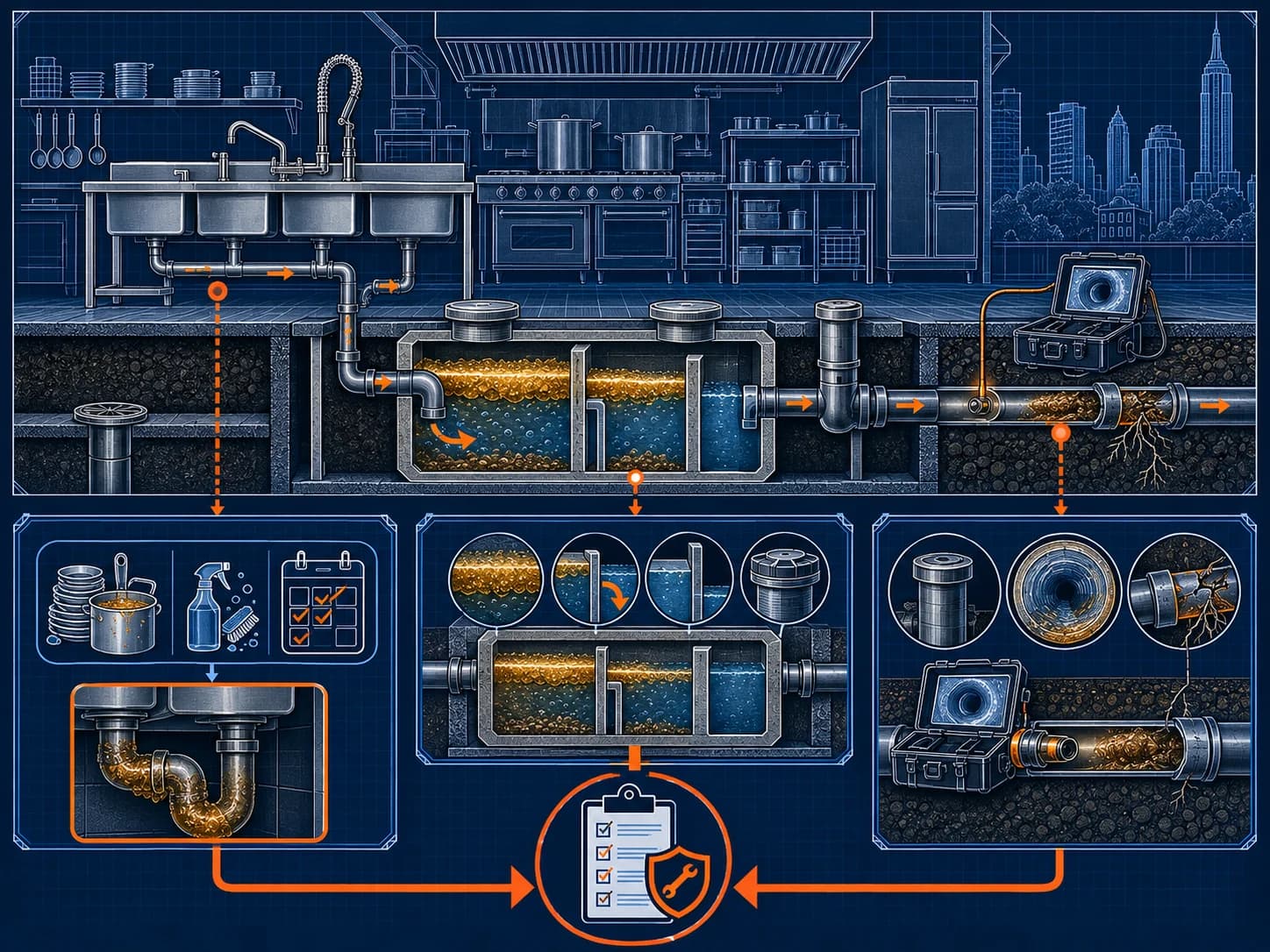
Recurring restaurant drain backups need a three-part diagnosis: operating and cleaning records, the grease interceptor itself, and the connected waste piping. Clearing the line or pumping the interceptor may restore flow, but neither action proves why the problem returned. Keep those three evidence lanes separate until the findings support a corrective scope.
If raw sewage is actively backing up, protect staff and customers, stop adding wastewater where practical, and arrange an immediate professional response. NYC DEP directs sewer backups to 311. The diagnostic record comes after the immediate exposure and operating risk are controlled.
Start with the pattern, not the assumed cause
A backup near a three-compartment sink can begin with grease and food solids, an overloaded or poorly maintained interceptor, a restricted fixture branch, or a problem farther downstream. More than one condition can be present. The first service note should describe what happened without turning the symptom into a diagnosis.
Record the pattern before recent details disappear:
| Question | Useful evidence |
|---|---|
| Where did wastewater appear? | Sink, floor drain, mop sink, dishwasher connection, cleanout, or another location |
| What was operating? | Prep, dishwashing, cleanup, or another high-discharge period |
| What else was affected? | One fixture, one kitchen area, or several connected fixtures |
| What happened before the backup? | Pump-out, drain clearing, menu change, new equipment, construction, or no known change |
| What restored flow? | The exact service performed, how long improvement lasted, and any unresolved observation |
Do not ask staff to open interceptor covers, enter contaminated areas, use chemicals, or operate unfamiliar valves for this record. Photos already taken safely, service invoices, and the operator's timeline are enough to start the professional investigation.
Compare three possible failure lanes
The useful question is not simply “grease trap or drain?” The restaurant should compare three lanes that can overlap.
| Evidence lane | What the record may show | What the professional review should resolve |
|---|---|---|
| Operating and cleaning practice | Grease or solids entering drains, missed service, no pump-out record, or a change in kitchen volume | Whether operating controls and the maintenance interval fit the actual use |
| Grease interceptor | Rapid accumulation, inaccessible service points, damaged components, improper connections, or a unit that may not match the load | Whether the unit is correctly sized, installed, maintained, and operating effectively |
| Connected waste piping | Several fixtures backing up, a short-lived improvement after clearing, or findings beyond the interceptor | Whether a branch, grease waste line, cleanout, or downstream section needs further inspection or repair |
NYC DEP's business grease guidance says covered establishments must correctly install, operate, and maintain properly sized and designed grease interceptors. DEP also says it checks sizing, installation, maintenance, and effective operation. That is why a recurring backup should not be assigned to maintenance alone before the hardware and piping are evaluated.
Check operating and cleaning records first
An operator can improve the service visit by showing what the kitchen sends to the drain and how the interceptor has been maintained. The goal is not to assign blame. It is to compare the actual operating load with the system and service plan.
Bring these records together:
- Interceptor cleaning or pump-out dates and the company that performed the work.
- Notes about the material removed, damaged parts, difficult access, or unusual accumulation.
- Dates of drain clearing, jetting, camera work, or other plumbing service.
- Menu, hours, volume, staffing, or equipment changes near the first recurring event.
- The fixtures connected to the grease system, based on the available plans or prior service record.
- Staff practices for scraping food solids and handling used cooking oil.
NYC Business's restaurant compliance guide treats grease-interceptor maintenance, functioning plumbing, proper drainage, and a functioning sewage-disposal system as separate operating responsibilities. The records should therefore show more than the date of the last emergency clearing.
If there is no reliable maintenance history, begin a record now. Do not invent dates or treat a verbal recollection as a complete service log. Austin's restaurant grease-interceptor guide explains the broader sizing, installation, maintenance, and landlord-tenant record questions.
Inspect the interceptor as a system component
The grease interceptor sits between kitchen fixtures and the downstream waste line. A recent pump-out can remove accumulated material, but it does not establish that the unit matches the fixture load or that its internal and external connections are functioning as intended.
Ask the Licensed Master Plumber to document the inspected boundary and findings. The review may need to address:
- The unit type, rated capacity, connected fixtures, and actual kitchen use.
- Flow control, baffles or regulating components, covers, access, venting, and visible connections.
- Whether grease appears to be bypassing the intended separation path.
- Whether the unit can be serviced safely and completely.
- Whether the condition is maintenance-related, installation-related, damaged, or still uncertain.
DEP says grease interceptors must be the proper size and installed by a licensed plumber. The existing NYC grease-trap requirements guide remains the detailed compliance owner. This guide uses those requirements only to organize a recurring-backup diagnosis.
Follow the waste line when the evidence points downstream
When several connected fixtures back up, flow improves only briefly, or material reappears after interceptor service, the investigation may need to continue into the grease waste line or another downstream section. The exact method and boundary belong in the plumber's scope.
Ask the report to state:
- Which fixtures, branches, cleanouts, and piping sections were checked.
- What clearing or inspection work was performed.
- What the findings show about buildup, pitch, damage, an improper connection, or another restriction.
- Which sections were not accessible or remain unconfirmed.
- Whether the next step is operating correction, maintenance, targeted repair, replacement, or further investigation.
A camera image is evidence from one reachable section, not proof that the full system is sound. Likewise, a line that flows immediately after clearing has passed a short operational check, not a long-term root-cause test.
For a new buildout or equipment change, use the restaurant plumbing checklist before floors and walls close. It covers waste routing, cleanout access, interceptor planning, hot water, backflow, gas, and the owner record needed before opening.
Match the corrective scope to the findings
The final recommendation should identify which lane failed and why the proposed work addresses it. Avoid a proposal that lists equipment or pipe replacement without connecting it to the inspected condition.
| Finding | Appropriate owner question |
|---|---|
| Service interval does not match accumulation | What record and inspection point will define the next interval? |
| Interceptor may be undersized or improperly configured | What fixture and operating information supports the sizing or correction scope? |
| A specific piping defect or restriction was found | Where is it, what evidence supports the scope, and what remains unconfirmed? |
| Cause is still uncertain | What bounded next check would resolve the uncertainty without replacing unrelated components? |
| Several conditions contributed | Which actions are operational, which belong to a hauler, and which require licensed plumbing work? |
NYC DOB's plumbing-permit guidance distinguishes ordinary repairs from work that alters, rearranges, relocates, or installs piping. The Licensed Master Plumber should identify the filing and inspection path for the actual repair. Do not assume every clearing needs a permit or that a recurring problem can be corrected without one.
Verify the repair under normal kitchen conditions
Closeout should compare the original pattern with the condition after service. Record which fixtures were checked, the operating condition during the check, any maintenance change, and any exception that remains open. A quiet hour test may not reproduce a peak dishwashing or cleanup load, so the team should state what the verification did and did not establish.
Keep one operating file with the plumbing findings, interceptor service records, waste-hauler records, applicable permits or inspections, staff responsibilities, and the next review date. For multi-site or planned service, Austin's building maintenance practice can help define covered systems, records, and escalation responsibilities.
Bring Austin the evidence from all three lanes
Do not choose between “pump it again” and “replace the line” before the evidence is organized. Bring the affected-fixture pattern, service history, interceptor records, operating changes, and prior inspection findings to Austin's commercial kitchen plumbing team. The next scope should follow the restaurant's actual system, not a generic diagnosis.
Common Questions
Does pumping the grease interceptor prove the drain problem is fixed?
No. Pumping addresses accumulated material in the interceptor. It does not prove that the unit is correctly sized, its internal components and connections are sound, or the downstream waste line is clear and intact.
Can a restaurant's cleaning practices cause recurring backups?
They can contribute. Grease and food solids entering drains, an inadequate interceptor-cleaning interval, or missing service records can point to an operating-control problem. A plumber should still check whether the interceptor and connected piping also have defects.
When should the waste line be inspected?
A qualified plumber should decide the inspection scope when backups continue after clearing or interceptor service, affect several fixtures, or suggest a downstream restriction. The findings should identify the inspected boundary and any remaining uncertainty.
Does every recurring restaurant backup require a plumbing permit?
No. Diagnosis and routine clearing are not the same as altering, rearranging, replacing, or installing plumbing. The Licensed Master Plumber should identify the filing and inspection path for the actual corrective scope.
What should an operator have ready for the service visit?
Bring the affected-fixture list, dates and times, recent clearing and interceptor-service records, menu or equipment changes, prior findings, and a contact who can arrange safe access without interrupting kitchen operations unexpectedly.