
Key takeaways
- Start with an occupancy map and a system map. "Vacant" is not a mechanical operating plan.
- Keep occupied apartments, shared risers, domestic water, the water meter, heating equipment, fire protection, alarms, and inspection access in separate decision lanes.
- Do not use one guessed thermostat setting or one building-wide valve closure as a universal winterization method.
- Record every isolation point, active service, monitoring assignment, and restoration step before the property is left unattended.
- Treat fire-protection impairment, gas service, boiler compliance, and tenant heat or hot-water obligations as controlled professional work, not winter tips.
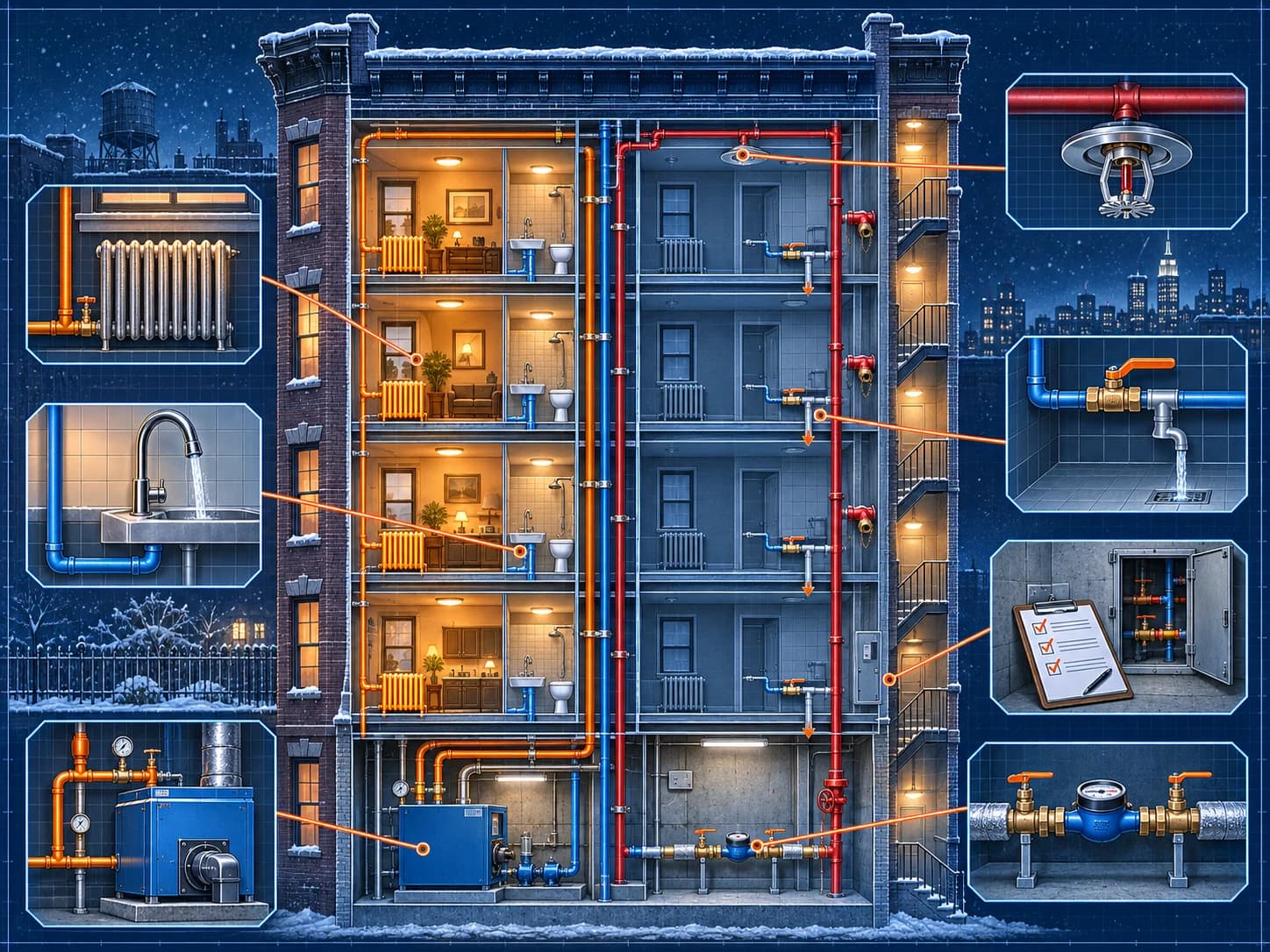
Winterizing a vacant or partly occupied NYC building means deciding what must keep operating, what may be isolated, what may be drained, and who will verify the building after each change. The safe plan follows the actual occupancy, piping layout, equipment, fire-protection systems, agency records, and access conditions. It does not begin with a blanket instruction to shut off the heat or water.
Partly occupied properties need an even tighter boundary. An apartment may be empty while its heating riser, domestic-water branch, return line, sprinkler piping, or control serves occupied space elsewhere. Owners should map those shared systems before authorizing any shutdown.
This guide owns the occupancy-and-systems winterization decision. Austin's separate backflow freeze-risk checklist owns exposed containment assemblies. The planned building-wide freeze-risk audit owns the full property walk and printable risk register. Active frozen-pipe response belongs to emergency service, not this preparation guide.
Start with an occupancy-and-systems map
The first useful deliverable is a one-page map showing which spaces are occupied, intermittently used, under construction, or fully vacant. Put the related mechanical and plumbing systems on the same record. This exposes shared risers, common returns, cross-connected zones, meter locations, and equipment that cannot be assigned by apartment number alone.
| Decision lane | What to verify | Owner record |
|---|---|---|
| Occupancy | Occupied units, staff areas, commercial tenants, construction zones, lender or receiver access | Current occupancy list and responsible contact |
| Heat | Boiler or plant status, zones, pumps, controls, terminal units, exposed piping, fuel and power | Operating sequence and alarm thresholds approved for the property |
| Domestic water | Service entry, meter, risers, branch shutoffs, exterior fixtures, tanks, pumps, hot-water generation | Valve and fixture schedule with photos |
| Fire protection | Sprinkler, standpipe, fire alarm, pump, tank, heat-trace or protected-room dependencies | Fire-protection contact and impairment procedure |
| Compliance and access | Required inspections, open permits, violations, testing, utility appointments, insurer visits | Calendar, key-control plan, and access instructions |
Walk the property with the existing drawings and records, but treat field conditions as controlling. Labels can be wrong. Old shutoffs can pass water. A line that looks apartment-specific may continue to another fixture or system. Record uncertainty and assign it for verification instead of guessing.
Keep tenant service obligations separate from freeze protection
If tenants remain, the owner must preserve required services in occupied apartments. NYC HPD states that hot water is required year-round and that heat-season temperature rules apply from October 1 through May 31 (NYC HPD, Heat and Hot Water, retrieved 2026-11-05). A vacancy elsewhere in the building does not erase those occupied-unit duties.
When construction is part of the vacancy plan, DOB also tells owners and contractors to plan how heat, hot water, cold water, gas, electricity, and other basic services will be maintained for tenants (NYC DOB, Maintaining Services, retrieved 2026-11-05). The construction or winterization plan should show the service boundary, not merely state that the building is "partly vacant."
For a fully vacant building, do not convert HPD's occupied-unit temperature rules into a made-up freeze-prevention setting. Ask the heating professional to define the operating method from the building's piping, equipment, envelope, exposure, fuel, controls, alarms, and insurer requirements. Some systems may need normal circulation or protected-space heat even when no apartment is occupied.
Vacancy also does not automatically pause equipment compliance. DOB's current boiler page requires annual inspection and filing for covered low- and high-pressure boilers in the applicable property types (NYC DOB, Boiler Compliance, retrieved 2026-11-05). Track the building's actual equipment and inspection status before reducing operation or planning service work. Austin's boiler inspection service can help separate annual compliance from a seasonal operating decision.
Decide which domestic-water branches may be isolated or drained
Domestic-water winterization should follow verified branches, not floor labels. Start at the service entry and water meter, then trace risers, pumps, tanks, hot-water equipment, recirculation, common fixtures, exterior faucets, and vulnerable runs through unheated spaces.
NYC DEP says owners are responsible for protecting pipes and water meters from freezing. Its guidance calls out basements, crawl spaces, unheated garages, exterior drafts, outside faucets, hoses, and cabineted pipes against exterior walls (NYC DEP, Protect Your Pipes from Freezing, retrieved 2026-11-05). Those conditions belong in the field survey and monitoring plan.
Use three statuses for each verified domestic-water segment:
- Remain active and protected. This may include the service, meter, shared riser, occupied-unit supply, hot-water system, or a branch needed for building operations.
- Isolate and drain under an approved scope. Record the upstream valve, downstream fixtures, low points, trapped sections, and restoration responsibility. A closed valve alone does not prove that a branch is empty or protected.
- Unresolved. Do not operate the valve or assume the line is independent until the field condition is confirmed.
The owner file should also explain what happens if the meter, service line, or interior piping freezes. DEP directs owners to contact 311 for a cold-damaged meter and to use a Licensed Master Plumber for frozen or broken service lines and piping. Open flame is not an acceptable thawing method.
Do not treat fire-protection piping as domestic water
Sprinkler and standpipe systems may share rooms, shafts, water supplies, or freeze exposure with plumbing systems, but they are not domestic-water branches. A plumbing winterization instruction should never silently include fire-protection valves, tanks, pumps, or piping.
FDNY Fire Code Chapter 9 establishes separate requirements when a sprinkler, standpipe, or fire-alarm system is out of service, including an impairment coordinator and protective actions such as evacuation or fire watch when applicable (FDNY, 2022 New York City Fire Code Chapter 9, retrieved 2026-11-05). The building's fire-protection professional should determine the applicable notification, supervision, restoration, and record path.
Add a hard boundary to the winterization scope:
- Identify fire-protection valves and equipment separately.
- Mark them "not part of domestic-water isolation" unless a specific fire-protection scope says otherwise.
- Confirm how protected rooms, tanks, pumps, dry or wet systems, alarms, and supervisory devices will remain functional.
- Give staff the impairment contact and emergency procedure before the building is left unattended.
If a pipe, valve, or room serves both a plumbing and fire-protection decision, stop and resolve the interface with the responsible professionals before work continues.
Preserve gas, electric, alarms, and inspection access
A winterization plan can fail even when the water valves are correct. Boilers, pumps, heat trace, alarms, control panels, remote sensors, sump pumps, fire protection, lighting, and communications may depend on electric service. Gas-fired equipment and gas service have their own utility, filing, testing, and licensed-work boundaries.
Do not shut, restore, test, or relight gas service as a casual vacancy step. If gas service or gas-fired equipment will change, use a building-specific plan with the utility and the licensed professionals responsible for the work. Austin's licensed gas-piping service is the correct handoff for that scope.
Preserve access for:
- Required boiler, fire-protection, elevator, backflow, utility, agency, insurer, and lender visits that apply to the property.
- Mechanical and meter rooms, roof tanks, crawl spaces, basements, yards, vacant apartments, and shared shafts that need inspection.
- Emergency entry without defeating building security, tenant privacy, or lawful key control.
- Posted contacts, lockbox or key logs, alarm procedures, and a clear path to the responsible decision-maker.
An inaccessible room is not a monitored room. List who can enter, who receives the alarm, how quickly the condition must be checked, and who can authorize repair.
Build a monitoring and restoration handoff
Winterization is an operating state, not a one-time visit. Assign recurring checks to observable conditions and name the person responsible for each response.
| Check | Evidence | Escalation trigger |
|---|---|---|
| Heat and plant | Control status, room condition, leaks, fuel or power state, alarm history | Loss of heat, abnormal pressure or temperature, leak, shutdown, or alarm |
| Water service and meter | Room temperature condition, insulation, drafts, visible leakage, meter area access | Water flow where none is expected, no flow where service is required, cold damage, or leak |
| Vacant branches | Valve position, drain-point condition, fixture condition, unauthorized use | Changed valve position, new water, damage, or uncertain restoration path |
| Fire protection | Supervisory status and professional inspection record | Any planned or unplanned impairment or damage |
| Building envelope | Broken opening, draft, roof or drain condition, unheated exposure | New exposure affecting protected piping or equipment |
Avoid a checklist that says only "inspect weekly." The frequency and response threshold should follow the property, weather, equipment, remote monitoring, insurer, construction, and occupancy conditions. Record every visit and corrective action.
Before spring occupancy, construction turnover, or a new tenant move-in, reverse the plan through a controlled restoration sequence. Verify valves, fixtures, leaks, traps, hot-water circulation, heating, alarms, fire protection, equipment, and required records before calling the building ready.
What belongs in the owner winterization file?
Keep one current file that can move from the owner or receiver to the property manager, super, lender, insurer, and contractors without losing the system boundary.
Include:
- Occupancy and access map with dates and responsible contacts.
- Domestic-water, heating, fire-protection, gas, electrical, alarm, and meter system maps.
- Valve and equipment schedules with clear photos and verified statuses.
- Licensed contractor scopes, inspection reports, permits, filings, violations, utility records, and open items.
- Approved operating instructions, alarm routing, inspection frequency, and emergency contacts.
- A log of visits, temperatures or conditions observed, alarms, leaks, service changes, and corrective work.
- The restoration sequence, acceptance checks, and person authorized to return each system to service.
For larger portfolios, link this file to Austin's property-manager plumbing compliance calendar. For an immediate boiler-room walkthrough, use the heat-season preflight guide. The heating service hub is the primary route for a building-specific winter operating assessment.
Common Questions
Can an owner turn off all heat in a fully vacant NYC building?
Do not use occupancy alone as the operating instruction. The owner should first confirm the building's piping, boiler, fire-protection, permit, insurance, inspection, and monitoring requirements with the appropriate professionals. A property-specific plan may keep selected systems operating even when no apartment is occupied.
What changes when only part of the building is vacant?
Occupied apartments keep their required heat, hot water, cold water, fire protection, and safe access. Vacant spaces should be mapped as separate zones before any branch is isolated or drained. Shared risers, returns, controls, meters, and fire-protection piping can cross both occupied and vacant areas.
Should a vacant apartment's water piping always be drained?
No. Whether a branch can be isolated and drained depends on the actual piping layout, shutoff condition, shared fixtures, heating arrangement, and fire-protection boundary. A Licensed Master Plumber should verify the field condition and the restoration plan before work proceeds.
Can sprinkler or standpipe piping be drained as part of plumbing winterization?
Not as an ordinary domestic-water step. Fire-protection systems have separate code, impairment, notification, fire-watch, inspection, and restoration requirements. Any planned or unplanned impairment should be handled through the building's fire-protection professionals and the applicable FDNY process.
What records should the owner keep after winterization?
Keep the occupancy map, system and valve schedule, photos, meter and equipment records, active-service list, monitoring and inspection schedule, responsible contacts, open filings or violations, restoration sequence, and every licensed contractor or fire-protection record produced by the work.