
Key takeaways
- Ideally, walk the boiler room before October 1. If the season has started, use the same walkthrough promptly to identify missed access, service, control, and record gaps without delaying required heat or urgent repairs.
- Observe and document; do not turn a manager checklist into equipment adjustment, safety-control bypass, or an informal DOB inspection.
- Keep the physical condition, tenant complaint pattern, service report, and agency record in one building file.
- Route gas odor, a carbon monoxide alarm, active smoke, or another immediate hazard to 911 and the serving utility from outside.
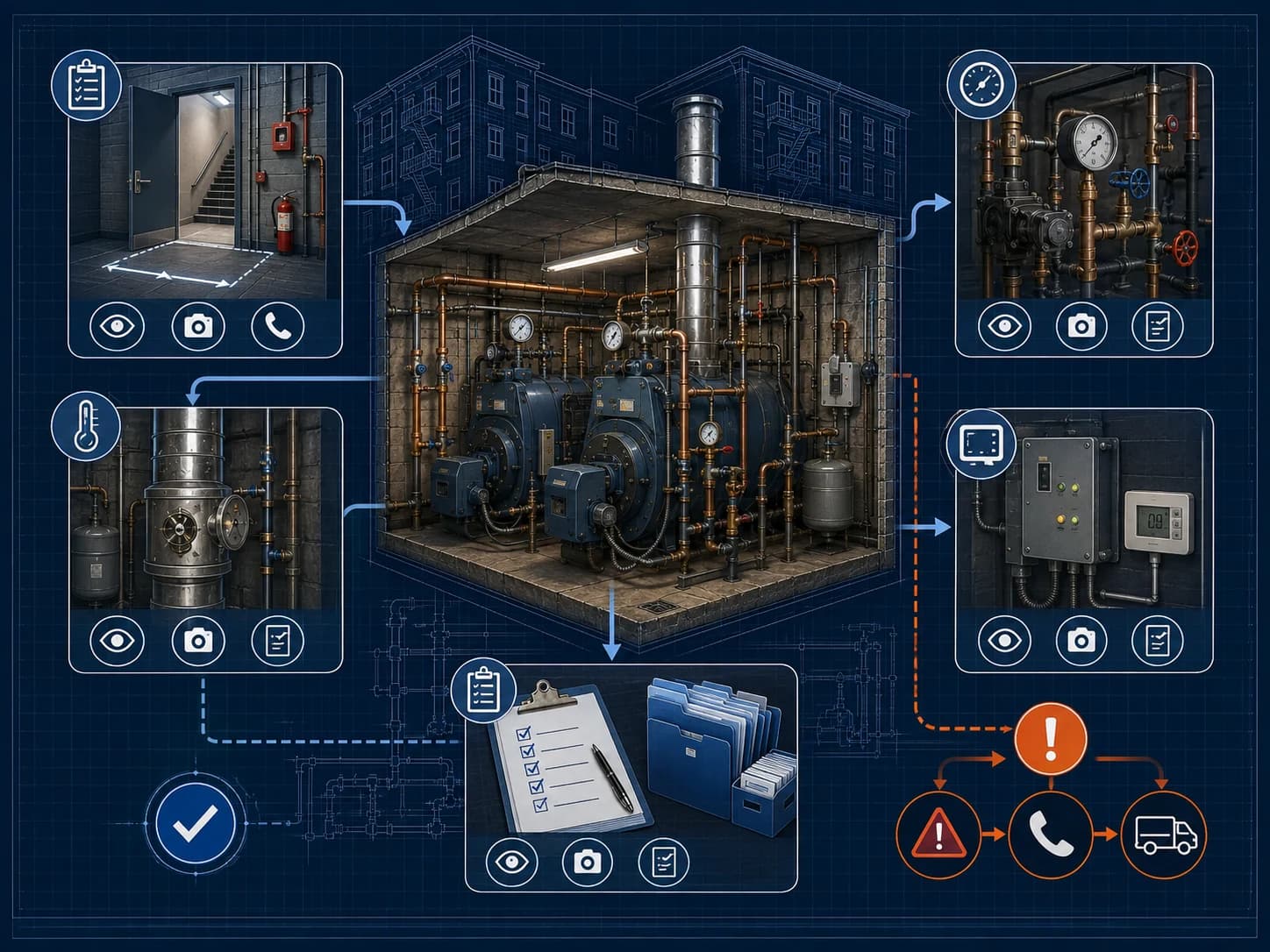
An NYC heat-season boiler-room preflight should answer one practical question: can the building call for heat, document what happens, and route any failure to the right person? Use it before October 1 where possible, or as a catch-up readiness check in the opening weeks of heat season. It is a structured management walkthrough, not a promise that the boiler will run all winter.
HPD says heat season runs from October 1 through May 31. From 6 a.m. to 10 p.m., residential owners must provide at least 68 degrees indoors when the outside temperature is below 55 degrees. From 10 p.m. to 6 a.m., the indoor minimum is 62 degrees regardless of the outside temperature. Hot water is required year-round at a constant minimum of 120 degrees (NYC HPD, Heat and Hot Water Information, retrieved 2026-10-08).
Use this walkthrough to create a short, assigned gaps list. Then send equipment testing and service work through Austin's heating service, filing questions through annual boiler inspection and DOB filing, and gas-piping issues through the licensed gas work lane.
What is a heat-season preflight—and what is it not?
A preflight is a manager's observation, access, and records check before the building depends on the heating system every day, or a prompt catch-up check if that preparation was missed. It should show whether the boiler room is reachable, whether obvious conditions need qualified review, whether the controls can call for heat, and whether management can find the service and compliance records when a problem occurs.
This guide owns the manager's walkthrough. Use the separate boiler startup and shutdown program guide when comparing contractor proposals, seasonal service deliverables, exclusions, and acceptance records.
It is not a boiler tune-up, combustion test, gas-leak survey, annual DOB inspection, or permission to operate questionable equipment. DOB says boiler work must be handled by the applicable Licensed Master Plumber or Licensed Oil Burner Installer, with permits and Registered Design Professional involvement where the scope requires them (NYC DOB, Project Requirements for Owner: Boiler, retrieved 2026-10-08).
That boundary is useful. The manager owns access, history, communication, assignments, and proof. The licensed professional owns the technical inspection, service, correction, and filing work within that person's scope.
Start at the boiler-room door
The first failures are often operational. A technician loses time because no one has the key, stored material blocks the working area, the equipment list is missing, or the emergency contact sheet names a former manager. Correct those gaps before anyone evaluates the equipment.
Walk the approach and record:
- Access. Confirm who holds keys, how after-hours entry works, and whether a locked interior or tenant-controlled area can delay service.
- Route. Keep the path, doorway, and immediate working area visible and usable. Photograph any obstruction for assignment; do not move hazardous material during the walkthrough.
- Lighting and communication. Confirm the room can be safely seen and that the posted contact list reaches the current manager, super, heating contractor, gas utility, and emergency services.
- Equipment identity. Match the boiler, burner, control, and fuel information in the service file to the equipment in front of you. Record uncertainty rather than guessing at a model or system type.
- Recent history. Bring the last service report, open recommendations, tenant complaint map, and any DOB or HPD record that could affect the visit.
Take one wide photograph from the doorway before the equipment is touched. It creates a dated reference for access, visible piping, floor condition, and the overall room. Add close photographs only where they can be taken safely without entering a restricted or hazardous area.
What should the manager record before anyone adjusts equipment?
Record observable conditions in plain language. Avoid diagnosing from a photo or writing that equipment is "safe" because it appears normal. A useful entry says what was seen, heard, smelled, displayed, or reported; when it happened; and who received the next action.
| Observation | Put in the building file | Route next |
|---|---|---|
| Gas odor, hissing, carbon monoxide alarm, smoke, or an immediate hazard | Time, location, people notified—only after reaching safety | Leave immediately; call 911 and the serving utility from outside |
| Water on the floor or an active leak | Wide photo, source area if safely visible, time, affected equipment | Qualified heating or plumbing service; protect occupants from the area |
| Fault light, control message, or boiler not responding | Exact display photo, thermostat call time, affected apartments | Heating service; do not bypass or repeatedly reset a safety |
| Gauge or water-line position that differs from the prior report | Photo from a safe distance and the prior reference | Qualified professional review; do not adjust from the checklist |
| Damaged, displaced, or obstructed venting or air path | Location and photo if safe | Stop the walkthrough and request qualified service |
| Corrosion, staining, soot-like residue, or repeated makeup-water history | Photo, service history, and whether the condition is changing | Heating service and documented assessment |
| No visible defect, but recurring cold apartments | Apartment/riser map, time pattern, control calls, prior repairs | System diagnosis; do not assume the boiler itself is the only cause |
Con Edison tells anyone who suspects a gas leak to leave immediately, take others, and call 911 or the utility from outside. It also warns against operating switches, doorbells, phones, appliances, or electronics in the affected area (Con Edison, Gas Safety, retrieved 2026-10-08). National Grid publishes the same leave-and-call-first sequence for its NYC customers (National Grid, Gas Emergencies, retrieved 2026-10-08).
For a carbon monoxide alarm, HPD instructs occupants to get out immediately and call 911 (NYC HPD, Fire Safety, retrieved 2026-10-08). Do not stay in the boiler room to troubleshoot an alarm.
How should management check the operating chain?
Management should document whether the building can make a normal call for heat and whether the result reaches the occupied spaces. The qualified heating professional should perform the actual startup, combustion, safety, venting, and equipment checks.
Use a simple chain:
- Request. Record the authorized thermostat, outdoor-control, timer, or building-management-system call that normally starts heat.
- Response. Record what the control displays and whether the responsible technician confirms normal boiler and burner operation.
- Distribution. Check a planned sample of apartments, risers, or zones instead of standing in the boiler room and assuming heat reached the building.
- Hot water. Review any summer hot-water complaints separately. Year-round hot water operation does not prove the space-heating side is ready.
- Closeout. Write down adjustments and repairs made by the qualified professional, the result of the recheck, and any watch item left open.
For a steam building, map slow or cold radiators by line and floor. Do not use one warm radiator as proof that every main and riser is working. Austin's steam heating service is the same-hub path when the pattern points to venting, pitch, valves, traps, controls, or near-boiler piping rather than a building-wide failure.
Which records belong in the preflight file?
The preflight file should let a new manager or an after-hours dispatcher understand the building without searching old email threads. Keep one index and link each open item to a named owner and due date.
Include:
- boiler, burner, control, fuel, and serving-utility identification;
- current management, super, service, utility, and emergency contacts;
- the latest service report and proof that its accepted corrections were completed;
- prior heat and hot-water complaint history by apartment, riser, zone, time, and outcome;
- the latest applicable DOB boiler inspection and filing status, plus open defects, violations, extensions, or correction records;
- gas, utility, permit, or First Test records that affect the equipment's current status;
- photos of access, displayed conditions, and completed work;
- a one-page open-item log showing owner, next action, due date, and closeout evidence.
DOB's boiler inspection cycle runs January 1 through December 31, and inspection reports are due within 14 calendar days of the inspection. Covered low-pressure and high-pressure boilers have different qualified-inspector and reporting requirements (NYC DOB, Boiler Compliance, retrieved 2026-10-08). Use Austin's annual boiler filing guide for that filing decision; this preflight should only confirm that the record was checked and assigned.
HPD and NYC311 also let owners and managers check complaint and violation history. NYC311 says HPD may contact the managing agent after a complaint and may inspect when the condition is not corrected or the tenant cannot be reached (NYC311, Heat or Hot Water Complaint in a Residential Building, retrieved 2026-10-08). That makes current contact information and a complaint-response log part of operational readiness.
How do you separate routine service, compliance, and an emergency?
One condition can touch more than one lane, but the first response should be unambiguous.
| Lane | Typical preflight finding | First action | Proof to retain |
|---|---|---|---|
| Emergency | Gas odor, carbon monoxide alarm, active smoke, immediate life-safety concern | Leave, call 911 and the serving utility, follow responder instructions | Incident number and later authorized service records |
| Heating service | Boiler does not respond, fault recurs, water leaks, controls or distribution do not perform as expected | Request qualified diagnosis and repair | Work order, findings, approvals, photos, completion result |
| Compliance | Missing annual report, open boiler defect, violation, expired filing, unresolved First Test status | Review the DOB record with the responsible licensed/professional team | Filing receipt, inspection result, correction or sign-off record |
| Building operations | Key/access gap, stale contacts, undocumented tenant pattern, blocked work area | Assign management correction before the service appointment | Updated access sheet, contact list, photos, complaint map |
A repair does not automatically close an agency record, and a filed report does not prove that a new operating complaint has been solved. If the problem started with tenant reports, use the HPD heat and hot-water complaint workflow. If a boiler failed DOB First Test, use the separate correction and reinspection guide.
Who owns each next action?
Assign every gap before the walkthrough ends.
| Owner | Preflight responsibility |
|---|---|
| Property manager | Schedule the walkthrough and service, provide records, assign access, communicate with ownership and residents, track closeout |
| Super or building staff | Report observed conditions and complaint patterns, provide safe access, preserve the room and operating history |
| Qualified heating professional | Test, diagnose, service, document findings, and state what further licensed or permitted work is required |
| Licensed Master Plumber or Licensed Oil Burner Installer | Perform work within the applicable NYC license and permit boundaries and coordinate required inspections or filings |
| Registered Design Professional | Handle design and filing responsibilities where the project scope requires professional plans or approvals |
| Owner or board | Approve scope and access, fund authorized work, and confirm that open operating and record items are closed |
Buildings that need this discipline every season may be better served by a defined building-services program than a stack of unrelated emergency calls. The useful difference is not a promise that nothing will fail. It is a clear scope, an assigned calendar, and one record of what was checked, corrected, and left open.
A suggested seven-day management follow-up
Use seven days as an internal tracking target for routine records and assignments, not an agency deadline or permission to postpone service. An immediate hazard, loss of required heat or hot water, or an agency notice needs the applicable prompt response regardless of this target.
For routine follow-up after the walkthrough:
- send the dated gaps list to the owner, super, and responsible service contact;
- schedule technical testing or repair with enough lead time for parts, access, and recheck;
- resolve keys, escorts, room access, and apartment sampling before the appointment;
- compare the latest service findings with DOB boiler and HPD complaint records;
- photograph accepted corrections and attach the qualified professional's report;
- assign every remaining item to a person and date;
- give after-hours staff the current emergency and utility instructions;
- confirm the first normal call-for-heat result across the planned apartment or zone sample.
The final status should be specific: ready for normal monitored operation, service scheduled with open items, or do not treat as ready pending qualified review. Avoid a vague green check that hides exceptions.
When to call Austin
Call Austin Plumbing & Heating when the preflight identifies a boiler, burner, control, steam, hydronic, gas, domestic hot-water, venting, piping, or record issue that needs NYC Licensed Master Plumber oversight. Austin can connect the physical service call to the applicable boiler, gas, DOB, or HPD record instead of leaving management with separate explanations.
For planned work, start with heating and hot-water service. For a gas odor, carbon monoxide alarm, smoke, or another immediate hazard, leave the area and call 911 and the serving utility before calling a contractor.
Common Questions
Is a manager's boiler-room preflight the same as an annual DOB boiler inspection?
No. This walkthrough helps management document access, visible conditions, operating complaints, and records before heat season. DOB-required annual inspections must be performed by the qualified professionals identified by DOB, and equipment service or repair belongs with the properly licensed trade.
When should an NYC property manager perform the walkthrough?
Ideally, complete it early enough to schedule qualified service and resolve access or record gaps before October 1. If heat season has already started, perform the missed readiness check promptly without delaying repairs or required heat. Repeat it after material repairs, a utility interruption, a control change, or recurring complaints.
Should a super adjust boiler controls during the preflight?
Not as part of this checklist. Photograph the displayed setting or fault, record the time and operating condition, and route adjustment, testing, or bypass questions to the qualified heating professional responsible for the system. Never bypass a safety control to make equipment run.
What if the manager smells gas or a carbon monoxide alarm sounds?
Leave the area immediately, move others to safety, and call 911 and the serving utility from outside. Do not use switches, phones, doorbells, appliances, or other potential ignition sources in the affected area, and do not re-enter to finish the checklist.
Which boiler records should management confirm before heat season?
Keep the current service report, prior complaint map, equipment and emergency contacts, latest applicable DOB boiler inspection and filing status, open defect or violation records, completed repair evidence, control notes, and any utility or gas-work documentation that affects safe operation.