
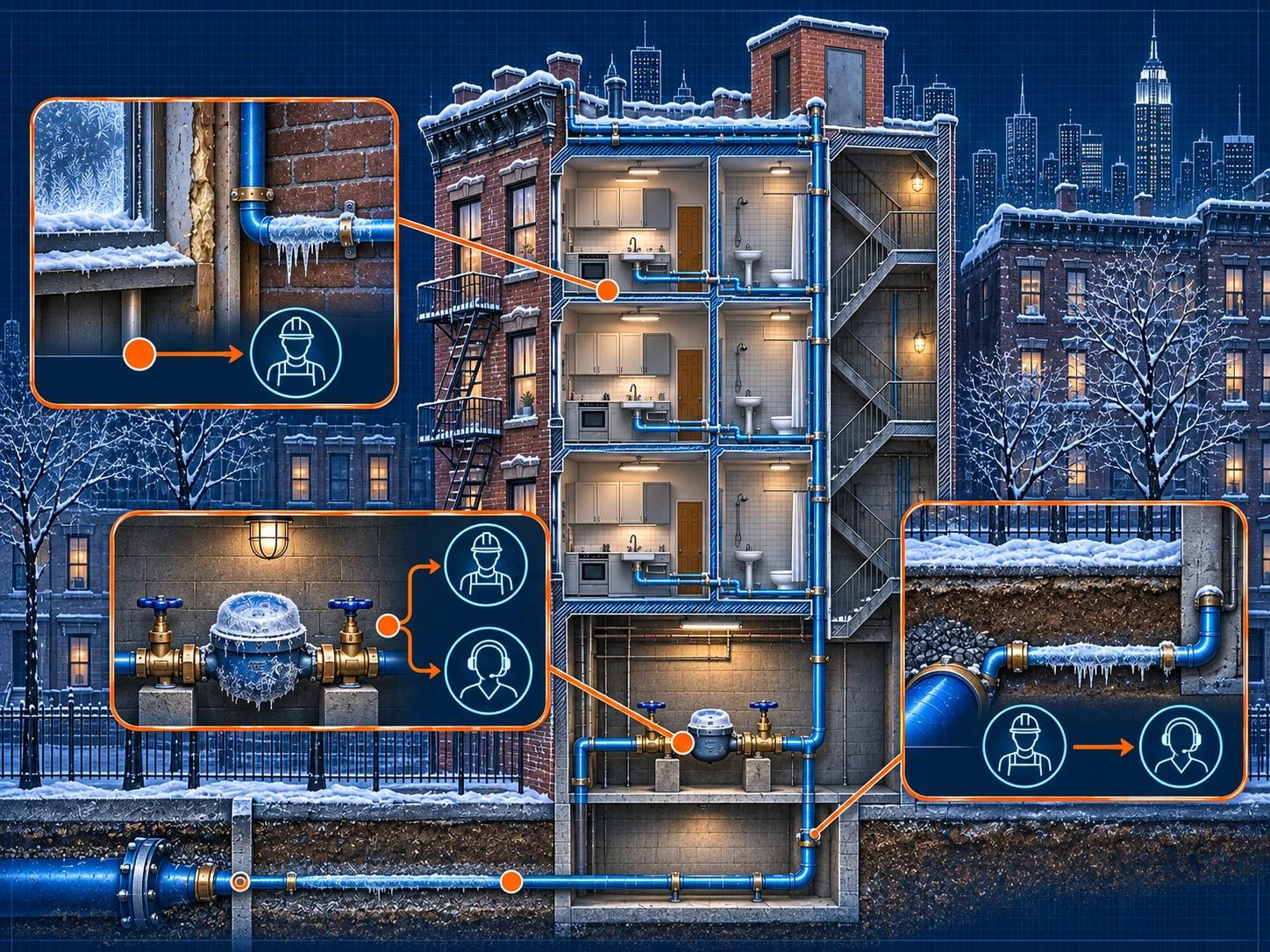
Key takeaways
- A cold-damaged water meter, frozen interior pipe, private service line, and City water-main condition follow different response paths.
- Report a cold-damaged meter through 311. Call a Licensed Master Plumber when building piping or the private service line is frozen, leaking, or cannot be safely restored.
- NYC property owners own the water service line from the building to the City main, including the section below the sidewalk and street.
- Never use an open flame to thaw a pipe or meter. If water is escaping or the condition is unsafe, protect people first and call for emergency help.
- Record the outage pattern, meter condition, visible leak location, street conditions, and affected fixtures before choosing a repair scope.
A building can lose water because the meter is cold-damaged, an interior branch is frozen, the private service line is blocked or broken, or the City main has a problem. Those conditions may look alike at the faucet, but they do not have the same owner, repair path, or first call.
NYC DEP's freeze guidance makes the central distinction: contact 311 when a water meter is damaged by cold, and use a Licensed Master Plumber when a service line or pipe freezes and breaks. This guide helps owners and building teams organize the evidence before assigning the problem to the wrong party.
This Resource owns the post-freeze responsibility decision. The building pipe freeze-risk walkthrough owns the location-by-location prevention survey. The low-water-pressure diagnostic guide owns non-freeze pressure patterns. A DEP Notice to Repair follows the separate water-service-line notice workflow.
First decide which water-system section may be affected
Do not name the failed part from one dry faucet. Start with the pattern across the property, the meter area, visible piping, and the street. Record what is affected before anyone opens walls, excavates, or promises a repair.
| Observed pattern | Possible section | First useful handoff |
|---|---|---|
| Meter body is cracked, leaking, displaced, or visibly cold-damaged | Water meter | Report through 311; also call an LMP for surrounding piping or active leakage |
| One branch, room, apartment, or fixture group has no flow | Interior building piping | LMP diagnosis of the affected run and any damage |
| Whole property has no water and the meter or incoming line appears affected | Private service line, meter, or upstream condition | LMP building-side diagnosis; 311 report when meter damage or an outside condition is suspected |
| Several nearby properties are affected, or water is coming from the roadway | Possible City-main or neighborhood condition | Report through 311; call 911 for immediate danger |
This table is a routing tool, not a diagnosis. A frozen point can be concealed. Ice can also split a pipe before the split becomes visible. The professional response should identify the affected boundary and the evidence supporting it.
What happens when the water meter is frozen or damaged?
The property owner must protect the meter from freezing, but the meter follows a different service path from the owner's piping. DEP says that when a meter freezes and breaks after inadequate protection, DEP will repair or replace it and bill the homeowner. DEP directs the owner to contact 311 when the meter is damaged by cold.
Before reporting, record:
- The meter location and nearby windows, doors, exterior walls, drafts, or failed heat.
- Whether the meter body, fittings, or surrounding piping is leaking.
- Whether the whole property or only part of it has lost water.
- Clear photographs taken from a safe location.
- The 311 service-request number and the person responsible for access.
Do not assume every leak near the meter belongs to DEP. The owner-side valves, fittings, and building piping around the meter can require an LMP. If water is escaping or the boundary is unclear, make the 311 report and call a Licensed Master Plumber so the meter issue and the plumbing issue can be separated.
Who handles a frozen pipe inside the building?
Interior domestic-water piping is the owner's responsibility. DEP's Resources for Homeowners says owners are responsible for their property plumbing and should hire a Licensed Master Plumber for plumbing and service-line work.
Give the plumber a useful pattern:
- Which fixtures, apartments, floors, risers, or rooms have no water.
- Whether hot, cold, or both supplies are affected.
- When the condition began and whether another area still has normal flow.
- Any visible frost, bulging, joint movement, dripping, staining, or recent repair.
- Nearby exterior walls, broken openings, unheated spaces, or failed building heat.
- Known shutoff locations, access restrictions, and occupied areas downstream.
Never thaw a pipe or meter with an open flame. DEP and NYC Emergency Management's utility-disruption guidance warn that an open flame can cause fire or a steam explosion. If the frozen section cannot be identified or safely restored, stop and use an LMP rather than turning the guide into a do-it-yourself repair plan.
Who handles a frozen private water service line?
The private water service line connects the building plumbing to the City water main. NYC DEP's water-shutoff guidance says the property owner owns and is responsible for that service line. The owner boundary continues to the connection at the City main; it does not stop at the property line or curb.
An LMP should determine whether the evidence points to the service line and whether the condition requires thawing, repair, relay, excavation, or another scope. If work in the street is needed, the project can involve DEP and DOT permits, utility mark-outs, excavation protection, inspection coordination, and restoration. Those steps depend on the actual condition and must not be assumed from a symptom alone.
Ask the service report to state:
- Which section was tested or observed.
- What evidence distinguishes a service-line problem from a meter or interior-pipe problem.
- Whether water is leaking, the line is blocked, or the failure remains uncertain.
- Which permit, access, excavation, or agency coordination is needed.
- How water service and the repaired section will be checked afterward.
If DEP later issues a Notice to Repair, switch to the documented notice workflow. Do not treat the absence of a notice as proof that the service line is sound.
When could the condition be on the City-main side?
A City-main or neighborhood disruption is more plausible when several nearby buildings lose water, water appears in the roadway, or DEP reports work in the area. It is still not proven by one neighbor's report. A private service-line failure can also surface near the street.
NYC311's no-water and low-pressure guidance provides the complaint path for no water or low pressure. For an owner-specific building condition, NYC311 explains that DEP can investigate after a licensed plumber determines the problem is outside the owner's responsibility.
Keep the plumber's written finding and the 311 service-request number together. If water is coming through the roadway, severe flooding is spreading, or the surface appears unstable, keep people clear and call 911 for immediate danger.
Build one incident record before approving the repair
The owner file should make the boundary visible to the next person who reviews it. Include:
- Date, time, weather conditions, and who first reported the issue.
- Affected and unaffected fixtures, apartments, floors, and nearby properties.
- Meter photographs and visible pipe or service-entry conditions.
- Active leaks, property damage, access limits, and immediate safety actions.
- LMP findings, measurements, scope, and unresolved uncertainty.
- 311 and DEP reference numbers, notices, permits, inspection records, and closeout evidence.
- The restoration check: where flow returned, where leakage was ruled out, and what still needs monitoring.
That record matters after water returns. A thawed line can still contain hidden damage, and the same draft, opening, failed heat, or unprotected route can freeze again. Use the freeze-risk walkthrough to move from incident response to a building-specific prevention scope.
Call with the pattern, not a guessed component
Start with the affected locations, the meter condition, visible leakage, street conditions, and any 311 or DEP reference. Austin's plumbing service team can trace the building-side condition and define the licensed scope. For an active frozen-pipe or service-line condition, call (718) 835-3555. The first review should identify the boundary, protect the building, and define the licensed work and agency handoffs the actual condition requires.
Common Questions
Who should I call for a frozen water meter in NYC?
If the meter is damaged by cold, NYC DEP directs owners to contact 311. The owner is still responsible for protecting the meter and may be billed when freezing damage follows inadequate protection. If surrounding piping is frozen, leaking, or cannot be safely restored, call a Licensed Master Plumber too.
Who repairs a frozen pipe inside an NYC building?
The property owner is responsible for the building's plumbing. NYC DEP says a frozen or broken pipe should be repaired by a Licensed Master Plumber. Do not use an open flame, operate unfamiliar valves, or assume the visible ice marks the full damaged section.
Is the water service line the City's responsibility?
No. NYC DEP says the property owner owns the water service line in its entirety, from the building to the City water main in the street. A Licensed Master Plumber should identify the failed section and coordinate the applicable DEP and DOT permit path for repair or relay work.
When should I report a possible City water-main problem?
Report no water, low pressure, suspected street-main trouble, or water coming from the roadway through 311. Multiple affected buildings and a street condition can support that report, but they do not prove the cause. If flooding or collapse creates an immediate danger, call 911.
How can an owner tell which part is frozen?
Start with the outage pattern, the meter location, visible piping, street conditions, and which fixtures or floors are affected. A Licensed Master Plumber can trace the building-side path and document whether the evidence points to interior piping, the private service line, or a condition for DEP to investigate.