
Key takeaways
- Map complaints by apartment, riser, floor, time, and fixture before replacing equipment or changing controls.
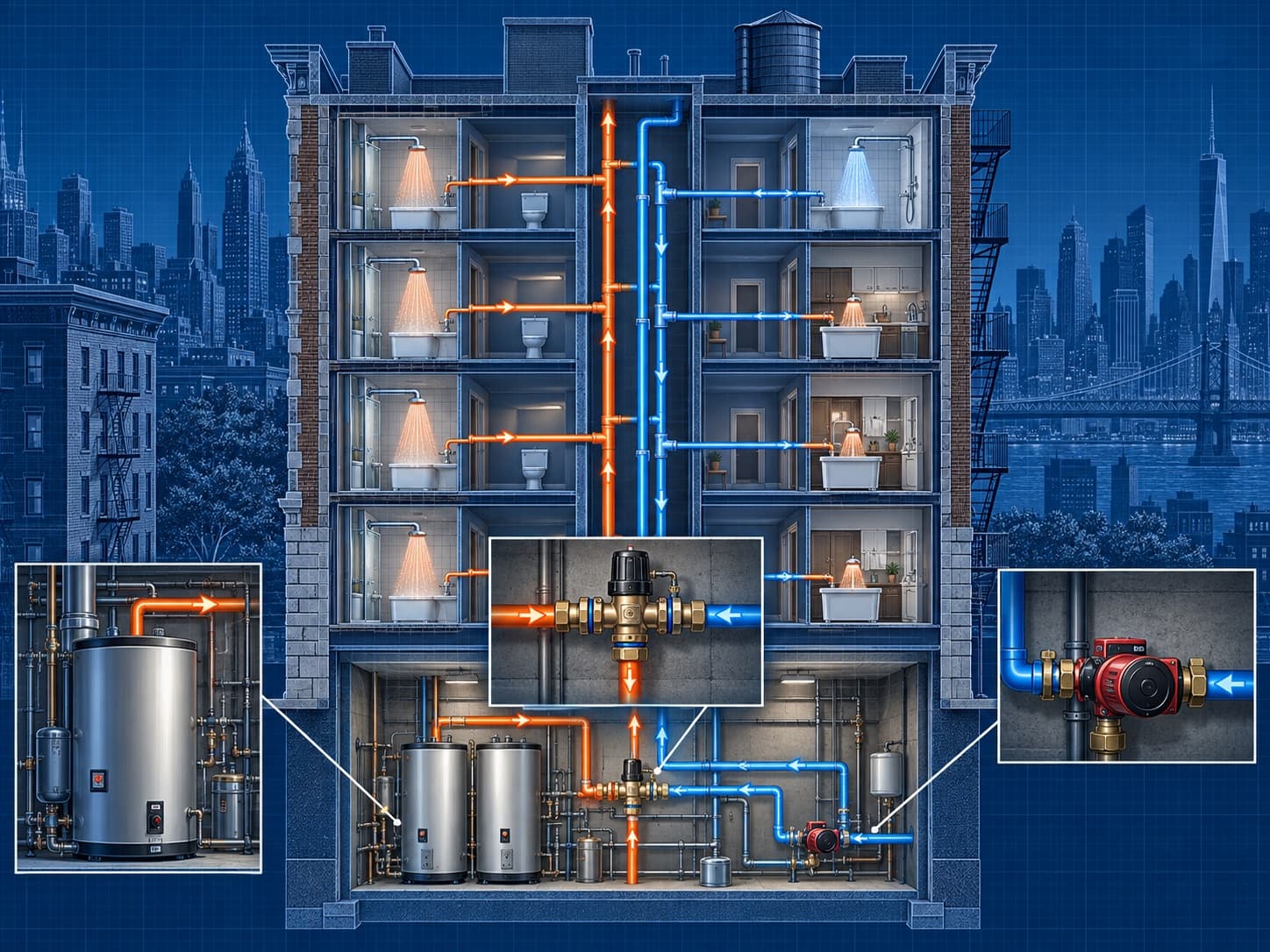
- Separate four possible layers: heater output, mixing and temperature control, recirculation and distribution, and an apartment-level fault.
- Record plant, mixed-supply, return, and representative fixture temperatures under the same operating condition; isolated readings can point in the wrong direction.
- Keep management observation separate from licensed testing, adjustment, repair, and code review.
A multifamily hot-water complaint is not a diagnosis. The same tenant report—“the water never gets hot”—can start at the heater, a master mixing valve, the recirculation loop, one riser, or one fixture. The useful first move is to map the pattern, preserve comparable readings, and send a qualified plumber evidence instead of a guess.
NYC HPD says residential owners must provide hot water year-round at a constant minimum temperature of 120 degrees Fahrenheit (NYC HPD, Heat and Hot Water Information, retrieved 2026-10-08). That requirement defines the owner’s obligation. It does not identify which part of a central domestic hot-water system failed.
Use this guide to organize the service call. Send active equipment or distribution problems through Austin’s water-heater service lane. If the complaint has already become a 311 or HPD record, use the separate HPD heat and hot-water complaint workflow for tenant response and agency documentation.
Start with the complaint map, not the boiler room
The location and timing of the complaints narrow the system faster than one equipment-room snapshot. Ask the same short set of questions for every report and put the answers on one building plan or riser list.
Record:
- Where? Apartment, floor, line or riser, and fixture.
- When? First draw in the morning, evening peak, all day, or after a long idle period.
- What happens? No hot water, a long wait, temperature that fades, temperature that swings, or water that is dangerously hot.
- How broad is it? One fixture, one apartment, one line, one side of the building, or the entire property.
- What else was happening? Laundry demand, a recent repair, a pump or control alarm, utility interruption, or an apartment renovation.
Then compare one affected location with one nearby unaffected location during the same operating window. A complaint map that shows every line cooling during peak demand points in a different direction than a map showing only the top apartments on one return branch.
When does the heater or storage plant become the leading suspect?
The heater side moves to the front of the list when the problem is broad and begins before water enters the distribution system. Building-wide complaints, low plant output, slow recovery after peak demand, a faulted burner or element, leaking storage, or a recent capacity change all justify heater-side testing.
Look for a pattern such as:
- hot water is weak throughout the building, not just at distant fixtures;
- the complaint becomes worse after predictable high-demand periods;
- the plant’s operating display or service log shows a fault, lockout, or abnormal cycling;
- stored water recovers slowly after demand drops;
- a recent occupancy, fixture, or operating change increased the load;
- the equipment is producing heat, but not enough usable hot water for the building’s current pattern.
This still does not prove the heater should be replaced. A qualified plumber should confirm the equipment condition, controls, fuel or electrical supply, storage, recovery, and actual load. In some buildings, the heater is operating correctly while a mixing or distribution problem prevents that heat from reaching apartments.
If the existing plant is approaching a larger capital decision, Austin’s heating-plant planning guide explains how to document equipment, domestic hot water, controls, utilities, and occupied-building constraints before comparing replacement options.
When does the mixing valve become the leading suspect?
A central mixing valve deserves qualified testing when the heater side is hot but the temperature delivered into the building is unstable, too cool, or too hot across multiple lines. Its job is to blend hot and cold water to the intended distribution temperature; a valve, sensor, check, strainer, or piping problem can change the blend without a heater failure.
The current NYC Plumbing Code includes hot-water supply, temperature-maintenance, and temperature-control provisions in Chapter 6. It also addresses recirculation where a thermostatic mixing valve is used (NYC DOB, 2022 Plumbing Code Chapter 6, retrieved 2026-10-08). Applicability depends on the actual system and work scope, so this guide does not turn those provisions into a universal adjustment instruction.
Patterns that justify mixing-control review include:
| Complaint pattern | What it may suggest | What to preserve |
|---|---|---|
| Multiple lines swing hot and cool | Unstable mixing or control response | Time-matched plant, mixed-supply, and fixture readings |
| Plant is hot but distributed water stays cool | Mixing, sensor, check, strainer, or piping issue | Plant and mixed-outlet readings plus recent service history |
| Water becomes dangerously hot | Loss of temperature control or another unsafe condition | Stop-use instructions, location, time, and qualified service response |
| Problem began after valve or piping work | Installation, setting, check, or connection issue | Work order, approved scope, photos, and before/after complaint map |
Managers should not “turn it up” to overcome a distant complaint. That can hide a recirculation problem and create excessive temperatures closer to the plant. The safer handoff is a measured pattern plus the recent work history.
When does recirculation become the leading suspect?
Recirculation moves up the list when the plant and mixed supply are satisfactory but hot water does not remain available near distant fixtures. Typical clues are long waits on upper floors, one return branch cooling faster than another, good performance near the mechanical room, or complaints that improve only after someone lets water run.
The U.S. Department of Energy describes a recirculation loop as a way to keep the hot-water source closer to fixtures by returning cooler water in the loop to the heater. DOE’s multifamily guidance also identifies pump controls, temperature sensing, return-line layout, system balancing, check valves, insulation, and crossover prevention as distinct distribution considerations (DOE, Efficient Hot Water Distribution in Zero Energy Ready Multifamily Buildings, retrieved 2026-10-08).
Have the qualified plumber evaluate the system as a loop:
- Is the pump running when the control strategy calls for it?
- Do supply and return temperatures tell a consistent story?
- Does one return branch lag behind the others?
- Are check valves, balancing devices, and isolation valves in the expected position and condition?
- Did a recent repair introduce air, debris, a closed valve, or a changed flow path?
- Is the piping insulated and arranged as the documented system expects?
- Does the problem occur at the branch beyond the loop rather than in the loop itself?
DOE’s Building Science Education resource describes a compact distribution layout that uses recirculation and short branches to keep hot water closer to fixtures (DOE Building Science Education, Hot Water Recirc on Demand, retrieved 2026-10-08). The exact control method varies by building. Do not apply a residential on-demand sequence to an existing central multifamily plant without a system-specific review.
What if only one apartment or fixture complains?
An isolated complaint should stay local until evidence shows otherwise. One failed shower cartridge, a crossed hot-and-cold connection, a partially closed valve, a clogged strainer, a branch restriction, or a fixture-specific issue can make the plant look unreliable from one apartment.
Compare fixtures inside the apartment first. If the kitchen becomes hot but one shower does not, the fault is unlikely to be the central heater. If every fixture in one apartment is affected while the apartment above and below perform normally, examine the local branch, valves, and recent work before changing plant controls.
Also ask whether a renovation or fixture replacement occurred before the complaints began. A local cartridge or connection can allow cold water to influence the hot-water side under some conditions. The plumber may need access to more than the complaining apartment to isolate that crossover safely.
Keep access records with the diagnostic file. A missed apartment can leave the team with an incomplete comparison and an expensive plant-level guess.
Build one measurement set that can be compared
Useful readings are taken under the same operating condition and labeled with time and location. A plant reading at 10:00 a.m. and a tenant reading from the evening peak do not form a reliable comparison.
Ask the qualified plumber to define the safe measurement plan. A practical record may include:
| Point | Why it matters |
|---|---|
| Heater or storage outlet | Shows what the plant is producing before central mixing and distribution |
| Mixed hot-water supply | Shows what enters the building distribution system |
| Recirculation return | Shows what comes back after moving through the loop |
| Representative near fixture | Establishes performance close to the plant or loop |
| Representative distant fixture | Tests the complaint area under the same demand condition |
| Affected fixture and nearby control fixture | Separates a local fault from a line or building pattern |
For each point, record the time, demand condition, who took the reading, method used, and any simultaneous pump or equipment status. Preserve the plumber’s findings and approved adjustments rather than copying unlabeled temperatures into an email thread.
How should management route the result?
End the first visit with a bounded next action, not “monitor it” without ownership.
| Finding | Next action | Closeout evidence |
|---|---|---|
| Plant cannot produce or recover as expected | Heater diagnosis and scoped repair or replacement review | Service report, approved scope, post-repair readings |
| Plant is hot; mixed supply is unstable or unsafe | Mixing-control diagnosis | Before/after readings and valve/control service record |
| Supply is satisfactory; distant return or branch is weak | Recirculation, balance, check, insulation, or branch review | Loop findings, corrected condition, representative fixture recheck |
| One apartment or fixture is isolated | Local fixture, cartridge, valve, branch, or crossover diagnosis | Apartment access record and local repair result |
| Physical problem corrected but HPD record remains | Complaint and violation closeout workflow | HPD Online status, certification, inspection, and repair file |
Buildings with recurring complaints may need a defined building-services program rather than disconnected emergency calls. The value is a consistent complaint map, equipment history, assigned maintenance scope, and one closeout file for each recurring condition.
When to call Austin
Call Austin Plumbing & Heating when a multifamily hot-water complaint needs system-level diagnosis across the heater, storage, mixing controls, recirculation loop, risers, or apartment branches. Start with the pattern: affected apartments, timing, wait time, temperature behavior, recent work, and whether the condition is isolated or building-wide.
For planned or active service, use Austin’s water-heater installation and repair page or call (718) 835-3555. If a suspected gas leak or carbon monoxide alarm is involved, leave the area and call 911 and the serving utility from outside before calling a contractor.
Con Edison says to leave immediately for a suspected gas leak, avoid switches and electronics in the affected area, and call 911 or the serving utility from outside (Con Edison, Gas Safety, retrieved 2026-10-08). HPD instructs occupants to get out immediately and call 911 if a carbon monoxide alarm sounds (NYC HPD, Fire Safety, retrieved 2026-10-08). For dangerously hot water, keep occupants away from the affected fixtures and obtain urgent qualified service; do not raise or lower central settings from this guide.
Common Questions
How can a manager tell whether the water heater is causing the complaint?
A heater-side problem becomes more likely when complaints are building-wide, stored or generated water is below the normal operating target, recovery falls behind during peak demand, or the plant cannot maintain output. A qualified plumber should compare plant readings with the complaint timeline before recommending repair or replacement.
What complaint pattern points to a mixing-valve problem?
A mixing-valve or control problem becomes more likely when the heater side is hot but the distributed temperature is unstable, too cool, or too hot across several lines. The valve, sensors, checks, strainers, and piping arrangement require qualified testing; managers should record patterns and readings rather than adjust the valve.
What complaint pattern points to the recirculation system?
Recirculation deserves attention when nearby fixtures receive hot water promptly but distant apartments, upper floors, or one return branch wait longer or cool between draws. Pump operation, controls, return temperature, balancing, check valves, insulation, and the loop layout can all affect that pattern.
Can one apartment make the whole building's hot water seem unreliable?
Yes. A failed fixture cartridge, local valve problem, cross-connection, blocked branch, or apartment-level access issue can create a narrow complaint or disturb a larger line. Compare unaffected apartments and isolate the pattern before authorizing plant work. Do not assume that every hot-water complaint starts in the boiler room.
When is a hot-water complaint an emergency?
Treat gas odor, a carbon monoxide alarm, active leaking that threatens people or property, scalding water, smoke, or an unsafe equipment condition as urgent. Leave and call 911 and the serving utility for a suspected gas or carbon monoxide emergency. Building-wide loss of hot water also requires prompt service and documentation.